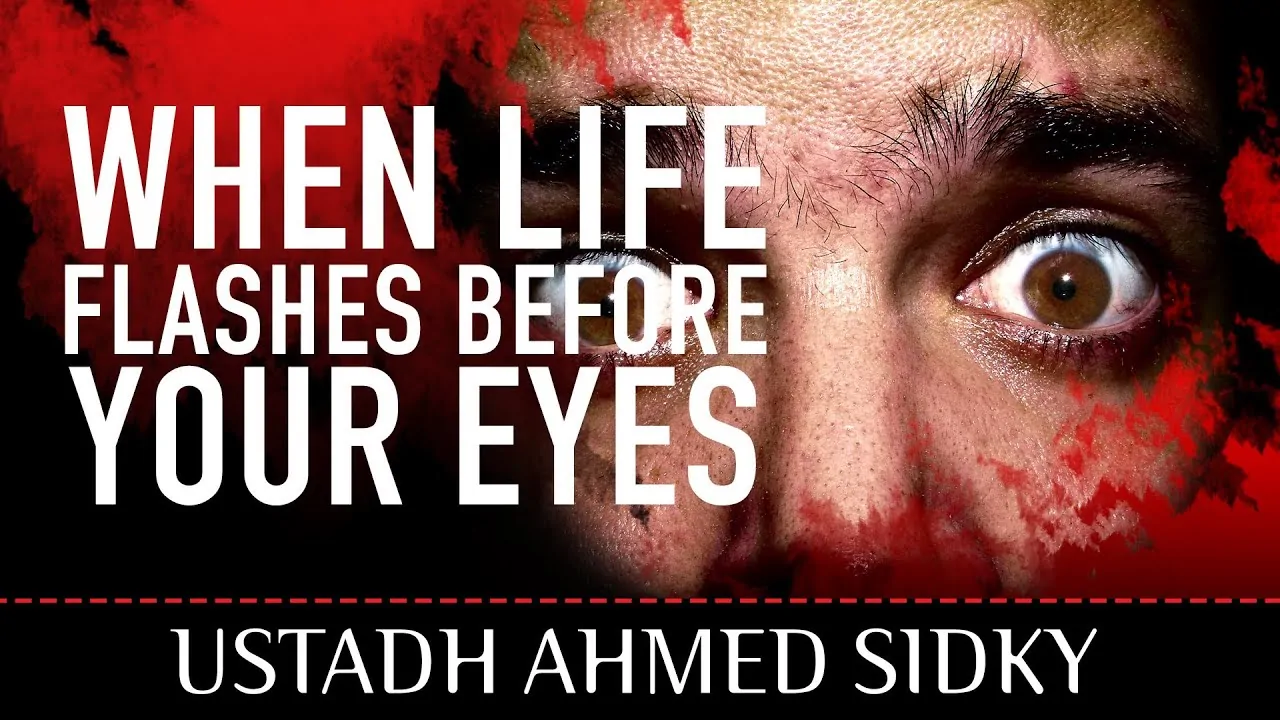
Have you ever heard someone describe a near-death experience — the way their entire life seemed to appear before them in an instant? In Islam, this is not merely a psychological phenomenon. It is a divine reality, confirmed by the hadith of the Prophet Muhammad ﷺ. In this powerful reminder, Ustadh Ahmed Sidky unpacks one of the most searching questions in our faith: at the moment of death, when every deed you have ever done is revealed to you in full — the good and the bad, the remembered and the long-forgotten — will you love to meet Allah, or will you dread that encounter? The answer, as the Prophet ﷺ explained, is determined not by fear of dying itself, but by the state of the deeds that greet your soul in those final moments.
A Prophetic Hadith That Reframes Every Day We Live
“Whoever loves to meet Allah — Allah will love to meet them. And whoever hates to meet Allah — Allah will hate to meet them.” — Prophet Muhammad ﷺ
When the companions heard these words, they were troubled. Surely, they said, we all fear death — does that mean we all hate to meet Allah? The Prophet ﷺ gently clarified: the fear of dying is not what He meant. What He meant was the state of your soul in the moment your deeds are laid bare before you. If your record reflects good, you will welcome that meeting with your Lord. If it overwhelms you with regret, you will recoil from it. Ustadh Sidky makes this viscerally real through a guided reflection — asking us to mentally replay yesterday, then the day before, then last week, last month, three months, a full year. Most of us struggle to recall even a fraction. The details blur. The moments slip away. And yet Allah, as the Quran attests, has recorded every second of our lives with perfect precision.
- Our deeds are permanent, even when our memory fails. What we forget, Allah does not — every act of worship and every sin is preserved in the divine record with complete accuracy.
- Self-audit is a Sunnah practice. Holding yourself to account before you are held to account is one of the most protective disciplines of Islamic spirituality and personal growth in faith.
- Loving to meet Allah is earned through daily action. Belief in the akhirah must be reflected in how we spend our ordinary hours — not just our moments of formal worship.
- The difficulty of remembering is itself a warning. If we cannot recall what we did last month, imagine how our complete record will appear when the entire arc of our lives is displayed before us.
The Sins We Normalise — and the Record That Never Forgets
Among the most sobering points in this reminder is our selective moral awareness. Most Muslims who have committed an obvious major sin carry an awareness of it — they feel its weight and seek forgiveness. But what about the sins embedded in the texture of ordinary family life? In Islamic scholarship, disrespecting one’s parents — rolling one’s eyes, raising one’s voice, dismissing them with impatience — carries the same gravity as drinking alcohol, yet it rarely prompts the same urgency for repentance. Brothers who hold grudges for years over petty disputes; sisters whose conversations drift into backbiting — these too accumulate steadily in a record we rarely pause to examine. These are the deeds, Ustadh Sidky warns, that may cause a person to look at their life in that final, irreversible moment and dread meeting their Lord — not because they were ignorant of Islamic guidance, but because they were heedless of its weight in the small, everyday choices that define a lifetime.
“Allah has gathered all this information and He remembers it — but you forget. You couldn’t even think of all the bad deeds you did last year. And those are the bad deeds that you know are bad deeds.” — Ustadh Ahmed Sidky
The profound mercy woven through all of this is that the moment of reckoning has not yet come for any of us still reading these words. The life-review has not played. The record has not been sealed. Tawbah — sincere repentance — remains open, relationships can be repaired, and the character of the chapter we are currently living is still being written. Islam is a faith of radical hope precisely because every day above ground is an opportunity to change the ending. Ustadh Sidky’s challenge is both direct and deeply compassionate: think about it right now, and from this moment forward, choose differently. Mend what is broken with your parents. Release the grudges that serve no purpose but to burden your own soul. Fill the days ahead with deeds you would be glad to witness on that day when life flashes before your eyes — because every soul will face that moment, and the only question is what will greet us when it comes.