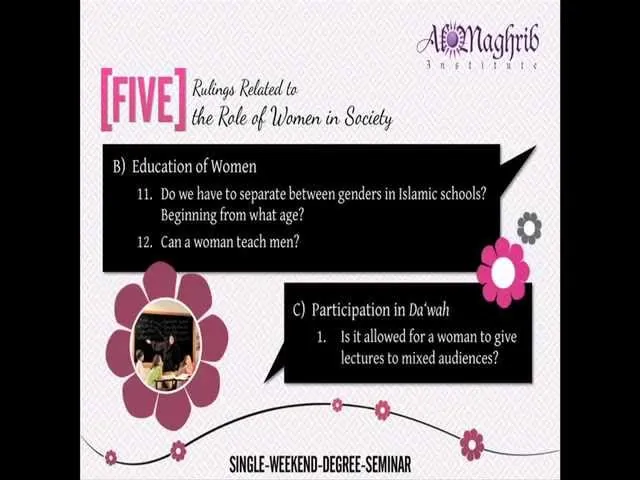
Chapter 5 of the “Complicated” series on women’s fiqh addresses the role of women in society. Sheikh Waleed Basyouni makes it clear from the outset: Islam sees women as vital contributors politically, economically, educationally, and socially. This is not a modern concession — it is a fact rooted in the Quran and the practice of the earliest Muslim community.
Women as Partners in Building Society
Allah says: “Believing men and believing women are allies of one another.” The first ten people to accept Islam included the Prophet’s wife Khadijah and his daughters, and women have been partners with men in building the ummah from day one. A woman in the Prophet’s time even ran her own carpentry business and built the minbar (pulpit) for the masjid. The idea that women should never leave their homes is a misunderstanding — the Quranic instruction means women should not neglect their homes entirely, not that they should be confined to them.
“Islam sees women as an important part in society — politically, economically, educationally, and socially. This fact cannot be ignored.”
Education and Practical Rulings
- Education is obligatory: Seeking knowledge is wajib (obligatory) upon all Muslims, male and female. Aisha (may Allah be pleased with her) was a master of medicine, learning by observing doctors
- Mixed educational settings: Gender mixing in schools cannot be entirely avoided, but one should minimize unnecessary interaction
- Studying medicine: Women are permitted to study medicine and treat male patients, as women in the Prophet’s time cared for wounded soldiers on the battlefield
- Islamic vs. public schools: If Islamic schools are unaffordable, public schools are permissible with proper parental oversight
- Fasting during exams: Exams in Ramadan do not permit breaking the fast unless one is genuinely ill
The message is clear: Muslim women are called to be educated, active participants in every aspect of society while maintaining their Islamic principles and modesty. Balance is the key — neither total seclusion nor abandoning one’s responsibilities at home.