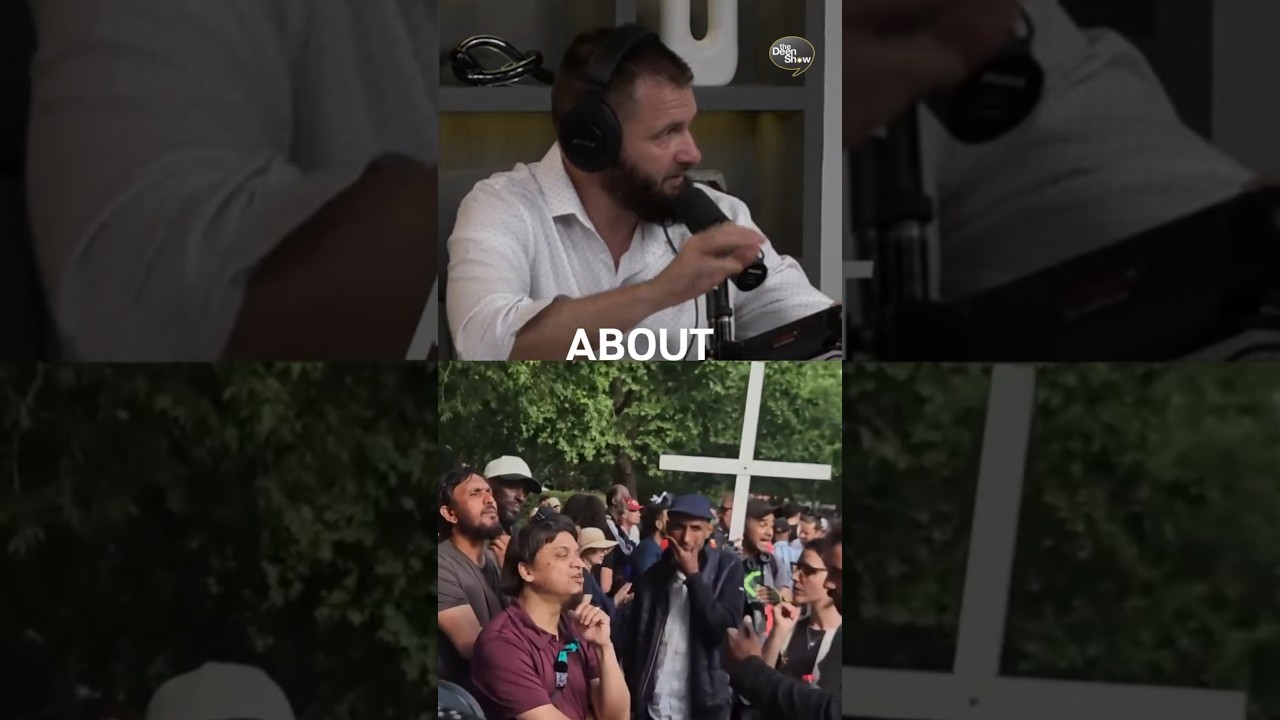

One of the most pressing crises quietly unraveling the faith of young Muslims in the West is not persecution from outside — it is confusion from within. When a new convert is pressured to adopt an Arab name, or when a second-generation teenager is told that wearing Western clothing makes them less Muslim, the message being transmitted is not Islam — it is culture wearing the robes of religion. This distinction matters profoundly: classical Islamic scholarship has always recognised that the Prophet Muhammad ﷺ lived as both a Messenger of Allah and as a human being of his time, and not every action of his carries the same legislative weight. On The Deen Show, Dr. Gerald Dirks — an American former Christian scholar, clinical psychologist, and educator who taught in private Islamic schools — addressed this crisis with scholarly clarity and pastoral urgency, articulating what too many Muslim homes, mosques, and Islamic schools have failed to teach: Islam is pure and universal, and it belongs to no single culture on earth.
Sunnah Versus Custom: A Distinction That Saves Faith
The scholars of usul al-fiqh — the foundational principles of Islamic jurisprudence — have established a careful taxonomy of the Prophet’s ﷺ actions. Some were unambiguously legislative: his manner of performing wudu, salah, and Hajj were explicit demonstrations of Quranic commands, accompanied by direct instructions to follow him (“Pray as you have seen me pray,” “Take your rites of Hajj from me”). Other actions, however, were purely habitual — expressions of being human in 7th-century Arabia. The turban, the length of his hair, the style of his sandals, the foods he ate: these fall into the category of adat (custom), not tashri’ (legislation). As Ibn Hajar al-Asqalani recorded in Fath al-Bari, the gauge for customary practice is that “everything done by human nature with no apparent intent of worship, legislation, or invitation to imitate” belongs to the permissible, not the obligatory. Wearing modest Western clothing fulfils the Islamic dress code; insisting on a thobe does not add piety — it adds culture. Eating halal meat is obligatory; eating biryani is simply enjoyable. More dangerously, when folklore and cultural superstitions are taught alongside authentic Islamic knowledge — as Dr. Dirks witnessed firsthand in an Islamic school classroom, where students were taught that a jinn would kill anyone who stepped out of a pentagram — a ticking clock is set. The moment a child encounters reality and the myth collapses, if that myth has been fused too tightly with Islam, the child’s faith collapses with it.
“There is no such thing as a Muslim name. There are Arab names, names associated with Prophet Muhammad ﷺ and his Companions — but calling them ‘Muslim names’ is rather ridiculous. There is no reason that any person should feel constrained to change his name unless it has a clearly anti-Islamic meaning.” — Dr. Gerald Dirks
- The Sunnah has categories: Legislative actions such as wudu, salah, and Hajj are obligatory to follow; personal habitual actions such as turban style and hair length are permitted to imitate but are never required.
- Islam prescribes modesty, not a culturally-specific dress code: Within Western clothing, modest dress is entirely achievable — no thobe, kufi, or cultural garment is an Islamic obligation.
- Cultural myths taught as Islamic fact backfire severely: When a non-Muslim easily disproves a folklore tale that a Muslim was taught as religious truth, it generates doubt about Islam itself, not merely the myth.
- Names, food, and language are cultural markers, not faith: A Muslim named John who eats hamburgers and speaks English is no less a Muslim than one named Muhammad who eats biryani and speaks Urdu.
- 27% of American mosques listed ethnic heritage preservation as a key goal (CAIR survey): This effectively excludes Muslims of other backgrounds and replaces the universal brotherhood of Islam with tribal gatekeeping that fractures the Ummah.
- New converts who “out-Arab the Arabs” often leave Islam entirely: Jumping into a foreign culture rather than into the actual religion creates an unsustainable identity that collapses under social pressure.
Raising Muslim Children in America Without Losing Them to Confusion
Dr. Dirks drew on his dual lens as a clinical psychologist and classroom educator to name what many immigrant Muslim parents have struggled to see: children raised in America are American children, and fighting that reality does not protect their faith — it endangers it. A recognisable and heartbreaking pattern emerges when culture and Islam are fused and then imposed on the young: children perform one identity at home to satisfy parental expectations, and live an entirely different life the moment they are free from oversight. They are not rebelling against Islam — they are escaping a foreign cultural straitjacket. The tragedy is that because the culture and the religion were never separated for them, when they discard the culture, they discard the deen along with it. The answer is not for Muslim parents to become permissive about Islamic obligations, but to become crystal clear about what those obligations actually are. A Muslim American teenager can pray five times a day, observe halal dietary guidelines, avoid intoxicants and premarital relationships — and simultaneously carry an American name, maintain American friendships, and hold a fully American national identity without contradiction. Many Christian communities across America do exactly this: they maintain deep religious convictions within a fully American cultural life. There is no reason Muslim families cannot do the same, provided they teach the Quran and the authentic Sunnah — not a particular homeland’s customs, culinary traditions, or folk beliefs that have no basis in revelation.
“We need to be teaching the pure Islam. We don’t need to be teaching culture. Let your children develop an American national cultural identity — they are going to do it anyway. Just work on making sure they keep the Islamic religious identity. It is the religious identity, not the cultural stuff that has been attached to it.” — Dr. Gerald Dirks
Allah ﷻ commands in the Quran: “Hold fast to the rope of Allah altogether, and do not become divided” (3:103). That rope is the pristine, authenticated guidance of Islam — the Quran and the verified Sunnah of the Prophet Muhammad ﷺ — not the food, the fashion, the language, or the folk traditions of any particular land. Muslim mosques, Islamic schools, and Muslim homes carry a shared responsibility: to actively and consciously separate what is religion from what is culture, and to give the next generation the freedom to be fully American and fully Muslim without internal conflict. Celebrate your heritage, enjoy its food, speak its language, and cherish its wholesome customs — but never elevate those things to the status of religious obligation, and never allow cultural gatekeeping to become the reason a young person walks away from their relationship with their Creator. Islam came as a guidance for all of humanity, across every era and every land, precisely because it is not chained to the customs of any single people. When we strip away the cultural accretions and teach the pure message as the Prophet ﷺ taught it — with the Quran as our anchor and the authenticated Sunnah as our guide — we give our children not just a religion, but a living, universal, and enduring faith capable of taking root in any soil, in any generation, in any corner of the world.