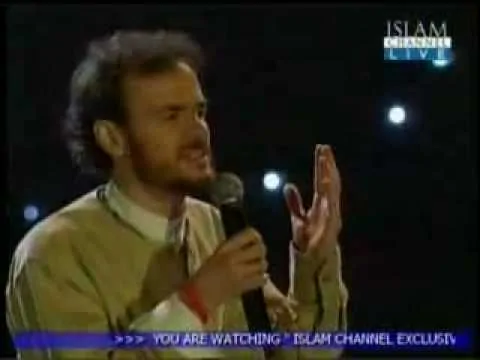
Performed in front of 22,000 people, this nasheed carries within it one of the most quietly devastating lessons in Islamic spirituality: the most powerful form of dawah is not argument, nor refutation, nor eloquent speech — it is character. Set on a desert road, where an elderly woman spent an entire journey mocking and maligning the very man silently carrying her load, the story distils centuries of prophetic wisdom into a single, unforgettable moment of recognition. When the chorus finally shifts — from “don’t talk to me about Muhammad” to “oh, talk to me, Muhammad, because of you I now have peace” — it does not just move the heart. It challenges every Muslim to ask honestly: am I actually living the sunnah I claim to love?
A Desert Road, a Heavy Load, and the Character That Changed Everything
An old woman, struggling under her burden on a desert road, accepts a young stranger’s offer of help on one condition: do not speak to her about Muhammad ﷺ. She then spends the entire journey cataloguing the accusations of his opponents. He was dividing communities with his claim that God is One, misleading the weak and the slaves, corrupting the youth, upending the comfortable order of their society. The young man says nothing. He carries the load. He walks with patience. When they arrive and she turns to thank him and asks his name, the revelation transforms her in seconds. “I am Muhammad,” says the Prophet ﷺ — and the woman who had spent the entire journey denouncing him bears witness to his prophethood on the spot. She had not been argued into Islam. She had been served into it.
“Oh, talk to me, Muhammad — because of you I now have peace, and you have eased my troubled mind. And as I travel down life’s road, I will get along just fine.”
The Sunnah We Forget: Prophetic Character as an Act of Worship
The deeper provocation of this nasheed — and of the story it tells — is the mirror it holds up to contemporary Muslim practice. Many of us grow up learning to follow the sunnah in its outward forms: the beard, the miswak, the turban, the kohl. These are honourable, and not to be dismissed. But the Prophet ﷺ warned us directly that abstaining from food and drink during Ramadan while continuing to engage in dishonesty, cruelty, or harsh speech misses the point entirely — God, he told us, has no need of our hunger if we cannot guard our tongues. If a merchant advertises his meat as halal while knowing it is not, his leather socks are no evidence of faith. If a cabbie cheats passengers while wearing a full beard, he is neglecting the very sunnah he displays. The Quran itself calls out hollow ritual at the expense of lived morality — and the following lessons from this nasheed’s prophetic story speak directly to that call:
- Silence is often the most eloquent response to hostility — the Prophet ﷺ never retaliated verbally, even while being openly mocked throughout the journey.
- Service is not conditional on how we are treated — he continued carrying the old woman’s load regardless of her words, demonstrating mercy as a default rather than a reward.
- Character converts where argument cannot — it was a lived example, not a theological debate, that brought the old woman to her shahada.
- Outward ritual without inner morality is incomplete sunnah — the physical marks of observance must be matched by honest conduct in every dealing.
- True Islam calls us to universal service — the Prophet ﷺ showed compassion to someone who was actively hostile, embodying the mercy he was sent to extend to all of humanity.
- The fast is of the tongue and heart, not only the stomach — Ramadan and every act of worship are training grounds for the character this nasheed so powerfully portrays.
“True piety does not consist in turning your faces toward the east or the west — but truly pious is he who believes in God, and the Last Day; who spends his wealth upon his near of kin, and the orphans, and the needy, and the wayfarer; who keeps his promises whenever he promises; and is patient in misfortune and hardship and in time of peril: it is they that have proved themselves true, and it is they who are conscious of God.” (Quran 2:177)
Give Your Neighbours a Chance: Faith as a Way of Walking Through the World
The nasheed closes not with a theological argument but with a simple, human appeal: give your neighbours a chance. We do not like being pointed at, judged, or reduced to a headline — and neither does anyone else. The Prophet Muhammad ﷺ spent his entire mission demonstrating that Islam is not an identity worn on the outside but a quality lived from within: in patience with those who wrong us, in generosity toward those who mock us, in honesty when dishonesty would be easier, and in the willingness to smile at a brother or sister when we feel least like it. Guidance, in the prophetic model, never looked like dominance or argument — it looked like a young man carrying the heaviest load in silence, and trusting that character, over time, does what words never can. As the old woman discovered on that desert road, sometimes showing is enough. And every one of us, as we travel down life’s road, carries within us the same extraordinary opportunity: to be the reason someone else finally finds peace.