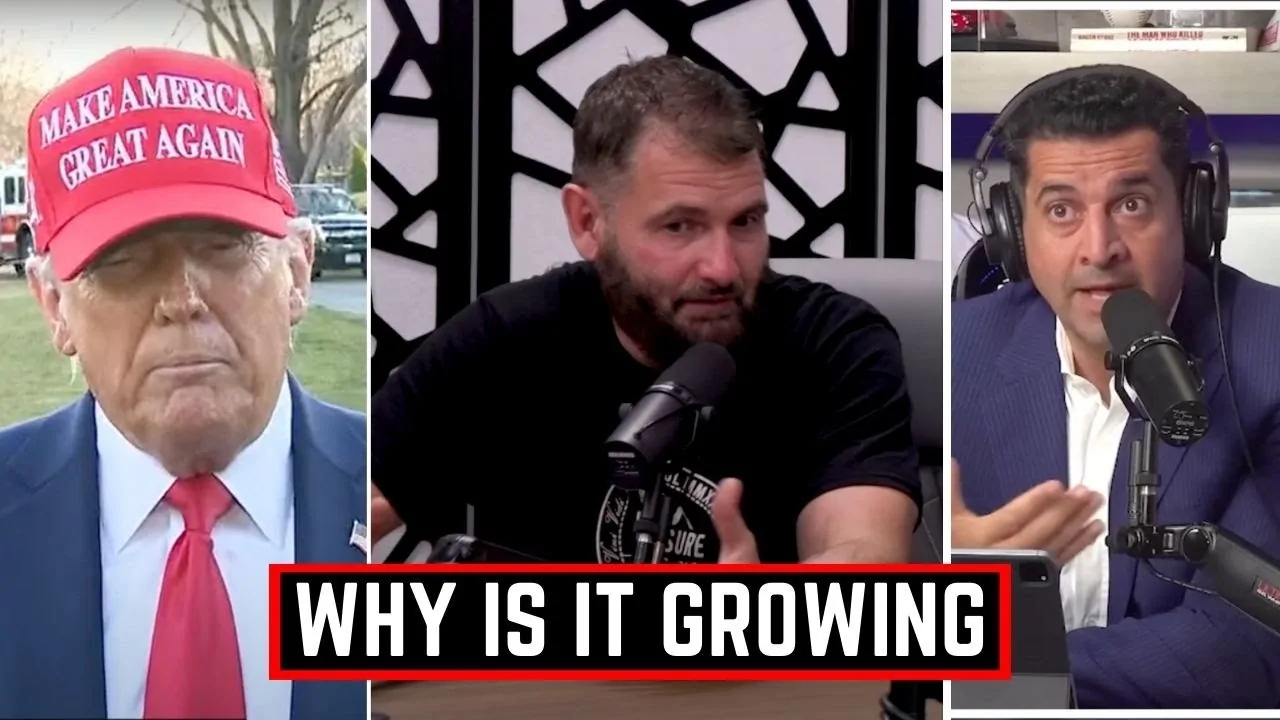
With 1.9 billion followers worldwide and projections placing Islam on course to become the world’s largest religion within three decades, it is no surprise that influential voices like entrepreneur and commentator Patrick Bet-David are openly asking: why has Islam grown so explosively? In a compelling episode of The Deen Show, host Eddie sits down with Imam Anir Arat, Director of AURA USA, to answer that question — and to confront something far more urgent along the way: the glaring double standard in how Muslim identity is treated by media, politicians, and public discourse. From a Miami Beach shooting rooted in misdirected hate, to a frank examination of the Quran’s preservation versus the Bible’s textual instability, this conversation offers honest, faith-grounded insight into why Islam continues to capture the hearts and minds of people across every corner of the globe.
The Selective Silence Around Anti-Muslim Hate and Media Double Standards
In Miami Beach, a man fired seventeen shots at two individuals he believed were Palestinian — they turned out to be Israeli Jews visiting from Israel. The story barely registered in national news. As Eddie and Imam Arat discuss at length, had the shooter been Muslim, the media cycle would have been relentless and unforgiving. Political leaders would have spoken out, imams across America would have been called upon to issue public condemnations, and the entire Muslim community would have been held collectively responsible for one man’s crime. Instead, the case quietly faded. This pattern repeats itself — in Jerusalem, where an Israeli man shot a fellow Jew he mistook for an Arab, refusing to believe him even as the victim cried out in Hebrew that he was Jewish; in another incident where an Israeli man attacked a Jewish woman he mistook for a Christian. In each case, the perpetrators were not Muslim, and in each case, the silence was deafening. Imam Arat, drawing on fifteen years of serving as an Imam in America, frames the root cause plainly: it is ignorance, amplified by the absence of real Muslim voices in people’s lives. The antidote is not only demanding media accountability — it is personal dawah, the simple but powerful Islamic act of inviting others to know you, to share a meal, to have an honest conversation. When people encounter Muslims as real human beings, the television-manufactured image of Islam dismantles itself.
“There can be no coexistence with this violence — no tolerating it, no accepting it, no excusing it, and no ignoring it. If we do not stand in uniform condemnation, we will be judged by God.”
- A man in Miami Beach fired 17 shots at individuals he assumed were Palestinian — they were Israeli Jews; the story received little to no national media attention.
- When Muslims are the perpetrators of any act of violence, the entire global Muslim community is expected to condemn it; the same standard is never applied in reverse.
- Muslim history records consistent protection of Jewish communities — from the time of Caliph Umar allowing Jews to return to Jerusalem after 600 years of exile, to the flourishing of Jewish life under Muslim Spain and the Ottoman Empire.
- Imam Arat identifies two key drivers of Islamophobia: ignorance and the absence of real Muslim relationships in people’s lives — both solvable through personal outreach and dialogue.
- Even a politically charged figure like Donald Trump reportedly acknowledged to visiting Imams that Muslims, like him, have been among the most misrepresented groups in modern media — a shared experience that opens a genuine bridge for understanding.
The Quran’s Unmatched Preservation and the Evidence of Islam’s Truth
Patrick Bet-David’s genuine curiosity about Islam’s growth also leads to a theological question that the episode addresses head-on: given that the Quran was revealed to an unlettered Prophet ﷺ, how does a book with claimed inconsistencies become the foundation of the fastest-growing faith on earth? Imam Arat’s answer cuts to the heart of what makes Islam intellectually compelling to every sincere seeker — the Quran’s textual preservation is unlike anything in religious history. In mainstream American churches today, over 200 different versions of the Bible are in use, with entire passages added or removed across centuries of copying, translation, and reinterpretation. The authors of the Gospels are unknown; the original manuscripts do not exist; verses and even entire chapters were added by human hands long after the original text. The Quran stands in complete contrast: there is one version, read in one language, memorised by millions across every continent. A Muslim in Malaysia, Kazakhstan, Gambia, or Michigan recites the exact same Arabic words that the Companions of the Prophet ﷺ recited fourteen centuries ago. And the Quran itself issues a direct challenge — had this book come from other than Allah, much contradiction would have been found within it. No contradiction has ever been established. That a man who was illiterate, without access to pen or manuscript, reciting over twenty-three years without a single revision, produced a text of perfect internal consistency — is not an argument for human genius. It is evidence of divine revelation.
“If you are sincere in your research of Islam, you will find the truth. Sincerity will always lead a person to the truth — and I can hear that sincerity in Patrick’s questions.”
What this episode ultimately reveals is that the rapid growth of Islam is not an accident of demographics or political circumstance — it is the natural result of a faith that answers the deepest questions of the human heart with clarity, consistency, and verifiable evidence. The double standards in media coverage, the hate crimes born of unchecked ignorance, and the distorted image of Muslims spread through what Imam Arat aptly calls “the hate industry” — none of these can extinguish a light that nearly two billion souls carry. Islam’s growth is not driven by coercion or coincidence. It grows because the Quran is preserved. It grows because Muslim history is one of protection, scholarship, and invitation — not compulsion. And it grows because when people encounter Islam honestly, with sincerity and an open heart, what they discover is guidance, purpose, spirituality, and a truth their souls already recognise. For every person whose only knowledge of Islam has come from a television screen, the door remains open: find a Muslim, have a conversation, read the Quran — and judge for yourself.