Few dietary prohibitions are as universally recognised — yet as misunderstood — as the Islamic prohibition on pork. For many in the West, bacon, ham, and pepperoni are simply staples of daily life, deeply woven into culture and comfort. But Islam, in its comprehensive guidance for human wellbeing, draws a clear and firm line. This is not a ruling born of arbitrary restriction; it is a divine command rooted in Quranic revelation, confirmed by previous scriptures, and increasingly validated by modern science. Understanding why pork is forbidden in Islam requires us to look simultaneously at faith, reason, and the physical realities of what we put into our bodies — because true spirituality has never been divorced from the wisdom that protects us.
A Divine Command Confirmed Across Scriptures
The Quran explicitly prohibits the consumption of pork in no fewer than four separate verses — 2:173, 5:3, 6:145, and 16:115 — leaving no ambiguity for the believer. What is striking is that this prohibition is not unique to Islam. The Bible, in Leviticus 11:7–8 and Deuteronomy 14:8, similarly declares the pig unclean and forbids its consumption, echoed again in Isaiah 65:2–5. The consistency across Abrahamic traditions is not coincidental — it reflects a unified divine wisdom that transcends denomination and epoch. In the Quranic framework, Allah’s guidance is always purposeful: what He forbids, He forbids to protect us, spiritually and physically. A Muslim submits to this command not out of blind obedience, but from a deep trust that the Creator knows best what He created.
“Forbidden to you (for food) are: dead meat, blood, the flesh of swine, and that on which hath been invoked the name of other than Allah.” — Al-Qur’an 5:3
- The Quran prohibits pork in four distinct verses, establishing it as an unambiguous ruling, not a cultural suggestion.
- The Bible corroborates this prohibition in Leviticus, Deuteronomy, and Isaiah — pork was never considered food in early scripture.
- Islamic dietary law (halal) is part of a broader system of spiritual and physical purification, not mere ritualism.
- Submission to divine guidance on food is an act of faith — trusting that Allah’s wisdom exceeds our personal preferences.
- The prohibition applies to all pork products: ham, bacon, pepperoni, lard, gelatin derived from swine — anything originating from the pig.
What Science and Reason Reveal About the Pig
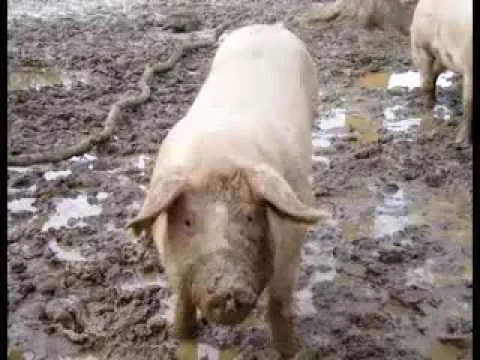
Beyond scripture, the physical nature of the pig itself provides compelling rational grounds for the prohibition. The pig is a scavenger by design — it will consume waste, excrement, infected carcasses, and even its own dead young. More critically, its digestive system completes its cycle in roughly four hours, compared to 24 hours for a cow. This rapid, poor-quality digestion means toxins from everything the pig consumes are not properly eliminated but are instead stored in its fat tissue. When that pork reaches your plate days later, those toxins come with it. The health implications are well-documented: pork consumption is linked to over seventy types of disease, including tapeworm infestations from Taenia Solium — whose eggs can migrate through the bloodstream to the brain, heart, eyes, and liver. Research conducted in America found that 22 out of 24 cases of Trichuris infection occurred in people who had cooked their pork thoroughly, debunking the myth that high heat eliminates the risk. Excess pork fat also accumulates in blood vessels, contributing to hypertension and heart disease at alarming rates in populations where pork is a dietary staple.
“God knows what’s best for us. I made changes not only for my health’s sake — I made changes to honour God. And I believe that if I’ll do what I can to take care of myself, God will do what I can’t.” — Pastor, as quoted in The Deen Show
- The pig’s 4-hour digestive cycle is one of the shortest and least effective of any food animal — toxins accumulate rather than being expelled.
- Pigs are omnivorous scavengers, consuming faeces, sick animals, and rotting matter — all of which enters their fat and flesh.
- Taenia Solium (tapeworm) eggs survive normal cooking temperatures and can cause catastrophic organ damage once in the human body.
- Pork fat deposits in arterial walls, contributing to hypertension and cardiovascular disease — conditions now endemic in high-pork-consuming populations.
- By contrast, permitted animals (cow, lamb, deer, buffalo) eat clean vegetation, have sophisticated multi-stage digestive systems, and properly eliminate toxins before slaughter.
- Even in modern, “hygienic” farm conditions, pigs retain their innate scavenging habits — environment changes behaviour, not nature.
The prohibition on pork in Islam is ultimately a gift — one of countless expressions of divine mercy (rahmah) embedded in the shari’ah. When Allah forbids something, He does not leave us without wisdom, whether we access that wisdom through the clarity of revelation, the confirmation of earlier scriptures, or the growing body of scientific evidence. For the Muslim, the command alone is sufficient — and the rational evidence simply deepens appreciation for how comprehensively Islam guards human dignity, health, and spiritual purity. For those outside the faith who hear this reasoning, it is an invitation to reflect: when a Creator who designed the human body tells us what not to consume, perhaps the wisest response is not resistance, but gratitude. Making changes to honour God — as the pastor in this very episode testified — is not deprivation. It is a step toward living with purpose, alignment, and the quiet peace that comes from walking in accordance with divine guidance.