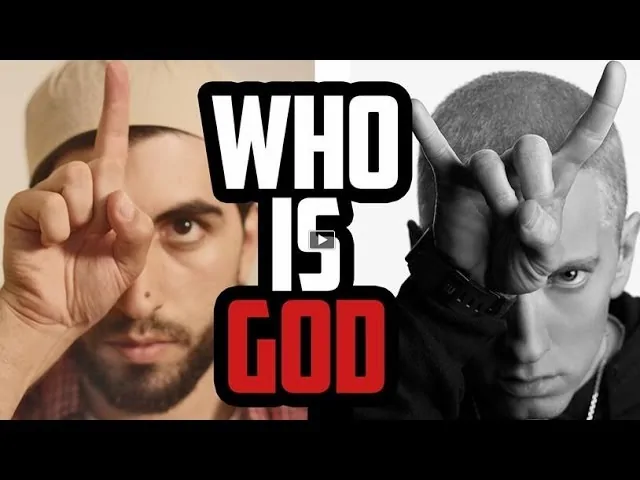
In 2013, Google’s year-end search trends for Australia revealed something quietly extraordinary: the second most-searched question, nestled just behind “what is twerking,” was who is God? That contrast says everything about where modern culture has arrived. The concept of God has been so thoroughly trivialised and commercialised — from the mythology of Zeus and Thor, to Kanye West releasing an album titled Yeezus and producing a track called “I Am God,” to Eminem crowning himself the “Rap God” — that billions are either searching blindly or have quietly stopped searching altogether. In this striking spoken word piece by Kamal Saleh, produced by The Daily Reminder and drawing on the philosophical scholarship of Hamza Tzortzis, the fog finally lifts. Rather than appealing to sentiment or tradition, it presents the God of Islam — Allah — as the most logical, rational, and philosophically coherent answer to humanity’s oldest question: an answer that demands ten sincere minutes and an open mind.
Why the Gods of Pop Culture and Mythology Fail the Most Basic Test of Reason
Any honest intellectual inquiry must begin where we all agree: things exist, and things that begin to exist require a cause. A glass cannot make itself. A universe cannot assemble itself from nothing. Leading cosmologists confirm the universe had a beginning — and that beginning demands a cause. But if that cause itself had a cause, and that cause had a cause, we face an infinite regress: a chain with no first link, which would make our existence logically impossible. The only coherent resolution is a First Cause that is itself uncaused — eternal, without beginning, requiring nothing to bring it into existence. Furthermore, this Being must be transcendent, existing beyond the realms of time, space, and matter that He authored, much as a designer remains separate from the product they design. And He must be One — for two equally all-powerful beings with conflicting interests would be philosophically self-defeating. With this framework established, every mythological contender collapses immediately. Zeus sleeps. Thor was born. Kanye’s divine self-image ends when he walks into a street sign. Not one figure from ancient pantheons or modern pop iconography satisfies even the most rudimentary criteria of what God must logically be. Only Allah — One, Eternal, Self-Sufficient, All-Knowing, All-Seeing, and utterly unlike anything in creation — meets every condition that reason itself demands.
“For God to exist, He must exist without a beginning — therefore not requiring a cause, making Him Eternal. He should also be Transcendent from His creation, not bound by any of the realms He created: whether time, space, or matter.”
- Everything that begins to exist has a cause — the universe had a beginning; therefore it has a cause
- The First Cause must be eternal and uncaused — infinite regress renders our existence logically impossible
- God must be transcendent — existing outside of time, space, and matter, not subject to their constraints
- God must be One — multiple all-powerful beings with conflicting wills is internally contradictory
- Mythological gods all fail — Zeus, Thor, and others are created, dependent, finite beings requiring sleep, food, and oxygen
- Allah alone satisfies every criterion — Eternal, Self-Sufficient, All-Knowing, All-Seeing, and beyond all human imagination
The Quran’s Inimitable Challenge — and Why Not Even the Rap God Can Meet It
Accepting the logical case for a Creator still leaves the question: which revealed source speaks from that Creator? This is where the Quran stands entirely apart from every other book in human history. Revealed over 1,400 years ago to the Prophet Muhammad ﷺ at a time when Arabic poetry represented civilisation’s highest art form, and Arabia’s greatest poets were its most celebrated minds, the Quran did not merely impress those masters of language — it silenced them. It occupies a literary category entirely its own, a fusion of prose and poetry that defies classification and continues to move the hearts of Muslims and non-Muslims alike centuries later. Kamal Saleh makes the comparison vivid and direct: Eminem — genuinely formidable as a lyricist, with rhythm, rhyme, alliteration, and assonance sustaining near-continuous rhyme schemes — is nonetheless a useful benchmark. Compare his finest work to Surah Al-Kawthar, the Quran’s shortest chapter: just three verses, ten words in Arabic, within which scholars have identified over thirty simultaneous linguistic and rhetorical devices, including emphasis, multiple meanings, grammatical shifts, ellipsis, palindromes, conceptual relatedness, and fulfilled prophecy. That prophecy is itself extraordinary — revealed at one of the Prophet’s ﷺ lowest moments, having lost his son, mocked by enemies, with a small following and little worldly standing, Allah promised him abundant good. Today, over 1.6 billion people from every walk of life recite that promise daily, and the Quran remains the most memorised, recited, and practised book in all of human history. The challenge it issues — produce even a single chapter like it — has stood unanswered for fourteen centuries. No Rap God, no poet laureate, no committee of scholars has come close.
“The Quran gives meaning to life — from our overall purpose of existence, to why we are here, and what happens once we die. We were not created for mere play. We were created with a purpose: to be obedient to God.”
The question of who God is was never merely an academic puzzle — it is the question on which every other question in human life depends. If there is no Creator, there is no objective purpose, no ultimate accountability, no grounding for justice, and no answer to the silence we feel in our most honest moments. But if the logical and evidential case presented here is as sound as reason and revelation together suggest — and the Quran’s linguistic precision, its scientific references, its historical accuracy, and its fulfilled prophecies all point to an authorship beyond human capacity — then we are not adrift. We have been given guidance. Islam teaches that each of us is here by design, tested with purpose, and answerable to a God who is closer to us than we often allow ourselves to believe. The most intellectually honest response to this material is not to close the tab but to open the Quran, engage with it sincerely, and let it speak for itself — because that is precisely what it has been doing, to the hearts of billions, for over fourteen hundred years.