
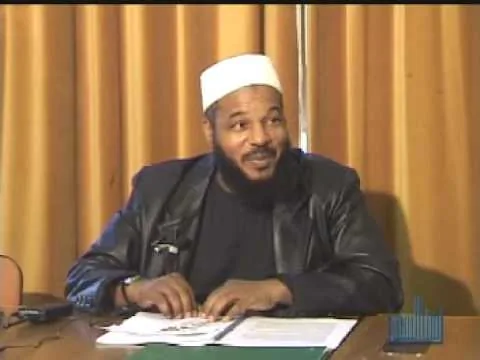
Few conversations test a Muslim’s confidence in public quite like the moment someone challenges Islam with a provocative question — about the Prophet’s ﷺ marriage, about Islamic law, or about the treatment of women in Muslim societies. Rather than retreating in embarrassment, Bilal Philips — one of the world’s most experienced da’ees — teaches Muslims in Part 6 of the Ultimate Dawah Course that every difficult question carries an opportunity: to demonstrate the coherence, wisdom, and justice of the Islamic worldview. This session equips believers with both the intellectual tools and the spiritual grounding to respond with clarity and conviction, turning moments of pressure into moments of profound dawah.
Answering the Hardest Questions with Context and Confidence
One of the most frequently weaponised attacks against Islam today is the claim that the Prophet Muhammad ﷺ was a “paedophile” because of his marriage to Aisha (radhiallahu anha). Bilal Philips addresses this head-on by placing the accusation in its proper historical, biological, and comparative context. Across Europe today, the age of consent varies between 12 and 18 years depending on the country — yet those same societies attack a marriage contracted 1,400 years ago within an entirely different historical reality. Islam does not use an arbitrary legislated number; it uses a natural, biological threshold: puberty. When a person reaches puberty — a physiological milestone signalling readiness for adult responsibilities — Islam considers them eligible for marriage. In the Arabian Peninsula of the Prophet’s time ﷺ, puberty commonly arrived earlier than in colder climates, reflecting well-documented human biological variation across different regions of the world. Most decisively, the marriage to Aisha (ra) was not exploitation — it was a blessed, legitimate union whose fruits speak for themselves. Aisha (ra) became the fourth most prolific narrator of hadith, a revered jurist consulted by the Companions, and a spiritual authority honoured by the entire Muslim community across centuries. Genuine abuse destroys; this marriage elevated. Any objective assessment of its consequences utterly vindicates the character and prophethood of Muhammad ﷺ.
- Historical context is non-negotiable: Marriage norms 1,400 years ago were governed by puberty across all civilisations — not by today’s legislated ages, which vary widely even across modern Europe.
- Puberty is a natural dividing line: Islam links marriage eligibility to a biological reality that accommodates genuine human diversity across geographies and climates — not an arbitrary political consensus.
- Aisha’s (ra) scholarly legacy refutes the accusation entirely: Her life produced thousands of hadiths, groundbreaking legal scholarship, and the deep respect of the Muslim world — the exact opposite of someone whose life was shattered by abuse.
- Marriage versus exploitation are fundamentally different: True child exploitation involves anonymous abuse and abandonment; the Prophet ﷺ contracted a recognised, honoured marriage with full family involvement and lifelong commitment.
- Apply the same standard consistently: British royal marriage customs 1,400 years ago followed identical norms — applying today’s standards retroactively would condemn every pre-modern civilisation equally, including the critics’ own ancestors.
“Aisha was one of the most prominent scholars of the Ummah — the fourth most prolific narrator of hadith, a juristic authority honoured by the entire Muslim community. Her life was not shattered; it was elevated. That is the consequence of this marriage, and consequences tell the truth.” — Bilal Philips
Islamic Law, Justice, and the Foundation of a Healthy Society
The second cluster of difficult questions in this session concerns Islamic law: the conditional permission for marital discipline, the penal code’s physical punishments, and the punishment prescribed for adultery. Bilal Philips systematically dismantles the caricatures that circulate in Western media. On marital discipline, he draws a sharp and crucial distinction between the symbolic, last-resort gesture permitted in Islam — a light touch when all communication has failed, explicitly prohibited from leaving any mark — and the epidemic of domestic violence that plagues Western societies despite its illegality. The very nations that condemn Islamic guidance see women beaten, hospitalised, and killed by partners at epidemic rates, in part because the nuclear family leaves women without the protective network that Islam’s extended family model provides. When a Muslim woman marries, she marries into a family: fathers, brothers, and cousins who take an active interest in her welfare — a built-in social accountability that no legislation has managed to replicate. On Islamic criminal law, Bilal Philips presents hard evidence: when Sudan implemented Sharia in the mid-1980s, crime rates dropped by approximately 40% within months of its application. Similar results followed in other Muslim-majority contexts. Meanwhile, in Britain, 172 convicted murderers were released between 1960 and the time of this lecture — most having served fewer than nine years of a so-called “life” sentence — with predictable consequences for public safety. Islam’s approach combines retribution (qisas), deterrence, and rehabilitation in a coherent framework, while its strict evidentiary standards — four adult eyewitnesses required to apply the hadd punishment for adultery — ensure these sentences function overwhelmingly as deterrents, not as regularly applied penalties. The hand amputation prescribed for theft is similarly hedged with conditions: the stolen item must exceed a threshold value, be taken from a secure location, and the offender must be a habitual professional thief, not a person stealing out of hunger or desperation. The goal throughout Islamic law is not cruelty — it is the preservation of family, security, and the social fabric that makes human flourishing possible.
- Marital discipline in Islam is strictly symbolic and conditional: The permission is a last resort when all communication has failed; it must leave no mark and carries no resemblance to the domestic violence epidemic in Western societies.
- Extended family provides real protection: The Islamic family structure gives a wife fathers, brothers, and relatives who actively intervene on her behalf — a safeguard legislation alone has never successfully replicated.
- Sharia demonstrably reduces crime: Sudan’s crime rate fell roughly 40% within months of Sharia implementation — concrete, documented evidence of Islamic law’s deterrent power in practice.
- The adultery punishment is a near-impossible threshold: Requiring four adult eyewitnesses to a specific act means the hadd for zina functions as a powerful societal deterrent, not a sentence regularly enforced in courts.
- Hand amputation targets professional criminals under strict conditions: The punishment applies only to habitual thieves stealing items of significant value from secured locations — not to those acting out of poverty or desperation.
- The family is the foundation of society: Islamic law treats anything that destroys the family — particularly adultery — with severity precisely because once the family unit collapses, the entire social order begins to unravel with it.
“The legislation the West has put in place has not guaranteed the safety of women — they are still being abused on a massive scale. Within the Islamic family structure, there are guarantees that help protect women regardless of what the law says. The two are not comparable.” — Bilal Philips
Part 6 of the Ultimate Dawah Course is, at its heart, a masterclass in intellectual confidence rooted in faith and guided by knowledge. Bilal Philips demonstrates that there is no question about Islam too difficult to answer — only questions that have not yet been placed in their proper context. When a Muslim genuinely understands the historical reality of Prophet Muhammad’s ﷺ marriages, the biological wisdom behind Islamic definitions of maturity, the family-centred logic of Islamic guidance, and the demonstrable social benefits of Sharia-based governance, the attacks of critics lose their power entirely. Dawah is not about apologising for the deen or softening its principles to gain approval; it is about presenting the truth of Islam — its profound rationality, its mercy, its social wisdom, and its complete and comprehensive guidance for human life — with the same clarity, purpose, and conviction that Bilal Philips has spent decades modelling for Muslims around the world. For every believer who has ever felt silenced by a hostile question, this session is both a shield and a lantern.