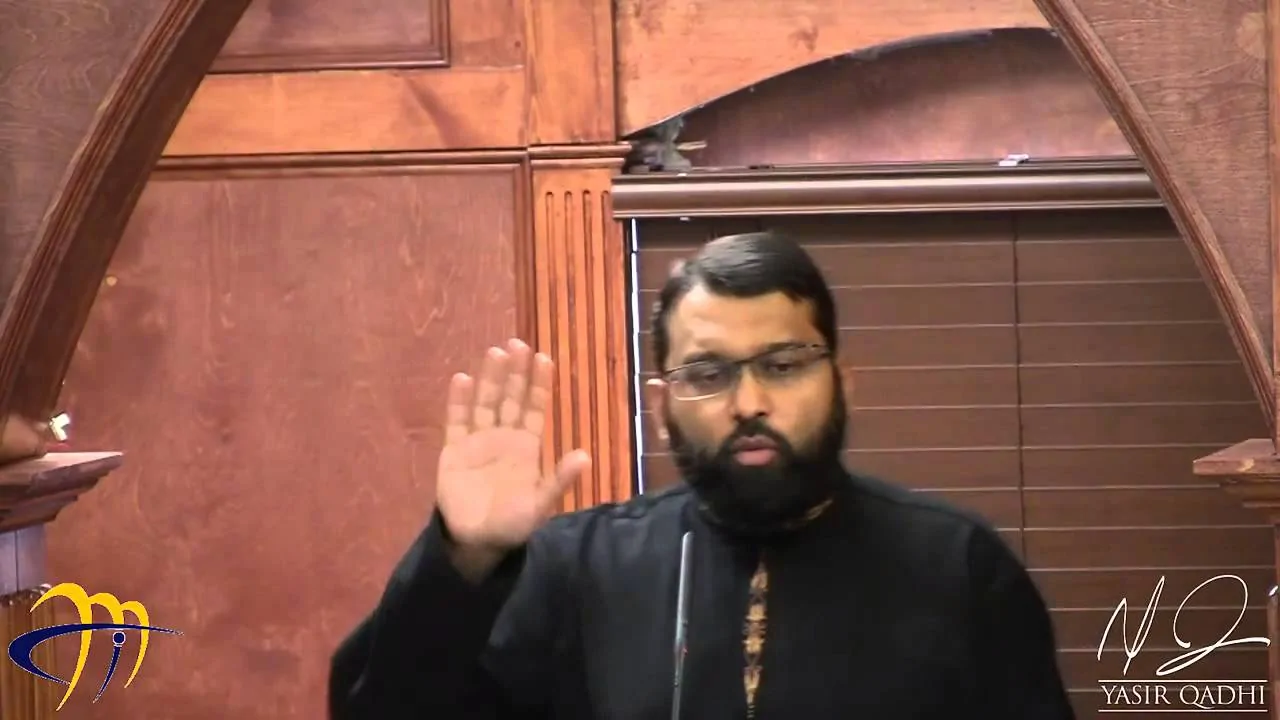
Over fourteen centuries ago, the Prophet Muhammad (peace be upon him) stood at Hunayn distributing the spoils of war when a man — thick-bearded, wide-foreheaded, shaved head — stepped forward and accused the Messenger of Allah of injustice. The Prophet (SAW) restrained those who rose to respond, and then delivered a warning that history has repeatedly confirmed: from this very mindset, groups would emerge who recite the Quran yet whose recitation never descends past their throats, who appear deeply devout yet whose actions have nothing to do with Islam. Recorded in Sahih Al-Bukhari across more than ten narrations, this prophetic prediction forms the backbone of this landmark Friday sermon by Shaykh Dr. Yasir Qadhi, delivered on 22nd August 2014 — a critical historical analysis connecting the Kharijites of the first Islamic century directly to the emergence of ISIS, and asking every Muslim to honestly confront what our faith, our spirituality, and our tradition actually say about extremism, violence, and the sanctity of innocent life.
The Birth of Kharijism — Islam’s First Internal Rupture
In the year 36–37 AH, during the caliphate of Sayyiduna Ali ibn Abi Talib (may Allah be pleased with him), a political dispute over arbitration with Mu’awiyah (may Allah be pleased with him) — a difference of opinion that was fundamentally political, not theological — caused a faction of approximately 6,000 Muslims to break away from the main body of the Ummah. Under Abdullah Wahb Al-Rasi, they declared that Ali’s acceptance of human arbitration constituted disbelief, coining the slogan “No rule but Allah’s” and branding the Caliph himself a kafir. Sayyiduna Ali dispatched Ibn Abbas to debate them, and his methodical refutation from the Quran itself — including demonstrating that the Quran explicitly permits human arbitration even in marital disputes — convinced 2,000 of them to return. The remaining 4,000 were the true fanatics, and they quickly revealed their nature: they captured Abdullah ibn Khabab ibn Al-Adhab, the son of a companion of the Prophet (SAW), interrogated him about his loyalty to Ali, then beheaded him from the front — along with his pregnant wife and children. In that same expedition, their leader furiously rebuked a soldier for plucking a grape from a Christian farmer’s vine without permission, and paid financial compensation for a pig one of them had killed. This is the foundational paradox of Kharijism: meticulous in ritual scruple, barbaric in the spilling of Muslim and protected non-Muslim blood — a contradiction that would define every manifestation of this deviance across the centuries.
“Sayyiduna Ali (may Allah be pleased with him) said to the departing Kharijites: ‘You have your religion and your methodology — and we have ours. We have no right to harm you unless you harm others.’ They had threatened to kill him for a difference of opinion. He did not march his army against them. He did not massacre them. He said: go your way, but do not harm others. This is the spirit of Islam — tolerance even toward those whose theology you believe is profoundly wrong.”
Recognising the Signs — A Prophetic Profile of Extremism Across the Ages
Shaykh Yasir Qadhi draws on more than ten authenticated narrations in which the Prophet (SAW) described this deviant typology in precise, repeatable terms — characteristics that scholars throughout Islamic history have used to identify Kharijite manifestations in every era, and which map with disturbing clarity onto groups active at the time of this sermon. The Prophet (SAW) described them as having the best speech and the worst actions — their rhetoric sounds like a call to the Quran and Islam, but their conduct contradicts it by unanimous scholarly consensus. Understanding these signs is a matter of religious literacy and communal protection for every Muslim today:
- Youth without wisdom: The Prophet (SAW) described them as having “the dreams of youth” — young men, overwhelmingly in their teens and twenties, with grandiose utopian goals, no seasoned scholarly leadership, and no real-world experience. You will not find senior scholars or elders of 60 and 70 guiding these movements; they are led by young rebels with naive notions of instantly restoring a global caliphate.
- Mesmerising speech, hollow faith: Their words captivate. They call to the Quran, they invoke Islam, they speak with confidence and passion — yet the Prophet (SAW) said their recitation does not pass their throats, meaning their faith has no depth. It is performative religion weaponised for political violence.
- Instant takfir: Disagreement equals disbelief. Anyone who questions their methods or interpretation is immediately branded a hypocrite, an apostate, an agent of the enemy. Shaykh Yasir personally noted a significant increase in death threats from such groups — precisely mirroring how the early Kharijites threatened to execute Sayyiduna Ali himself simply for a difference of political opinion.
- Bloodlust as a virtue: Killing ceases to be a regrettable necessity and becomes a point of pride. Blood becomes cheap. This is antithetical to the Prophet’s own example — when the first Kharijite insulted him at Hunayn, the Prophet (SAW) restrained his companions and said, “Do not kill him, lest people say I kill my own followers.”
- Ritual piety alongside mass atrocity: Just as the early Kharijites massacred a family and then panicked about a stolen grape, modern extremist groups display a warped religiosity — obsessing over outward forms while committing actions that every classical scholar of Islam, without exception, condemns as haram and contrary to the Shariah.
- Feeding off the opposite extreme: Kharijite fanaticism and secular disengagement from Islam each justify the other. The extremist points to disengaged Muslims as proof that the Ummah needs to be “woken up by force”; the disengaged Muslim points to the extremist as proof that religion itself is the problem. Both are errors, and both feed each other’s existence.
The Damage Done — and the Wisdom of the Middle Path
“Brothers and sisters — Israel’s actions do not damage the reputation of Islam. America’s foreign policy does not damage the perception of Islam among people of conscience. But when groups kill in the name of Allah, when an innocent journalist is beheaded on camera and displayed to the world — that damages Islam’s image in a way that no foreign adversary can. When a commentator calls for all Muslims to be shot in response, ask yourself: who created that moment? This is not our religion. This is not our Prophet. This is not our Shariah.”
Shaykh Yasir Qadhi does not shy from acknowledging the geopolitical context — the false invasions, the civilian deaths, the foreign policies that created the conditions in which such movements recruit — but he is equally unequivocal that political grievance, however legitimate, can never justify the methodologies of the Kharijites, past or present. The Prophet (SAW) and the Sahabah endured persecution far greater than anything Muslims face today, and not once did they respond with the indiscriminate terrorism these groups deploy. Our religion, approached genuinely through the Quran and the Sunnah, is nothing but mercy, guidance, and benefit — the more sincerely and knowledgeably a Muslim follows it, the more beautiful their character and conduct becomes. The lesson of this essential sermon is ultimately a call to the middle path: to reject the twin extremes of nihilistic secularism on one side and violent fanaticism on the other, to study Islamic history with honesty, to take our spiritual guidance from grounded scholars rather than charismatic young voices online, and to remember that our highest obligation — after worshipping Allah as He deserves to be worshipped — is to be, in the words and example of our beloved Prophet (peace be upon him), a mercy to all of humanity.