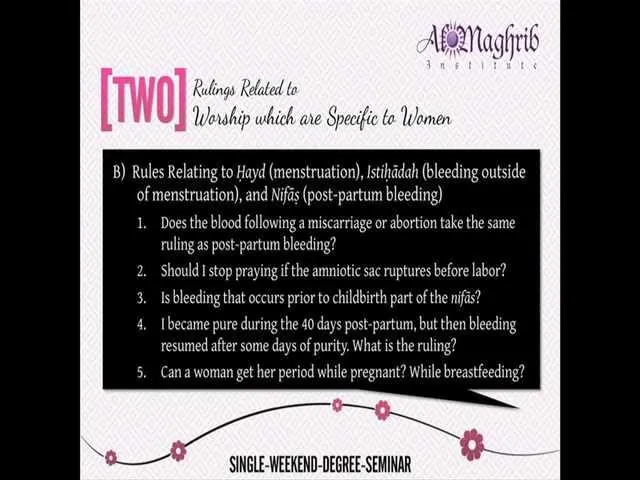
This comprehensive study session covers Chapter 2 Part 1 of “Complicated,” the A-to-Z guide on women’s modern fiqh taught by Sheikh Waleed Basyouni. The cardinal rule established at the outset is clear: females and males carry all the same Islamic rulings unless there is specific evidence proving otherwise, as the Prophet (peace be upon him) said, “Females are the other halves of males.”
Essential Rulings on Tahara (Purification) for Women
- Long dresses dragging on the ground: No need to wash unless wet impurity is visible — the Prophet (peace be upon him) said the land will purify it
- Internal vaginal wetness: Considered pure according to the strongest scholarly opinion (Imam Ash-Shafi’i)
- Vaginal discharge types: Madhi (from arousal without orgasm) is impure and requires washing but not ghusl; Mani (from intercourse/orgasm) requires ghusl; natural secretion unrelated to arousal is pure and does not break wudu
- Trapped air escaping: Does not break wudu
- Ghusl after intercourse: Mandatory regardless of whether orgasm occurred
“The silence of the Sharia on this issue despite its common occurrence is an indicator of its purity. Had natural discharge broken wudu, the Prophet (peace be upon him) would have explicitly taught women about it.”
Women’s Access to the Masjid
Islam has always valued women’s presence in the masjid. The Prophet (peace be upon him) assigned separate entrances for women, and a black woman who used to clean the masjid was so honored that when she passed away, the Prophet prayed over her grave. Women had roles in the masjid during the Prophet’s time, including suggesting the construction of a minbar. However, when attending the masjid, women should avoid wearing strong perfume or excessive beautification.
Frequently Asked Questions
- Repeating after a digital adhan: Not required, as there is no niyyah (intention) behind the recording
- Making up missed prayers: Intentionally missed prayers require sincere repentance and extra voluntary prayers; unintentionally missed prayers should be made up in correct order
- Praying while sitting in a car: Obligatory prayers must be prayed standing; it is better to combine prayers than to sit and pray, except during air travel where sitting is permitted
Sheikh Waleed Basyouni’s approach demonstrates that Islamic rulings for women are grounded in mercy and practicality. The Sharia accounts for the real circumstances of daily life while maintaining the dignity and spiritual obligations that apply equally to all believers before Allah.