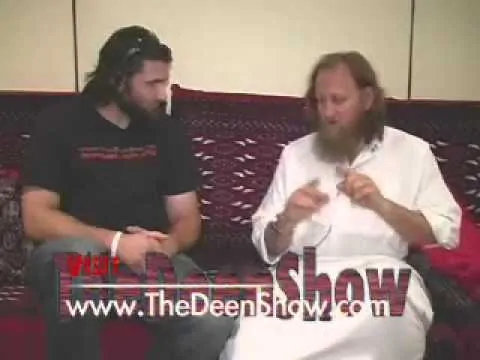
What does it take for a man raised in a Roman Catholic monastic boarding school — from a distinguished British colonial family — to travel through Buddhism, invent his own syncretic religion, and ultimately find peace and purpose in Islam? That is the story of Abdur Rahim Green, born Anthony Vatswaf Galvin Green in Dar es Salaam, Tanzania in 1962, son of a British colonial administrator and a devout Polish Catholic mother, whose spiritual odyssey stands as one of the most compelling conversion accounts in contemporary Islamic dawah. In this episode of The Deen Show, Abdur Rahim traces the arc of his search with disarming honesty, intellectual rigour, and the quiet conviction of a man who has genuinely found what the human soul was always seeking: the truth.
A Privileged Upbringing and the Questions No One Would Answer
Growing up within the rarefied atmosphere of Ampleforth College — a prestigious Benedictine monastic school in England — Abdur Rahim was immersed in Catholic theology from an early age. Yet even as a child, questions arose that his environment could not satisfy. Why would an eternal, self-sufficient God need a mother? If God is infinite and uncreated, how could He become finite, temporary, and mortal — and still remain God? These were not abstract theological puzzles; they were felt contradictions, the kind that persistent minds cannot simply bury beneath social convention. The deeper tension, he explains, was not only theological but existential: the materialist philosophy surrounding him — the idea that the purpose of life is merely to accumulate wealth, status, and comfort — felt equally hollow. Seeking more, he turned sincerely to Buddhism for nearly three years, practising meditation, yoga, and vegetarianism, engaging seriously with the Noble Eightfold Path. Buddhism offered genuine calm, but it could not answer the fundamental questions: Why are we here? What is the purpose of our existence? At its core, Buddhist philosophy teaches that life is suffering and that the solution is the annihilation of the self — a conclusion Abdur Rahim found unconvincing. He had arrived, without yet knowing it, at the insight that Islam would later confirm: the nafs, the self, is not inherently evil and does not need to be destroyed — it needs to be purified, disciplined, and submitted to divine guidance. When even his self-invented synthesis of Christianity, Buddhism, Hinduism, yoga, and philosophy failed him, he hit what he describes as rock bottom: momentarily concluding that perhaps there was no religious truth at all, and that the accumulation of wealth was the only answer worth pursuing.
“What is important is the truth — not the consequences of accepting the truth. The truth is something that is virtuous in and of itself.” — Abdur Rahim Green
The Quran, the Logic of Tawhid, and the Simplicity of Divine Forgiveness
It was, by his own admission, a somewhat ironic chain of reasoning that led Abdur Rahim to the Quran: noticing that Arabs seemed prosperous with apparent ease, he wondered about their religion — and walked into a bookshop to buy a translation of the Quran. What he found was not what he expected. He read it, reread it, studied it — and the conviction settled over him that if any book in the world carried the word of God, this was it. Around the same time, a Muslim friend posed a single, measured question in the calmest possible manner: “You believe Jesus is God. You believe Jesus died on the cross. So you believe God died?” The lights came on. The penny dropped. In that moment, Abdur Rahim realised that the entire doctrinal architecture of the Christianity he had been taught collapsed under its own internal contradictions. Islam, by contrast, offered luminous clarity: God is One, transcendent, eternal, and utterly self-sufficient; He does not become His creation; He does not require a sacrifice to forgive — He simply forgives, with a mercy so expansive that sincere repentance transforms past wrongs into good deeds. Key takeaways from his journey include:
- The Trinity is a logical impossibility, not merely a paradox: The infinite cannot become finite and remain infinite — this is self-contradiction, not divine mystery.
- Original sin and vicarious atonement contradict justice: Punishing all humanity for Adam’s act, and punishing an innocent person for the guilt of others, cannot be reconciled with a God who is perfectly just.
- Buddhism calms but cannot answer the ultimate questions: The claim that life is fundamentally suffering and that the self must be annihilated does not hold under careful scrutiny.
- The self-made spiritual buffet is the worst path of all: Picking and mixing from traditions according to personal taste creates spiritual chaos and, as Abdur Rahim testifies from personal experience, leads nowhere.
- True freedom comes through submission, not licence: Islam — submission to God — liberates the human being from enslavement to their own desires, just as law structures society into something liveable and just.
- Islamic forgiveness requires no intermediary and no sacrifice: Turn sincerely to God alone, affirm His oneness, feel genuine remorse, commit to change — and God forgives completely, without condition.
“The true freedom comes from submitting oneself to God — not by submitting yourself to your desires. The devil has fooled people into thinking that doing what you like means you are free. No — you are only now a slave to your desires.” — Abdur Rahim Green
Abdur Rahim Green’s story is ultimately not just the account of one man’s embrace of Islam — it is a mirror held up to the universal human search for meaning, purpose, and a God worthy of worship. From the incense-laden corridors of an English Catholic boarding school, through the meditation halls of Buddhism and the spiritual confusion of self-made religion, to the crystalline simplicity of the Shahada, his journey demonstrates that sincere, honest inquiry — unshackled from social pressure and the fear of consequences — leads the searching heart toward guidance. For anyone standing at a similar crossroads today, disillusioned with religion, uncertain about God, or quietly aware that neither materialism nor spiritual eclecticism fills the void, his counsel is direct: ask the real question. Is the Quran the word of God? Is Muhammad, peace be upon him, His final messenger? Investigate with the same rigour you would bring to any serious claim of truth — because what matters is not the social cost of accepting the truth, but the truth itself, and the profound mercy and freedom that come with submitting to it.