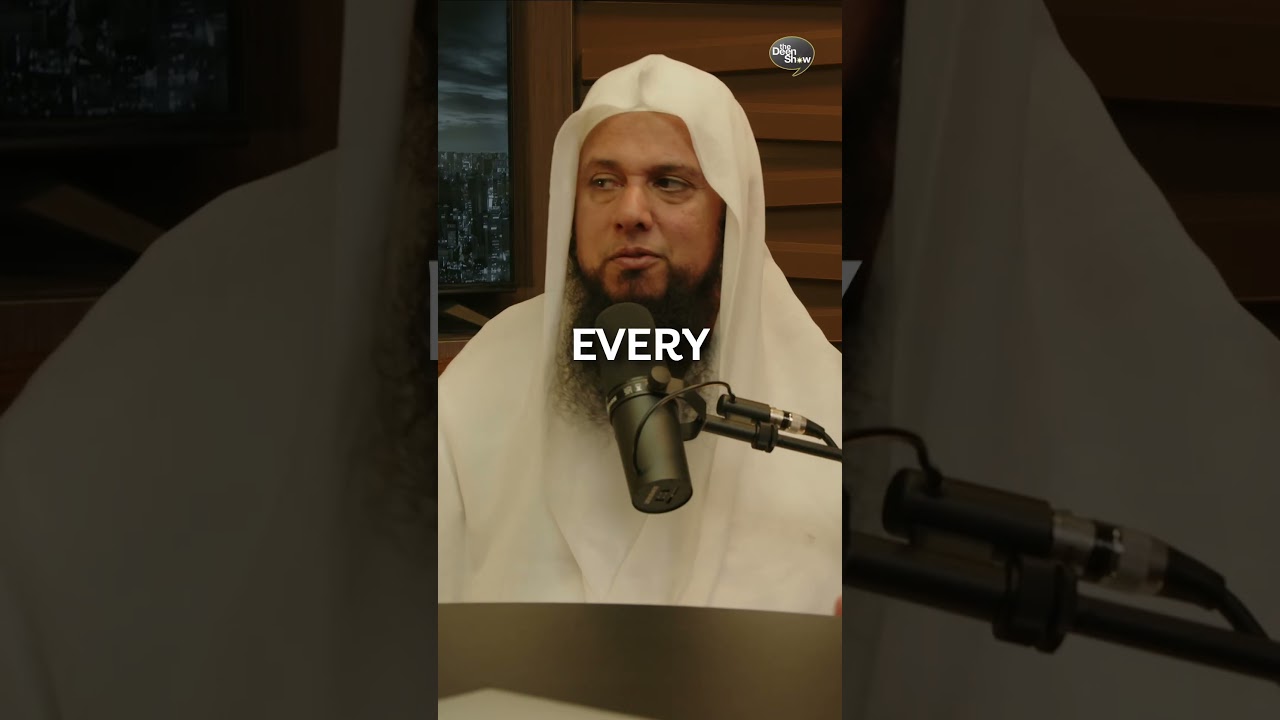
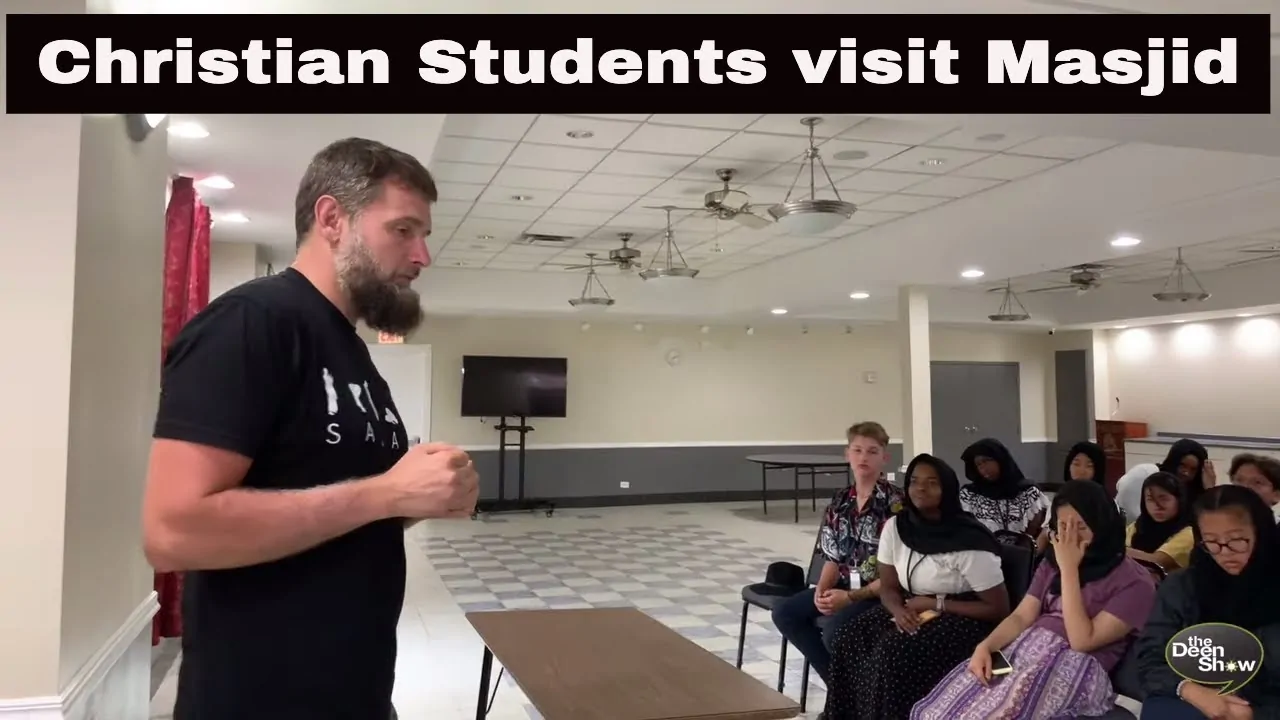
When a group of Christian students were asked how many felt nervous walking into a mosque for the first time, roughly half raised their hands — an honest reaction shaped by years of sensationalist media and cultural misunderstanding. That candid moment became the opening to one of the most grounded, accessible conversations about Islam and faith that The Deen Show has produced. Host Eddie wasted no time redirecting that nervousness into genuine inquiry: what is a mosque, what do Muslims actually believe, and why does it matter? The mosque, he explained, is simply a house of worship — a place where Muslims come to connect with the one God, the one Creator. And the faith itself begins with the most human of questions: what is my purpose, and why am I here?
What It Means to Be a Muslim: Submission, Purpose, and the Original Way of All the Prophets
Eddie opened with a deceptively simple observation: every object around us — from keys in your pocket to the eyelashes above your eyes — has a purpose. If all of creation is purposeful, the human being cannot be the exception. Islam answers this directly. The word Muslim means one who submits his or her will to the will of the Creator, and Islam means the peace acquired through that submission. This was not a religion invented in seventh-century Arabia — it is the original way God called every prophet, from Adam to Abraham to Moses to Jesus (peace be upon them all), to worship the One God alone. When any generation drifted from that message, God, out of His mercy, sent another messenger — not with a new religion, but with the same eternal truth: worship the Creator, without partners, without rivals. Eddie drew a striking parallel: Moses said “Hear O Israel, the Lord thy God is one,” Jesus reiterated the same commandment, and Prophet Muhammad ﷺ brought the identical message — a continuous, unbroken thread of divine guidance to all of humanity, regardless of race or nationality.
- Islam means peace through submission — surrendering one’s will to God brings the spiritual peace (salaam) the soul is designed for, not restriction.
- Every prophet carried the same message — Moses, Jesus, and Muhammad ﷺ all called to the worship of one God; the Quran echoes the Shema of Moses and the greatest commandment affirmed by Jesus.
- Muslims are not an ethnic group — Arabs represent only 12–13% of the global Muslim population; Islam has always been a universal message, not a cultural one.
- Submission is active, not passive — being a Muslim means choosing God’s guidance over personal desire, and living with moral integrity in business, family, and every human interaction.
- Islam provides a complete blueprint for life — from the five daily prayers that anchor the believer in constant remembrance of God, to fasting in Ramadan, to the once-in-a-lifetime Hajj pilgrimage, the faith structures an entire life of purposeful worship.
“A Muslim is literally one who submits his or her will to the will of the Creator — meaning, I’m going to do what God wants me to do. And Islam means to submit your will to the will of God. This is what gives you peace — peace acquired by submission to the will of God.”
— Eddie, The Deen Show
The Quran’s Divine Origin: Evidence, Logic, and the Challenge That Has Never Been Met
For those approaching Islam with intellectual curiosity, the episode addresses the most important question directly: how do we know the Quran is from God? Eddie laid out a clear, logical framework. The Quran issues its own falsification test — challenging any doubter to produce even one chapter like it, with all helpers and collaborators combined. The possibilities narrow to four: it was authored by Prophet Muhammad ﷺ (impossible, given he was unlettered, and known by his own people as Al-Amin — the Truthful, the Honest); it was produced by a group of human scholars (no assembly of the finest minds in history has met the challenge across fourteen centuries); it came from the devil (the book calls to monotheism, righteousness, and every noble virtue — the polar opposite of what evil invites); or it is, as it claims, the verbatim word of God Almighty, preserved in its original Arabic, unchanged, a direct address from the Creator to every human being who opens it. The episode also addressed the question of Biblical reliability with intellectual honesty — noting that leading scripture scholars, not just Muslims, acknowledge the anonymous authorship of the Gospels and the absence of original manuscripts. This is not presented as an attack on Christians, but as the context for why God sent the Quran as a preserved, universal scripture — a final guidance for all of humanity to examine with sincerity and logic.
“Do they not reflect over the Quran? Had it been from other than Allah, they would have found in it many contradictions and discrepancies.” — Quran 4:82, as recited and explained in this episode
What makes this encounter remarkable is not only its theological depth but its spirit. The Christian students who visited the mosque left with something unexpected: not pressure, but an invitation — to think, to read, to ask God sincerely for guidance. Eddie’s closing message was drawn from a hadith of the Prophet Muhammad ﷺ: that one is not a true believer until he loves for his brother and sister in humanity what he loves for himself. That is the foundation of genuine interfaith encounter — not debate for its own sake, but sincere concern for one another’s wellbeing and spiritual truth. Islam does not ask the seeker to abandon reason. It asks them to pick up the Quran, approach it as a potential book from the Creator of the heavens and the earth, reflect with an open and humble heart, and let the evidence speak. The mosque visit that once felt frightening became, for many of those students, a bridge to understanding — a first step toward the most important conversation a human being can have. That bridge begins with a single honest question: what is my purpose, and have I truly, sincerely sought the answer?