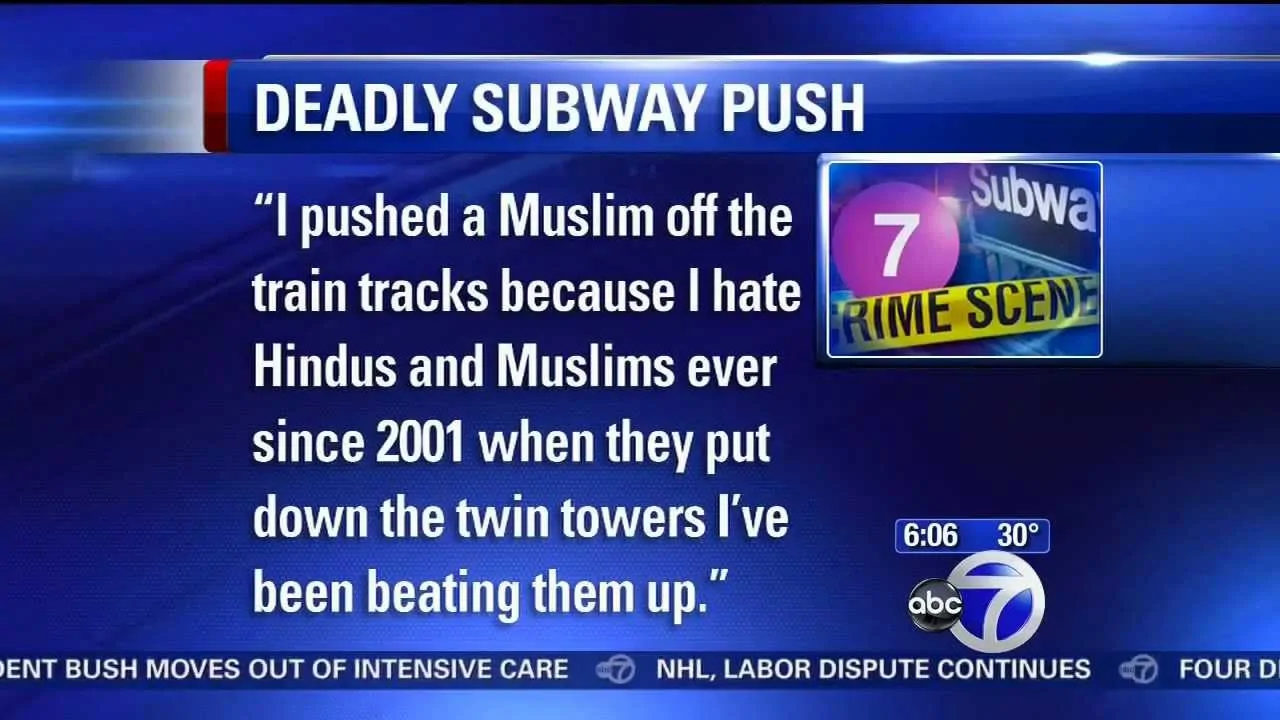
On a cold December evening in 2012, 46-year-old Sunando Sen — a quiet Indian immigrant living in Queens, New York — was waiting for the number seven train at the 40th Street station in Sunnyside when a stranger walked up behind him and shoved him onto the tracks. He was killed instantly. The woman charged with his murder, 31-year-old Erica Menendez, reportedly confessed to police with chilling clarity: “I pushed a Muslim off the train tracks because I hate Hindus and Muslims ever since 2001 when they put down the Twin Towers.” The tragic irony — that her victim was Hindu, not Muslim — speaks to the blinding, indiscriminate nature of Islamophobia: it does not stop to ask questions, it simply destroys. For American Muslims and the broader faith community, this act of hatred was not an isolated incident but a horrifying symptom of a much wider epidemic of anti-Muslim sentiment that had been building for over a decade.
A Pattern of Anti-Muslim Violence Across America
The subway murder was the most visceral expression of a disturbing trend documented by the Council on American-Islamic Relations (CAIR) throughout 2012. The same year saw a cascade of anti-Muslim hate incidents that together painted a portrait of a community under sustained threat — physically, rhetorically, and spiritually. These were not random aberrations; they were part of an organised and escalating climate of hostility directed at Islam and its followers, fuelled by a small but vocal minority of Islamophobes with platforms and reach.
“We again urge our nation’s leaders to speak out forcefully against the rising level of anti-Muslim hate in American society that is being fuelled and exploited by a vocal minority of Islamophobes.” — CAIR-NY Executive Director Muneer Awad
- A New York man of Afghan heritage was stabbed multiple times outside a mosque by an attacker shouting anti-Muslim slurs, who told witnesses he “doesn’t like Muslims.”
- Two teenagers beat a 70-year-old man in Queens after asking whether he was Hindu or Muslim — demonstrating that the hatred extends beyond Muslims alone to all perceived as “other.”
- An Indiana man pleaded guilty to intentionally setting fire to a mosque in Toledo, Ohio — an act of arson against a house of worship and the community it shelters.
- A man entered a mosque in Fremont, California, claiming to have a gun and threatening to kill everyone inside.
- In San Antonio, Texas, a man was arrested after threatening to “shoot as many people as possible” at a local mosque.
- White supremacists in New Jersey faced hate crime charges for attacking men of Egyptian descent, writing online that they went to “hunt down” Muslims.
- A designated hate group led by blogger Pamela Geller placed Islamophobic advertisements in New York’s subway stations — the very same stations where Sunando Sen lost his life — with CAIR raising concerns that such ads could directly incite violence.
Islam, Justice, and the Call for Moral Courage
CAIR, America’s largest Muslim civil liberties and advocacy organisation, submitted written testimony to a Senate hearing on hate crimes and domestic extremism, and published a landmark report — Thirteen Days in Ramadan 2012 — documenting a sharp spike in anti-mosque incidents during the holiest month of the Islamic calendar. The report and the Senate testimony together made undeniable what many in the Muslim community had long experienced: that anti-Muslim bigotry was not merely a social discomfort but a genuine threat to the safety and spiritual wellbeing of millions of American Muslims. Islam teaches that the sanctity of human life — every human life — is among the highest of divine trusts. “Whoever kills a soul, it is as if he had slain mankind entirely,” the Qur’an reminds us (5:32). The murder of Sunando Sen, a man of faith himself, stands as a sobering reminder that hatred — once given room to breathe — does not discriminate.
“No person should go out and randomly start targeting groups and trying to kill somebody. It’s very sad.” — Pedro Mendes, family friend of the accused
The community response to this tragedy — candles and roses placed quietly at the station platform, interfaith condemnation, CAIR’s calls for political and religious leaders to speak with moral clarity — reflects something essential about the Islamic values of justice (adl), mercy (rahma), and standing firm against oppression (zulm). The struggle against Islamophobia is not only a legal or political one; it is a deeply spiritual one, rooted in the conviction that every human being carries a divine dignity that no ideology of hate can extinguish. For Muslims navigating their faith in the West, this moment called — and continues to call — for patience, courage, and unwavering commitment to truth. Speaking out, bearing witness, and refusing to let hatred go unchallenged are not merely civic duties; in the tradition of the Prophet ﷺ, they are acts of worship.