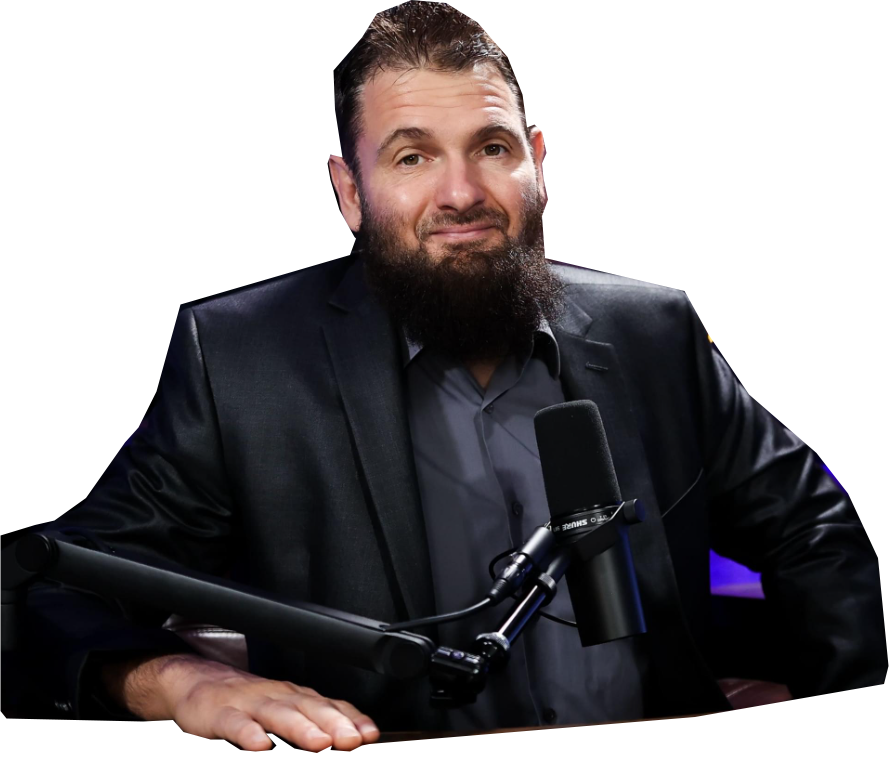

When God Almighty, in His infinite mercy, sent messengers throughout history — Abraham, Moses, David, and Jesus (peace be upon them all) — He accompanied each with divine revelation as guidance for humanity. Muslims believe in those original scriptures. But the central question examined in this episode is whether the Bible as it exists today is that preserved, unaltered Word of the Creator — or whether it has undergone significant change, addition, and compilation over centuries. To answer this with academic rigour and spiritual honesty, The Deen Show brought back Dr. Jerald Dirks: a Harvard Divinity School Master of Divinity graduate, former ordained minister of the United Methodist Church, and a scholar who, after years of deep study, embraced Islam in 1993. His journey is remarkable — not despite his deep knowledge of Christian scripture, but in many ways because of it. What he learned in seminary, and what mainstream biblical scholars across Christianity openly acknowledge, raises serious and unavoidable questions about the Bible’s authorship, canon, and textual integrity.
A House Divided: Which Bible Are We Actually Talking About?
- Protestant Old Testament: 39 books — the baseline most people in the West are familiar with.
- Roman Catholic Old Testament: Adds 1 & 2 Maccabees, Tobit, Judith, Ecclesiasticus, Wisdom of Solomon, and Baruch, plus additions to Daniel and Esther.
- Greek Orthodox Old Testament: Extends further still — includes a 151st Psalm, additional material in Jeremiah absent from Protestant and Catholic Bibles, and books like 3rd and 4th Maccabees and the Prayer of Manasseh.
- Ethiopian Orthodox Old Testament: Approximately 46 books, including Jubilees, Ethiopian Enoch, Pseudo-Josephus, and the Ezra Apocalypse — texts not found in any other tradition’s Bible.
- New Testament disagreements: Protestants, Catholics, and Greek Orthodox agree on 27 books; the Coptic Orthodox Church adds 1st and 2nd Clement (29 books); the East Syrian (Nestorian) Church omits 2nd Peter, 2nd and 3rd John, Jude, and Revelation; the Ethiopian Orthodox Church recognises 35 New Testament books, including titles found in no other denomination’s canon.
“Christianity has never agreed as to what constitutes the Bible — not the Old Testament, and not the New Testament.” — Dr. Jerald Dirks, former ordained United Methodist minister and Harvard Divinity graduate
Unknown Authors, Broken Chains: The Authorship Crisis Scholars Acknowledge
Even setting aside which books belong in the Bible, there is the graver question of who actually wrote them — and whether their accounts can be traced and verified. The five books traditionally attributed to Moses (peace be upon him) — Genesis, Exodus, Leviticus, Numbers, and Deuteronomy — are today understood by mainstream biblical scholarship to be compiled from four distinct source documents: “J” (written around 950 BCE), “E” (around 750 BCE), “D” (600s BCE), and “P” (400–500s BCE). By biblical chronology, Moses lived between approximately 1600 and 1200 BCE, meaning the earliest of these source texts was composed at minimum 250 years after him. The Torah as we have it today was most likely compiled during the Babylonian captivity and finalised around 400 BCE — the very text Ezra brought back to Palestine, according to scripture itself. The New Testament is no more secure. The Gospel of Matthew was written around 80–85 CE, is itself a compilation of earlier sources including documents scholars label Q, Proto-Mark, and M, and the first historical mention linking the disciple Matthew to a gospel comes from around 120 CE — decades after the gospel was already written. The other three gospels face the same authorship uncertainty. Even within the letters of Paul, books like Hebrews are widely agreed by scholars not to have been authored by him, despite tradition claiming otherwise. This stands in stark contrast to the Islamic methodology of preserving the sayings of the Prophet Muhammad ﷺ through the science of hadith — where every narration carries a complete chain of transmission (isnad), with narrators whose biographies, memory, character, and physical proximity to one another are meticulously documented and verified.
- The four source texts behind the Torah (J, E, D, P) were all composed centuries after Moses (peace be upon him), with the earliest dating to at least 250 years after his lifetime.
- The Gospel of Matthew was written approximately 50 years after Jesus (peace be upon him), is not in Hebrew as the earliest claim about Matthew suggested, and is a compilation of earlier unnamed source documents.
- The majority of Old Testament books have anonymous or unknown authors; legendary attributions from the Jewish Talmud are not accepted by modern biblical scholarship.
- Islamic hadith science, by contrast, requires a full, verified chain of narrators — each cross-referenced biographically — as a prerequisite for accepting any report as authentic.
Documented Alterations: Cases Where We Know What Was Added, When, and Why
The most striking evidence is not abstract — it comes in the form of specific, documented additions to the Biblical text where scholars can trace precisely when a passage was inserted, where, and the theological motivation behind it. The Trinitarian proof-text in 1 John 5:7–8 reads in the King James Version: “For there are three that bear record in heaven: the Father, the Word, and the Holy Ghost, and these three are one.” This passage, read by many as the clearest Biblical basis for the doctrine of the Trinity, does not appear in the earliest Greek manuscripts. In the New Revised Standard Version — which draws from earlier manuscript sources — the same verse reads simply: “There are three that testify: the spirit and the water and the blood.” Dr. Dirks confirms the additional Trinitarian language was inserted around 380 CE in a Spanish manuscript, later entered Jerome’s Latin Vulgate, and from there found its way into the King James Version. The ending of the Gospel of Mark is similarly compromised: the earliest manuscripts end at chapter 16, verse 8, yet later copies continue through verses 9 to 20 — describing resurrection appearances of Jesus — in what is universally acknowledged as a later addition. The famous story of the woman caught in adultery in the Gospel of John, where Jesus says “Let he who is without sin cast the first stone,” does not appear in the earliest manuscripts of that gospel at all. Even the genealogy of Jesus in Matthew chapter 1 — where the author explicitly claims 14 generations in each of three sets from Abraham to the Messiah — yields only 13 generations when actually counted in one of the three sets. These are not sectarian talking points. They are acknowledged by mainstream biblical scholars across denominational lines, and they were standard curriculum in Dr. Dirks’ Harvard seminary education.
“What we have in the gospels is basically Hadith — but without the provenance.” — Dr. Jerald Dirks
None of this is presented in a spirit of hostility toward sincere Christians or toward the people of the Book. The Quran itself honours Jesus, Moses, and Abraham (peace be upon them all) as noble prophets and messengers, and affirms that God did indeed send divine guidance through them. What this conversation invites is honest inquiry — the kind Islam consistently encourages through reason, reflection, and the use of one’s God-given intellect. The Quran, which remains memorised word-for-word by millions of Muslims across the globe in the same Arabic in which it was revealed over 1,400 years ago, stands as a living testimony to what preserved divine guidance actually looks like. Dr. Dirks himself — after years of the most rigorous academic engagement with Christian scripture — found that path of inquiry leading him to Islam, as have many sincere seekers before and after him. The practical advice he leaves viewers with is simple and profound: study carefully, don’t read on automatic pilot, ask the serious questions about your purpose and your Creator, and humble yourself before the One who knows what lies deep in your heart. If you sincerely seek truth, guidance is a promise from the One who created you.