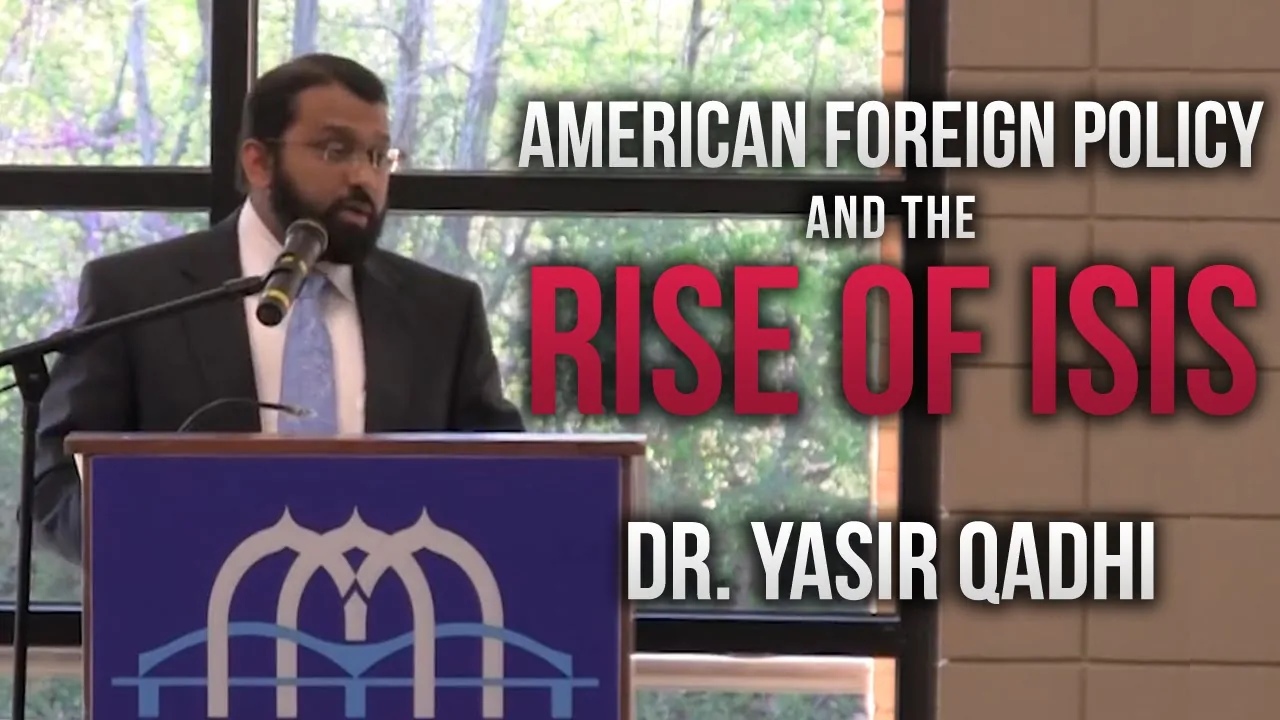
When ISIS burst onto the global stage and declared a caliphate in June 2014, capturing a city the size of Memphis almost overnight, political analysts and security experts were left scrambling for answers. In a landmark talk delivered to a non-Muslim audience in Memphis, Tennessee, in March 2015, Shaykh Dr. Yasir Qadhi offered what few public figures were willing to provide: a frank, academically grounded examination of both the theological bankruptcy of ISIS and the geopolitical conditions that allowed such a group to take root. His analysis cut in two directions simultaneously — challenging the distorted Islam of ISIS from within the tradition, while holding American foreign policy to account for decades of decisions that turned a once-thriving Iraq into fertile ground for extremism. This is not a comfortable conversation, but it is a necessary one.
What ISIS Actually Represents — and What It Does Not
One of the most persistent misconceptions in Western discourse is that ISIS represents something authentically Islamic — a claim Shaykh Dr. Yasir Qadhi systematically dismantles. ISIS, originally al-Qaeda in Iraq (AQI), broke from al-Qaeda around 2008–2009 over theological and methodological disputes. Despite its self-declared global caliphate and the call issued to the world’s 1.6 billion Muslims to pledge allegiance, the response was, in statistical terms, negligible. Roughly 20,000 fighters answered the call — approximately 0.00125% of the global Muslim population. By comparison, the Ku Klux Klan — which also claimed deep Christian identity and biblical sanction — had 4 million paid members in 1920s America, representing 3.8% of the US population at the time. The claim that ISIS defines Islam is mathematically 3,500 times less defensible than claiming 1920s America was a KKK society. The Muslim world’s response to ISIS has been overwhelming rejection: over 120 of the world’s foremost Islamic scholars signed an open letter — the “Letter to al-Baghdadi” — systematically refuting ISIS’s jurisprudence, its interpretation of jihad, its treatment of minorities, and its self-appointed authority. Grand muftis across every Muslim-majority country have publicly condemned it. Not a single credentialed, trained Islamic scholar of established reputation has ever joined or sanctioned ISIS — a pattern that mirrors what would happen if a newly graduated medical student declared all practicing neurosurgeons were wrong. The Yazidis, a community with Islamic cultural roots who had lived peacefully within Muslim civilisations in Iraq for over 800 years — including through 550 years of the Abbasid Caliphate — were never persecuted until ISIS arrived. That historical fact alone demolishes any claim that ISIS behaviour is rooted in the Islamic tradition.
“Is ISIS Islamic? If you’re using ‘Islamic’ as a noun — yes, these are Muslims claiming to act in the name of Islam. If you’re using it as an adjective — are they embodying what mainstream Muslims around the globe view as Islamic? Then the answer is a resounding no.” — Shaykh Dr. Yasir Qadhi
- ISIS is an ideological aberration: no established Islamic scholar of credibility has ever joined or legitimised the group
- Over 120 global Islamic scholars signed an open rebuttal of ISIS’s theology — translated into multiple languages
- Only ~0.00125% of the world’s 1.6 billion Muslims responded to ISIS’s global call to arms
- The Yazidis lived safely within Muslim-majority Iraq for 800 years — until ISIS, not Islam, threatened them
- Mainstream Islam has never, in 14 centuries, produced a caliphate with the level of barbarity displayed by ISIS
The Geopolitical Conditions That Allowed Extremism to Flourish
Understanding why ISIS gained any traction at all requires an honest accounting of what happened to Iraq over three decades. In the 1970s and early 1980s, Iraq was among the most developed nations in the Arab world — high female literacy rates, a University of Baghdad regarded as the most prestigious in the Middle East, a health system envied by neighbouring countries. Then came the Iran-Iraq War, which the United States actively fuelled by arming Saddam Hussein while ignoring mass human rights violations, including the chemical gassing of Kurdish civilians. After Iraq’s 1990 invasion of Kuwait, the United States led Gulf War I, which destroyed power infrastructure across the country, killing an estimated 100,000 Iraqis. This was followed by a 13-year comprehensive economic embargo that caused per capita income to collapse from $3,510 in 1989 to just $450 by the mid-1990s. UNICEF estimated that at least 500,000 children under five died as a direct consequence. Three senior United Nations diplomats — an Irishman, a German, and a WHO representative — resigned in succession, unable to continue administering what they described as policies violating the Geneva Convention. Then came the 2003 invasion of Iraq, justified through what a 2004 Congressional hearing documented as over 275 instances of what it called “blatant misinformation” — a diplomatic euphemism for deliberate deception. Physicians for Social Responsibility, partnering with the Nobel Prize-winning International Physicians for the Prevention of Nuclear War, concluded that the cumulative death toll attributable to US military action in Iraq over twelve years reached approximately 1.3 million people — likely closer to 2 million. This is not a justification for terrorism. Explaining context is not the same as offering excuse. Just as no one attributes the disproportionate incarceration rates among African Americans to inherent character flaws — but rather to centuries of structural deprivation, poverty, and systemic inequality — the conditions of Iraq cannot be ignored when asking how a group like ISIS found any audience at all.
“I refuse to continue to take Security Council orders — the same Council that imposed and sustained genocidal sanctions against the innocents of Iraq. I did not want to be complicit. My conscience would not allow this.” — Dennis Halliday, UN Humanitarian Coordinator for Iraq, upon his resignation after 35 years of service
The lesson Shaykh Dr. Yasir Qadhi draws from this history is neither anti-American nor pro-extremist — it is a call to intellectual honesty in the service of genuine peace. A faith as rich, textured, and spiritually profound as Islam — a guidance that has nourished civilisations for 14 centuries — cannot be reduced to the actions of a fringe group whose theological credentials are non-existent and whose emergence can only be understood through the lens of devastated infrastructure, mass civilian death, and geopolitical betrayal. True spirituality, rooted in divine guidance and prophetic example, has always stood against oppression in all its forms — whether that oppression is cloaked in the language of religion or the language of national interest. For Muslims in the West and non-Muslims seeking honest understanding alike, this conversation demands more than outrage at headlines. It demands the courage to hold complexity, to condemn terrorism absolutely while refusing to be incurious about its conditions — and to pursue, with sincerity and purpose, a world in which the despair that feeds extremism finds no purchase.