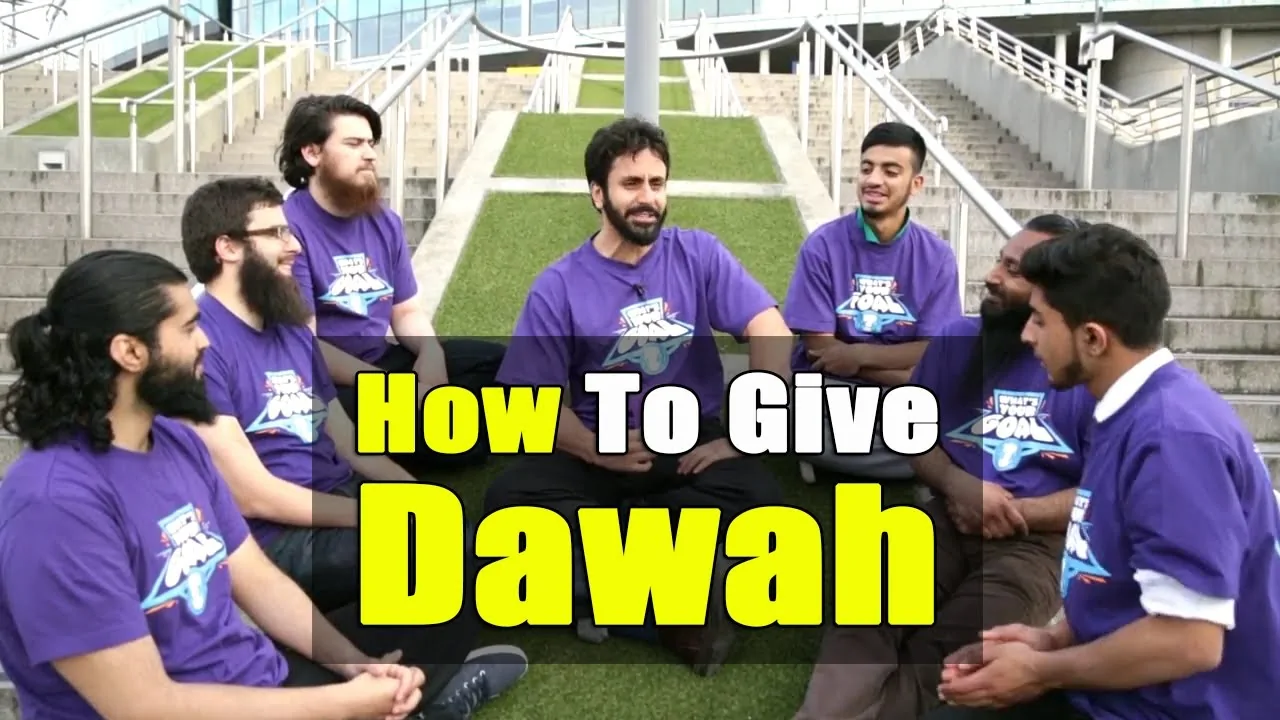
Da’wah — calling people to Islam — is not merely a religious obligation; it is the very mission entrusted to every Prophet and inherited by every sincere Muslim. The Prophet Muhammad ﷺ said: “Convey from me even if it is (only) one ayah” (Bukhari, 3461). Yet for many Muslims, dawah feels daunting — fraught with hard questions, hostile reactions, and the fear of saying the wrong thing. This episode cuts through that anxiety with a practical, principled framework grounded in the Qur’an and Sunnah: how to carry the message with the right state of heart, how to turn even the most uncomfortable question into a doorway to tawheed, and how to present Islam as a faith that satisfies both the intellect and the soul.
Cultivating the Mindset That Makes Dawah Work
Before a single word of Islam is spoken, your character is already speaking. Human beings are mirrors of one another — if you smile, people smile back; if you approach with warmth, warmth returns. This is not a social technique; it is the sunnah. The Prophet ﷺ smiled in the face of adversity, and that composure was itself a form of dawah. Beyond the smile, the speaker identifies several core mindset principles that separate effective callers to Islam from those who generate friction rather than connection:
- Speak to everyone as you would speak to your own mother — with genuine care, patience, and full respect.
- Treat others as if they are better than you — because you do not know how Allah will judge either of you in the end; humility unlocks connection that confidence alone never can.
- Never pre-frame people based on past negative experiences — Allah has the totality of knowledge; we only have the pixel, not the picture (Qur’an 2:30).
- Enrol people in your behaviour before expecting them to accept your message — become the state of character you want others to adopt.
- Replace defensiveness with dialogue — when faced with mocking or provocative questions about Islamic practice, resist the urge to debate surface details; use every question as a doorway into explaining the concept of Islam.
“Invite (mankind, O Muhammad) to the way of your Lord with wisdom and fair preaching, and argue with them in a way that is better. Truly, your Lord knows best who has gone astray from His path, and He is the Best Aware of those who are guided.” — [Al-Nahl 16:125]
From Awkward Questions to the Roots of Faith: The Initiation Method and the Case for Islam
Whether someone asks why your wife wears hijab, why you prostrate in prayer, or repeats a baseless slander about Muslims, the same principle applies: do not get lost in the branches — give them the roots. A technique called initiation channels any question back toward the foundational concept of Islam: “Before I can answer that properly, I need to explain what Islam actually is — do you have a few minutes?” This reframes the conversation from surface-level controversy to the heart of faith. From that foundation, the dawah unfolds across three intellectual pillars that address both the mind and the fitra — the innate human recognition of truth:
- God’s Existence: The universe began — so what caused it? Only four logical possibilities exist: it came from nothing (impossible — nothing produces nothing); it created itself (logically incoherent — something cannot exist and not exist simultaneously); it was created by another created thing (this leads to an infinite regress of causes, which can never produce an actual effect); or it was created by an Uncreated Creator — the only rational conclusion, and the one that makes sense of Allah.
- God’s Oneness (Tawheed): This Uncreated Creator must be eternal, all-powerful, all-knowing, and entirely distinct from His creation. Even our own self-love points us toward loving and worshipping Him — He created us, sustains us, and is the ultimate source of love itself (Al-Wadud). True freedom comes only by choosing to submit to the One who made you, rather than remaining enslaved to the countless lesser masters — culture, materialism, ego, and the approval of others.
- The Qur’an as Divine Revelation: Three lines of evidence converge: (1) the linguistic miracle — the finest Arab linguists of the 7th century, masters of the Arabic tongue, could not produce a single chapter like it, and no one has in 1,400 years since; (2) historical precision — the Qur’an correctly uses “Malik” (King) for the Egyptian ruler at the time of Yusuf ﷺ and “Fir’awn” (Pharaoh) at the time of Musa ﷺ, a distinction unknown to the Bible or Torah and confirmed only centuries later by the Rosetta Stone; (3) its multi-layered, timeless address — it speaks meaningfully to the 7th-century Arab, the 15th-century scholar, and the 21st-century sceptic alike, because it comes from the One who created them all.
- Plant seeds — and trust Allah to grow them: If someone resists an argument, do not get trapped in philosophical gymnastics. Rational arguments from the Qur’an and Sunnah exist to awaken the fitra, not to win debates. Agree to disagree, keep the conversation warm, and move on. We are farmers; it is Allah’s work to bring the fruit of iman.
“Whoever calls others to guidance will have a reward like the rewards of those who follow him, without that detracting from their reward in any way.” — [Narrated by Muslim, 2674]
At its heart, dawah is an act of love — love for fellow human beings who, beneath the noise of culture and confusion, carry within them a deep yearning for truth, for God, for purpose. Every Muslim who engages with patience, sincerity, and humility is walking the path of the Prophets — bearing what the Messenger ﷺ bore, with a fraction of his grace and a portion of his reward. You are not responsible for changing hearts; that belongs to Allah alone. Your responsibility is to carry the message beautifully, to embody what Islam looks and feels like when it is genuinely lived, and to trust that the seeds you plant today — in a bus queue, at a community stall, or in a quiet conversation over tea — may bear fruit in ways and seasons you will never see. May Allah purify our intentions, bless our tongues, and make us worthy bearers of His final, enduring message to humanity.