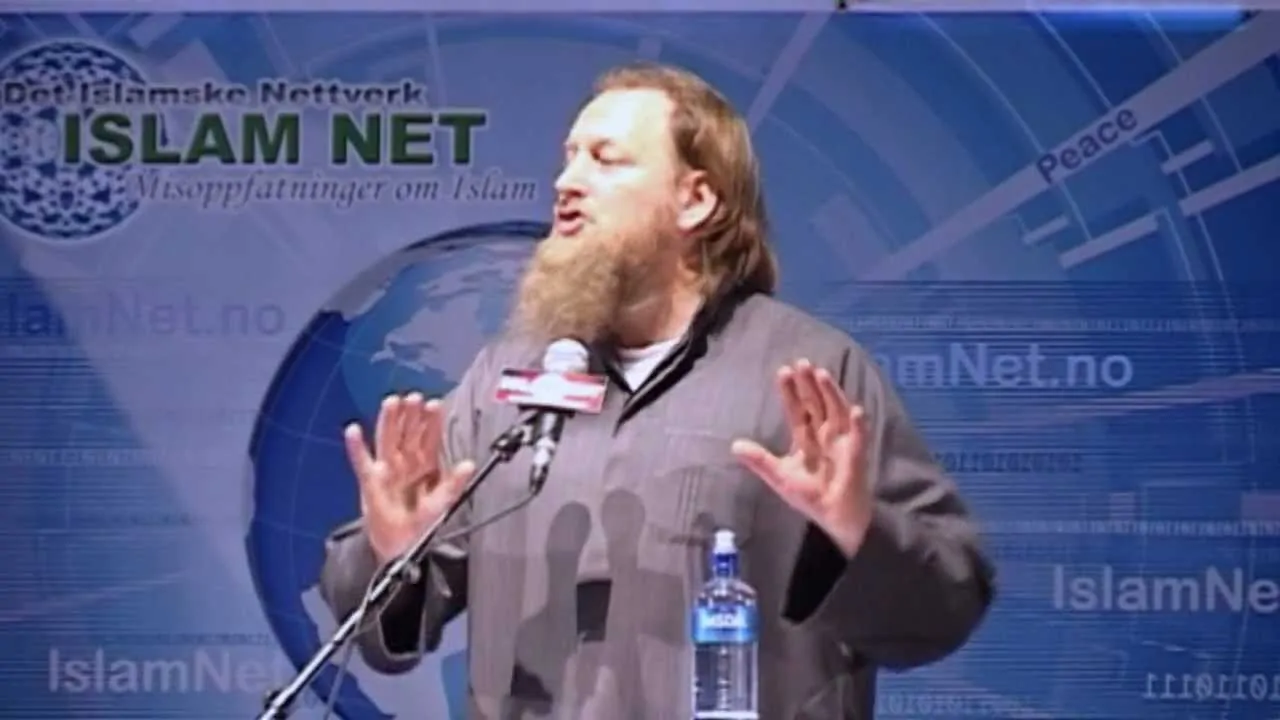
Every human being, at some point, confronts the same haunting questions: Why am I here? Is there a God? And if so, which religion — if any — is truly from Him? These are not peripheral questions; they are the most consequential a person can ask. Sheikh Abdul Rahim Green, a da’i who embraced Islam after encountering the Quran while pursuing a career in the City of London, argues with compelling clarity that Islam does not ask for blind faith — it demands reason. The very same logical faculties we use to evaluate any claim in daily life, he demonstrates, lead the honest, thinking person to one conclusion: Islam is the true religion of God, and the evidence for this is rational, verifiable, and profound.
The Universe as Proof: What Reason and Common Sense Tell Us About God
Sheikh Abdul Rahim Green opens his argument with a thought experiment as simple as it is devastating to atheism: imagine finding a mobile phone in the Saudi desert and being told it assembled itself over billions of years through random events — oil bubbling, sand shifting, lightning striking. No rational person would accept that claim. Yet this is precisely what some ask us to believe about the infinitely more complex universe and the life within it. Using what he calls the “gas meter test” — the basic human instinct to demand evidence before accepting any claim — he walks through the logical case for a Creator. The universe is ordered, systemised, and governed by precise laws. Order does not arise from chaos; design implies a designer. When we examine the fine-tuning of the cosmos — Earth’s exact rotation speed, the precise balance of atmospheric gases, the gravitational constant calibrated to a trillionth of a percentage — the rational conclusion is not random chance but intentional creation by a Being of supreme intelligence, power, and will. And since a Creator who is merely another part of the creation solves nothing — leading only to an infinite regress of creators creating creators — reason itself demands that this Creator be eternal where creation is temporary, infinite where creation is finite, and self-sufficient where creation is needy. There can only be one such Being.
- Human reason and common sense consistently show that order and design come from intelligence, not chance — no different from knowing a gas meter reader needs ID before you let him in.
- The “fine-tuning” of the universe — Earth’s rotation, ozone thickness, the strength of gravity — is so precise that any variation would make life impossible; this is not accident, it is design.
- The most primitive living cell is far more complex than any human-made technology; attributing its existence to random events is less rational than believing a mobile phone assembled itself in a desert.
- An infinite chain of creators-creating-creators produces nothing — like a chain of command that never stops escalating; there must be a stopping point, a First Cause that is uncaused.
- Logic therefore demands: the Creator is One, Eternal, Infinite, Unlimited by space and time, and utterly unlike anything in creation.
“It is reasonable to assume that where we see things working according to laws and according to patterns, something with intelligence, with power, with will has imposed those laws and those patterns. If the creation is temporary, the Creator must be Eternal. If the creation is finite, the Creator must be Infinite. If the creation is needy, the Creator must be Self-Sufficient — and logically, there can only be one such being.” — Abdul Rahim Green
Islam’s Concept of God: The Only Theologically and Philosophically Consistent Vision
Having established through reason that the universe must have a Creator who is One, Eternal, Infinite, and unlike anything in creation, the next logical question becomes: which religion actually teaches this concept of God without contradiction or compromise? Sheikh Abdul Rahim Green argues that Islam stands alone. Christianity uses the same rational arguments to establish God’s existence — but then asserts that Jesus, peace be upon him, who ate, breathed, was born, and died, is that same God. By the very logic used to prove God exists (the Creator must differ from creation), someone who is mortal, finite, and confined by space and time cannot be the Creator. Similarly, pantheistic systems that equate God with the creation — “you are God, the tree is God, everything is God” — offer no coherent evidence and dissolve under scrutiny; if God is everything, the concept of God becomes philosophically meaningless. Islam, by contrast, presents a vision of divinity that is both internally consistent and complete.
- Islam’s core declaration — La ilaha ill-Allah (There is no deity worthy of worship except Allah) — affirms God’s absolute Oneness and transcendence with no philosophical compromise.
- The Islamic concept of God perfectly matches what reason itself demands: One, Eternal, All-Powerful, Self-Sufficient, and unlike anything in creation (Surah al-Ikhlas 112).
- No other major religion maintains this pure monotheism without internal contradiction: Christianity introduces the Trinity and the Incarnation; pantheism dissolves God into creation; polytheism multiplies and limits divinity.
- Islam is addressed to all of humanity until the end of time — its message is universal, its guidance complete, and its God is not a national or tribal deity but the Creator of the heavens and the earth.
- The Islamic God is not a distant abstraction but the living, personal, All-Knowing Creator who communicates through revelation and guides those who sincerely seek truth.
The Quran: Divine Revelation and the Answers Reason Alone Cannot Reach
Reason can bring us to the threshold of God — but it cannot, on its own, tell us the purpose of life, what awaits us after death, or why suffering exists. Sheikh Abdul Rahim Green illustrates this with a striking image: a hidden room whose contents you cannot see or deduce from outside. The only reliable information about what is inside comes from someone with authoritative access. The same applies to the deepest questions of human existence — only the Creator Himself can answer them with certainty. Islam’s claim is that He did exactly that, through the Quran. And the Quran does not merely assert its divine origin — it offers evidence: a 1,400-year-old unmet literary challenge, internal consistency without a single contradiction across 23 years of revelation, and remarkable scientific foreknowledge confirmed centuries later by modern instruments. When Shaykh al-Zindani presented Quranic verses on embryonic development — describing in precise stages the formation of the human being inside “three veils of darkness” — to Professor Marshall Johnson, one of America’s leading scientists, the professor stood up in astonishment. After ruling out that the Prophet ﷺ could have had a microscope, and that the multi-stage descriptions could be coincidence, he reached his conclusion.
“There is no explanation except that this is revelation from above.” — Professor Marshall Johnson, American embryologist, upon hearing the Quranic description of human embryonic development, recounted by Shaykh al-Zindani
- The literary miracle (i’jaz): Allah challenges all of humanity and the jinn to produce even one chapter like the Quran — a challenge unmet for over 14 centuries, even by the most eloquent speakers of Arabic (Surah al-Baqarah 2:23).
- The absence of contradiction: a book revealed over 23 years in widely varying circumstances, yet entirely free of error or internal conflict — “Had it been from other than Allah, they would have found within it many contradictions” (Surah al-Nisa 4:82).
- The scientific foreknowledge: detailed descriptions of embryonic stages, internal ocean waves invisible to the naked eye, and layered atmospheric darkness — facts confirmed only in the 20th century — moved secular oceanographers and biologists to declare that “these cannot be the words of a human being.”
- The divine preservation: unlike previous scriptures left to human custodianship and subsequently altered, Allah Himself guaranteed the Quran’s preservation (Surah al-Hijr 15:9) — and it has been transmitted letter-perfect by thousands across every generation, with any alteration instantly detectable even by Muslim children.
- The self-rebuking verses: passages that openly correct the Prophet ﷺ himself (such as Surah al-Ahzab 33:37) — which he would surely have suppressed had the Quran been his own composition — stand as proof that its author is not a human being.
The question of whether Islam is the true religion of God is ultimately answered not by cultural inheritance or emotional comfort, but by the same careful, evidence-based reasoning we apply to any serious matter in life. From the rational necessity of a Creator deduced through the order of the cosmos, to the philosophically sound and uncompromised monotheism that Islam alone maintains, to the Quran’s layered and multiply-verified miracles, every line of sincere inquiry converges on the same answer. Reason brings us to God; revelation shows us who He is and why we are here. For the sincere seeker — whether a young Muslim woman standing firm in her faith in a town with no other hijab-wearing women, a City of London professional encountering the Quran for the first time, or anyone who has ever wondered what this life is truly for — Islam does not offer a leap in the dark. It offers a case: examined, tested across centuries, and found to stand. As Allah reminds those who reflect: “Indeed, in the creation of the heavens and the earth and the alternation of the night and the day are signs for those of understanding — those who remember Allah while standing, sitting, and on their sides, and reflect upon the creation of the heavens and the earth” (Surah Aal Imran 3:190-191). The invitation has never changed — and neither has the truth.