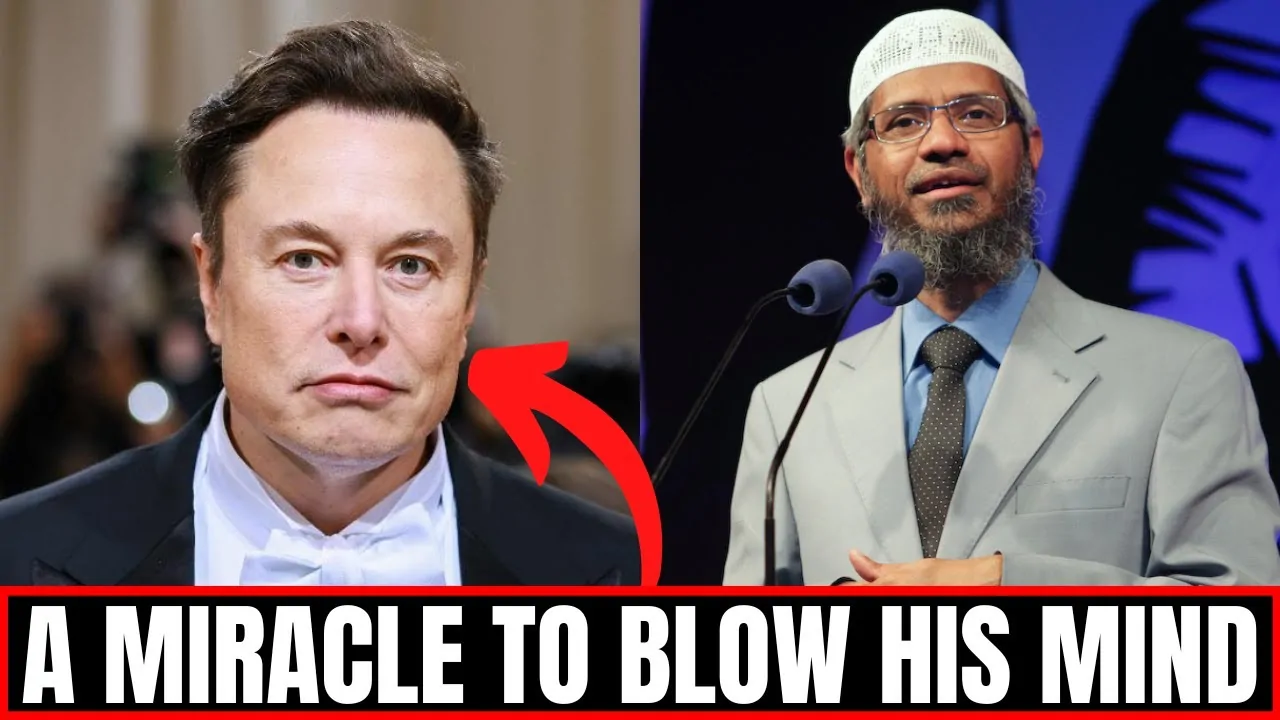
When Elon Musk was recently asked whether he believes in God, his answer surprised millions. The tech billionaire acknowledged that “something created the universe,” opening a door that scholars of Islam have been walking through for over 1,400 years. In a powerful reaction to Musk’s comments, Dr. Zakir Naik and dawah specialist Imran broke down exactly why the Quran holds the answers Musk is searching for — and why Prophet Muhammad (peace be upon him), an unlettered man from the Arabian desert, delivered scientific truths that modern science is only now confirming.
Elon Musk Admits Something Created the Universe
“Well something created the universe… you could say whatever caused the universe to come to be is God. I think what makes sense is to expand consciousness so that we’re better able to answer the questions of like what is the meaning of life, what is the nature of the universe.” — Elon Musk
This remarkable admission from one of the most influential minds of our time aligns directly with the foundational message of Islam: there is One Creator, and understanding His signs is the purpose of human consciousness. Dr. Zakir Naik pointed out that Musk is “a person of reasoning” and that Islam is uniquely positioned to answer his deepest questions because it does not ask anyone to abandon logic — it invites them to use it. Unlike theological frameworks that present God as a man or reduce divine miracles to party tricks, the Quran presents a Creator who is beyond human imagination, whose existence is proven through the very science Musk dedicates his life to.
How an Unlettered Prophet Spoke of Science 1,400 Years Ago
- The Big Bang in the Quran: Surah Al-Anbiya (21:30) describes the heavens and the earth as a single joined entity that was split apart — a description matching the Big Bang theory centuries before modern cosmology existed.
- All life created from water: The same verse states that every living thing was made from water, a biological fact only confirmed in the modern era.
- Over 700 verses on science: French surgeon Dr. Maurice Bucaille documented that more than 700 Quranic verses deal with modern science, and not a single one contains a scientific error.
- Prophet Muhammad could not read or write: The Quran itself (7:157) confirms he was an unlettered Prophet, making it impossible for these scientific revelations to have come from human study or borrowed knowledge.
“How can this person, 1,450 years back, talk about the Big Bang that you’re talking about now? There are more than 700 ayat of the Quran that science has agreed to be fact. Not a single scientific error in the Quran.” — Imran (IREF), reacting to Elon Musk’s statements
The Quran’s Jesus vs. the Bible’s Jesus: What Would Make Sense to Elon Musk
One of the most compelling points raised in the discussion was how Islam honors Jesus (peace be upon him) in a way that would resonate with a logical thinker like Musk. In Islam, the first miracle of Jesus was not turning water into wine at a party — it was speaking from the cradle as a newborn to defend his mother Mary’s honor (Quran 19:25-30). Muslims believe in the virgin birth, believe Jesus was the Messiah, and believe he performed miracles by Allah’s permission. In fact, Mary the mother of Jesus is mentioned more times in the Quran than in the entire Bible, and an entire chapter (Surah Maryam) is named after her. When Musk himself expressed discomfort with contradictions he found in Christian theology as a child — a God who “changes his mind from the Old Testament to the New Testament” — Islam offers the consistency and reason he was looking for. The Quran presents one unchanged message from the same God who sent every prophet, from Abraham to Moses to Jesus to Muhammad (peace be upon them all), calling humanity to worship the One true Creator alone.
Why Dawah to People Like Elon Musk Matters for the Muslim Ummah
- Dawah is the mission of every Prophet: Surah Al-Ma’idah (5:67) commands the propagation of Allah’s message — without it, the duty of messengerhood is unfulfilled.
- The Prophet emphasized outreach: In his last sermon, Prophet Muhammad (peace be upon him) instructed that those present must convey the message to those who are absent, even if they know only one thing about the faith.
- Influential voices carry weight: Just as the Prophet (peace be upon him) wished for influential leaders of Quraysh to embrace Islam for the benefit of the entire community, reaching thought leaders like Musk, Bezos, and Gates with the truth of Islam could open doors for millions.
- The Quran does the work: As emphasized in the episode, putting the right book — the Quran — into someone’s hands and letting them read it directly is one of the most powerful forms of dawah. The message speaks for itself.
The conversation between faith and science is not a conflict in Islam — it is an invitation. Every discovery Elon Musk and the scientific community make only confirms what the Quran revealed over fourteen centuries ago through an unlettered Prophet in the desert. If Musk is sincere in his search for meaning, the answers are waiting for him in the very book that has never been changed, never been contradicted by science, and never stopped transforming lives. As Muslims, our role is clear: convey the message with wisdom, kindness, and confidence, and trust that Allah opens the hearts He wills.