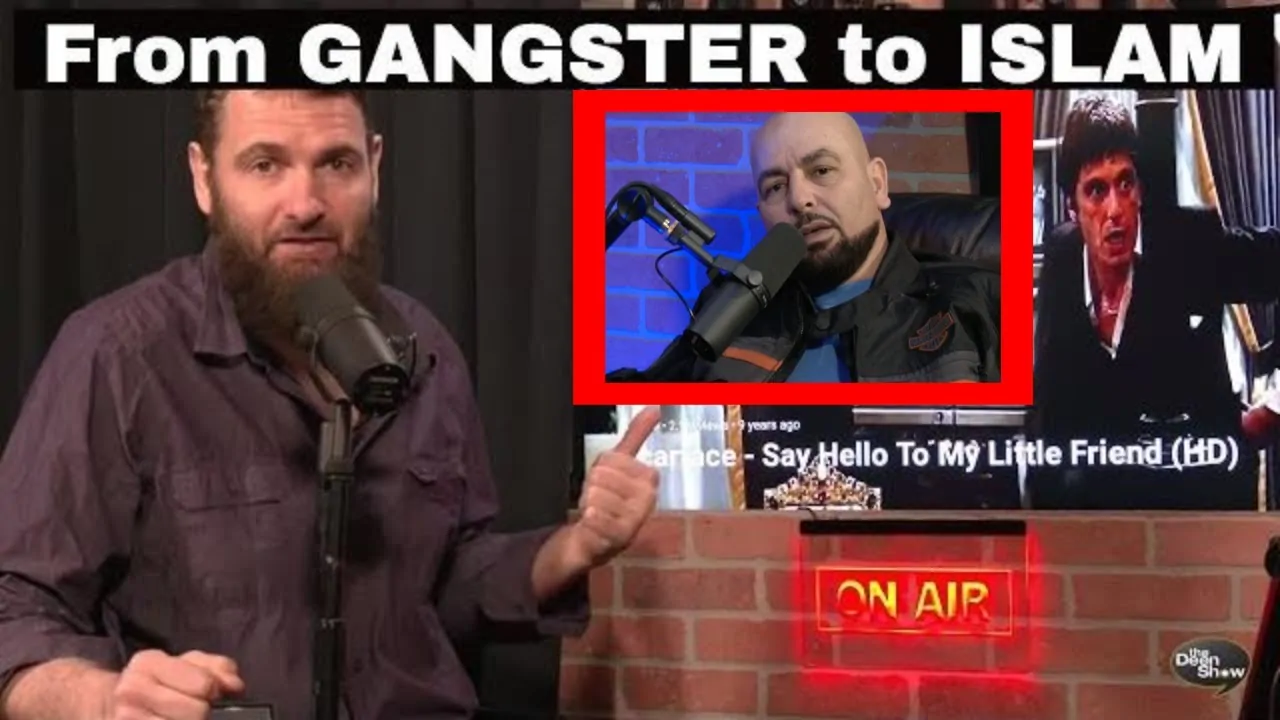
What does it take to walk away from millions of dollars, luxury cars, gang loyalty, and a life built on street power — and find something greater? Ahmet Sade’s story answers that question with raw honesty. Born in the Sheikh Jarrah neighbourhood of Jerusalem, less than a mile from al-Masjid al-Aqsa, Ahmet arrived in Chicago at age twelve without a father figure worth following, without Islamic education, and without a foundation. His communist father had banned faith from the household entirely. His mother — illiterate but deeply in love with Allah and His Prophet ﷺ — could not counter the pull of the streets. By 1982, Ahmet was neck-deep in gang life, seeking the belonging, respect, and love that his home had never offered. What follows is a story that every Muslim parent, every community leader, and every person chasing the wrong version of success needs to hear.
When Home Drives You to the Streets: The Roots of a Gangster’s Path
Ahmet is direct about what sent him into gang life: it was not Scarface, not rap music, not peer pressure in the abstract — it was misery at home. A violent, godless father had stripped the household of peace, and the gang filled the vacuum with something that felt, at the time, like love. By 1981 he was involved, by 1982 fully committed — shootings, drive-bys, and eventually state prison. Yet even behind bars, he found himself breaking bread with enemies, asking a question that would shadow him for years: why were we even fighting in the first place? The Prophet Muhammad ﷺ, as Ahmet later learned, warned that when the father fails in the household, it is as if the devil himself runs it. That hadith, discovered years after the damage was done, became one of the clearest lenses through which he understood his own childhood.
“The land is blessed — that does not mean the people are blessed. There could be somebody in the middle of New York, in the middle of Chicago, in a neighbourhood full of bars and nightclubs, who is far more spiritually elevated than many people in Jerusalem. It depends on what’s in the heart.”
- Growing up in Sheikh Jarrah, mere minutes from al-Aqsa, provided no automatic iman — faith must be actively taught and nurtured
- Nationalism replaced deen across much of the Arab world in that era; political identity crowded out Islamic identity
- Children driven out of broken homes do not disappear — they find communities willing to accept them, often gangs or worse
- The Prophet’s ﷺ guidance on fatherhood is not abstract theology; its absence plays out in real generational destruction
- Prison, paradoxically, can be a space of reflection — Ahmet began questioning the point of street rivalry while sharing meals with former enemies
The Void That Money Cannot Fill — and the Faith That Can
After prison, Ahmet did not return to gang-banging with the same intensity — but the drug trade pulled him back in. At its peak he was making twenty to thirty thousand dollars a day. Luxury cars, homes, hundreds of thousands in cash — and a hollow feeling that never left. He observed the same pattern in Hollywood: movie stars with more wealth than he ever accumulated, ending their own lives, permanently restless. The cycle, as he describes it, is endless: get the Rolls-Royce, immediately want the Lamborghini; accumulate power, immediately hunger for more. Islam did not enter his life as a poverty movement or an escape from ambition. He is clear that Islam does not forbid wealth or business — but that money without Allah as its foundation can become the very root of evil. What Islam gave him was not less, but rather a different kind of accounting — one that ends the chase and fills the gap that no car, no contract, and no status ever could.
“I am much happier now — with all my current struggles — than I was back then with all the luxuries. It does not fill the void. It does not fill the gap. That road never ends. The only thing that ended it for me was Islam and Allah.”
- Material acquisition follows a law of diminishing returns: each possession immediately creates desire for the next — Islam calls this hubb al-dunya, love of the world
- The glorification of the gangster lifestyle in popular culture (Scarface being a landmark example) functions as a false aspirational model with devastating real-world consequences
- Money anchored in iman becomes a tool for good — for family, charity, and halal enterprise; money without God becomes an idol
- Contentment (qana’ah) is an Islamic virtue precisely because it breaks the cycle Ahmet describes — sleeping well, waking well, dealing with hardship from a place of inner stability
- Ahmet is now training as a certified outreach worker, channelling his street credibility into steering young people away from the same path
Ahmet Sade’s journey from the alleys of Sheikh Jarrah to Chicago’s south side and eventually to the masjid is not simply a redemption arc — it is a warning, a mirror, and a mercy. His testimony dismantles the twin illusions that geography confers righteousness and that wealth confers peace. A man can be born in the shadow of al-Aqsa and lose everything for want of guidance; another can be raised in the most spiritually barren neighbourhood on earth and find his way to Allah. The difference, in both cases, is not location or money — it is the presence or absence of faith. For every parent watching their child edge toward the street, for every young person seduced by the glorified outlaw, and for every Muslim who has let dunya crowd out deen, Ahmet’s story is a living reminder that the void is real, that no amount of accumulation will fill it, and that the door of Islam — of return, of purpose, of genuine contentment — remains open.