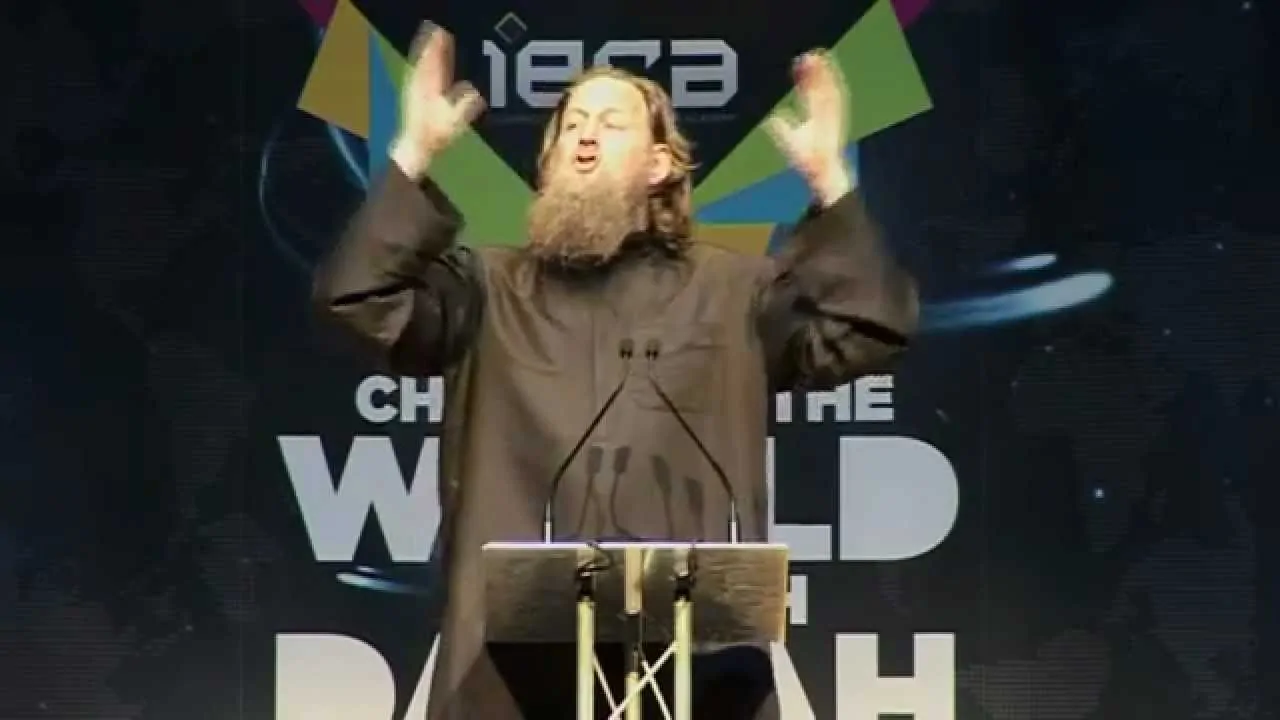
Over two decades of public dawah have given Abdurraheem Green a rare vantage point: he has seen what works, what fails, and — most critically — what Islam demands of every Muslim who draws breath on this earth. In this landmark talk delivered at the iERA “Changing the World Through Dawah” conference, Green strips away the comfortable excuses we construct and returns to a foundational truth: calling humanity to Allah is not optional outreach for the spiritually inclined — it is a binding obligation, inherited from the chain of prophets and now resting squarely on our shoulders. Drawing on his own conversion story, his years at Speaker’s Corner, and the Quran’s own structure as a dawah manual, he makes a case that cannot be easily dismissed.
Every Prophet’s Primary Mission — and the Inheritance We Have Accepted
The Quran, Green argues, is not merely a scripture of rulings and ritual — it is overwhelmingly a record of dawah in action. Ibrahim’s story is a story of dawah. Musa’s engagement with Pharaoh is dawah. Isa’s mission to the Children of Israel is dawah. Allah did not send a single messenger to any nation except to call the people to His worship and to reject the worship of false gods. Now that the seal of prophethood has closed with Muhammad ﷺ, no new messenger will come. The task — urgent, unfinished, global — has been transferred to the believing community. Green poses the question plainly: if there are no more prophets, on whose shoulders does the duty fall? The answer every Muslim already knows but often avoids: ours. He illustrates the danger of passive silence with a parable about a servant named Abdullah, dispatched by a king to announce his sovereignty over a distant land, who instead quietly settles into village life, opens a vegetable business, and hopes the people will somehow absorb the message through osmosis — without once delivering it. The question is pointed and personal: is that Abdullah us?
- Dawah is the dominant theme in the Quran’s stories of the prophets — not their personal worship in isolation, but their public calling to faith
- With the finality of prophethood, every Muslim inherits the responsibility to convey the message to humanity
- Calling people to Islam means calling them to Allah — not to a culture, ethnicity, or school of thought
- Knowledge must precede action: just as one learns salah before praying, one must study how to give dawah before engaging
- The Quran itself is the best manual for dawah — both as a practical guide answering every objection and as a source of spiritual motivation
- Supporting dawah organisations, attending retreats, and equipping new Muslims with knowledge are all part of fulfilling this communal obligation
“Let there arise out of you a band of people inviting to all that is good; enjoining what is right, forbidding what is wrong — they are the ones attaining success.” (Quran 3:104)
The Weight of Time, the Scale of Reward, and the Duty We Owe Our Neighbours
Green draws the listener’s attention to something most of us would rather not calculate: the proximity of death, and the brevity of everything between birth and the Day of Judgement. The Prophet ﷺ, gesturing toward a setting sun, said that the distance between his coming and the end of the world was like the remaining hours of that day — and that was 1,400 years ago. Our individual lives are even shorter. Against this urgency, Green places the extraordinary multiplication of reward that dawah carries: guide a single person to Islam, and every prayer they pray, every fast they keep, every act of charity they give, every child they raise who learns salah — all of it returns to the one who guided them, without diminishing their reward by an atom’s weight. The ripple extends to their children’s children and beyond. There is no deed with a comparable return. And beyond personal reward, Green frames dawah as a moral obligation toward neighbours, colleagues, and fellow citizens — people who, like us, descended from the same Adam and Eve, and who deserve at minimum to be warned. He uses the image of a vast labyrinth: billions running in confusion, searching desperately for a way out toward the palace on the hill — while the Muslim holds the map and says nothing.
“Whoever invites a person to a righteous action will receive the reward of that person acting upon it, without that person’s reward being diminished in the least.” (Prophet Muhammad ﷺ)
The talk ultimately ends not with a theory but with a call — the same call the Prophet ﷺ made from the top of Mount Safa when he first went public with Islam, addressing each tribe by name: I have come to warn you. Abdurraheem Green’s own journey — from a clumsy new Muslim in Portugal with only the Quran and Bertrand Russell for company, to one of the UK’s most recognisable voices for Islamic guidance and spirituality — is itself proof that dawah is learned, not innate, and that the capacity for it lives within every believer willing to acquire knowledge and take the step. The obligation is real, the time is short, and the reward is unlike anything else this brief life can offer. What remains is the decision each of us must make, in this moment, about how seriously we take the purpose for which Allah placed us here.