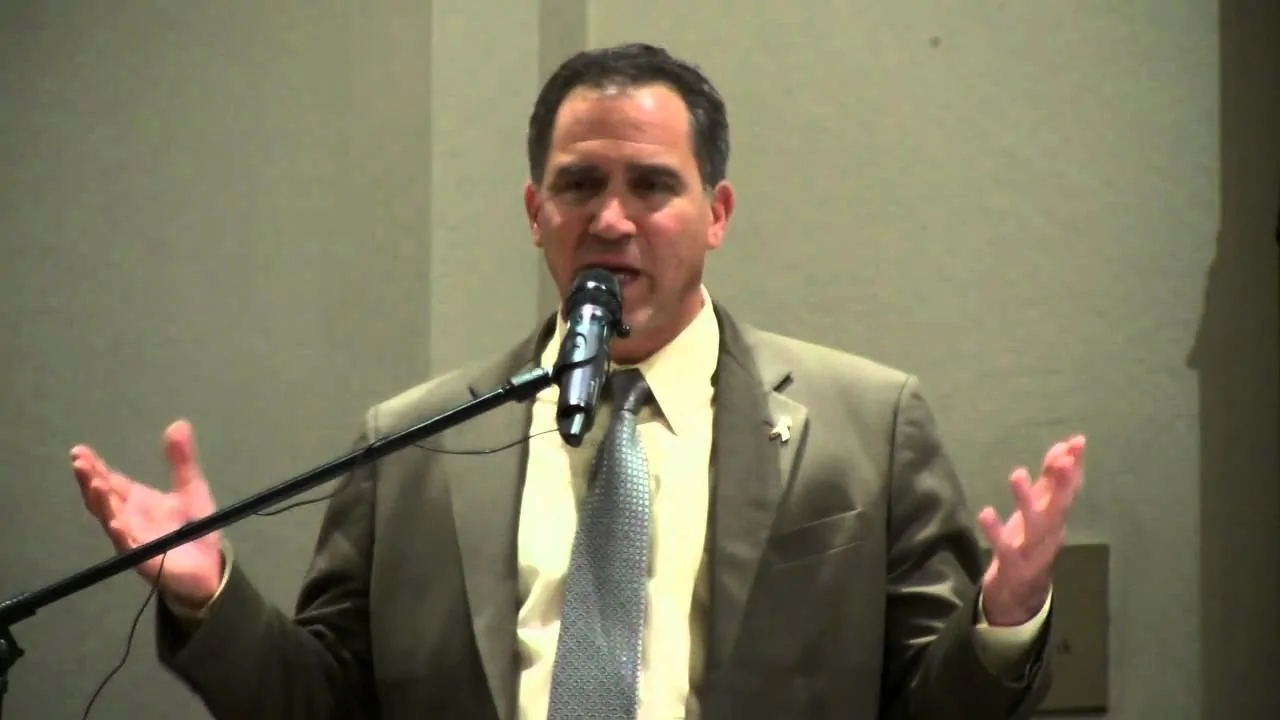
What does it mean to live inside a lie — to grow up believing a story about justice and homecoming, only to discover that the story was built on the bones of another people’s dispossession? Miko Peled, son of Israeli General Matti Peled and a product of Zionist education, has spent years confronting exactly that question. His memoir, The General’s Son: Journey of an Israeli in Palestine, is not a partisan polemic but a personal reckoning — a deeply human testimony that resonates with the Islamic principle of standing for truth even when it cuts against one’s own community. In a world where the suffering of Palestinians is routinely buried beneath myth and double standard, Peled’s voice carries a rare weight: the authority of a man raised at the very heart of the system he has come to challenge.
When the Official Story Collapses: Myths, Double Standards, and the Nakba
The first myth Peled dismantles is the one that frames the Israel-Palestine conflict as ancient, timeless, and therefore unsolvable. It is not. The modern roots of the conflict begin on a specific date — November 29, 1947 — when the United Nations voted to partition Palestine, allocating the majority of the land to a Jewish community that represented a minority of the population. The Palestinians, numbering roughly one and a half million compared to fewer than half a million in the Jewish community, were given the smaller portion and expected to accept this arrangement. Who, Peled asks, in their position would have accepted it? What followed has been systematically erased from mainstream discourse: Zionist forces, numbering nearly 40,000 armed and trained men — Peled’s own father among them — launched a campaign of ethnic cleansing that destroyed over 500 towns and villages, including mosques, schools, and churches, and displaced nearly a million Palestinians within a single year. Arab armies so often cited as the aggressors did not even enter the conflict until May 1948, by which point the dispossession was already well underway. Meanwhile, the double standard at the heart of the conflict endures: a Jewish right of return anchored in claims stretching back two millennia is treated as sacred, while a Palestinian right of return — held by families who still possess the keys and title deeds to homes their parents were expelled from within living memory — is declared off the table and inadmissible.
- The 1947 UN Partition Plan gave more than half of Palestine to the Jewish community, which represented roughly one-third of the population.
- Zionist forces had close to 40,000 armed soldiers in 1947; the Palestinians had no equivalent military force whatsoever.
- Over 500 Palestinian towns and villages — including mosques and places of worship — were destroyed between 1947 and 1948.
- Approximately one million Palestinians were displaced within a 12-month period, forming the core of the refugee crisis that persists to this day.
- Arab armies only entered the war in May 1948 — after months of ethnic cleansing had already taken place — demolishing the myth of Arab aggression against a defenceless new state.
“The truth lays in the personal story — not in the national narrative.”
— Miko Peled
The 1967 War, the Settlement Project, and Peace Made Impossible by Design
Two decades after 1948, Peled’s father — by then a full general — stood at the centre of events that would define the region for generations. The 1967 Six-Day War is presented to the world as another miraculous Israeli act of self-defence against overwhelming Arab aggression. Yet when Peled accessed the Israeli military archives to research his father’s career, he found minutes from the generals’ meetings that told a different story entirely. The generals were not warning of existential threat — they were identifying a military opportunity, explicitly stating that the Egyptian army was unprepared for war and that Israel must strike now, before that window closed. The war that followed conquered the West Bank, Gaza, the Sinai, and the Golan Heights in six days and killed over 15,000 Arab soldiers at a loss of fewer than 700 Israelis. Remarkably, at the very first generals’ meeting after the war, Peled’s father rose and proposed offering the Palestinians a state in the West Bank and Gaza — a bridge, he argued, that could lead to genuine peace across the Arab world. The proposal was never seriously considered. Instead, a massive settlement programme began almost immediately, designed from the outset to colonise the conquered territories so thoroughly that by 1993 a viable Palestinian state had become structurally impossible. It was only at that point — once the facts on the ground made genuine Palestinian sovereignty unachievable — that Israel agreed to negotiate at Oslo, leading Arafat toward what Peled describes as a carefully managed process of surrender rather than a genuine peace process.
- Israeli military archives confirm that generals framed the 1967 war as a strategic opportunity, not a defensive necessity.
- The Israeli military killed over 15,000 Arab soldiers while losing fewer than 700 of its own — reflecting an overwhelming offensive advantage, not desperate self-defence.
- Peled’s father proposed a two-state peace deal in the immediate aftermath of the 1967 war — but a settlement colonisation project began instead.
- By 1993, settlements had made a contiguous, viable Palestinian state in the West Bank functionally impossible — which is precisely when Israel agreed to “negotiate.”
- The Camp David talks in 2000 attempted to compel Arafat to surrender far more than any leader could accept; when he refused, the world was told the Palestinians had rejected peace.
Grief, Conscience, and the Courage to Speak Truth
“No real mother would want this to happen to another mother. Don’t talk to me about revenge… My government is responsible. My government brought these two young men to such a level of despair that they would take their own lives and take the lives of other innocent people.”
— Nurit Peled-Elhanan, mother of Madar Peled-Elhanan (aged 13), killed in Jerusalem, September 1997
Perhaps no passage in this entire account cuts deeper than what happened after tragedy struck Peled’s own family. In 1997, his 13-year-old niece Madar was killed in a suicide bombing in Jerusalem. The world — journalists, reporters, political commentators — descended on her mother expecting a call for retaliation, for the familiar cycle of vengeance to resume. Instead, she refused revenge and pointed the finger not at Palestinian people but at Israeli state policy, declaring that decades of occupation had driven those two young men to such depths of despair that they felt they had no path remaining. This is the kind of moral clarity that Islam calls us toward — the courage to name oppression where it exists, even when the oppressor is close to home, and to resist the seductive comfort of collective grievance. Miko Peled’s journey from Zionist upbringing to unflinching witness — a journey shaped by family history, archival truth, personal loss, and the slow dismantling of a national myth — is ultimately a story about faith in truth itself. For Muslims and people of conscience across all traditions, his testimony is a reminder that guidance begins with honest sight, that purpose is found in standing alongside the oppressed, and that justice — however long delayed — starts the moment we find the spiritual courage to see, and say, what is real.