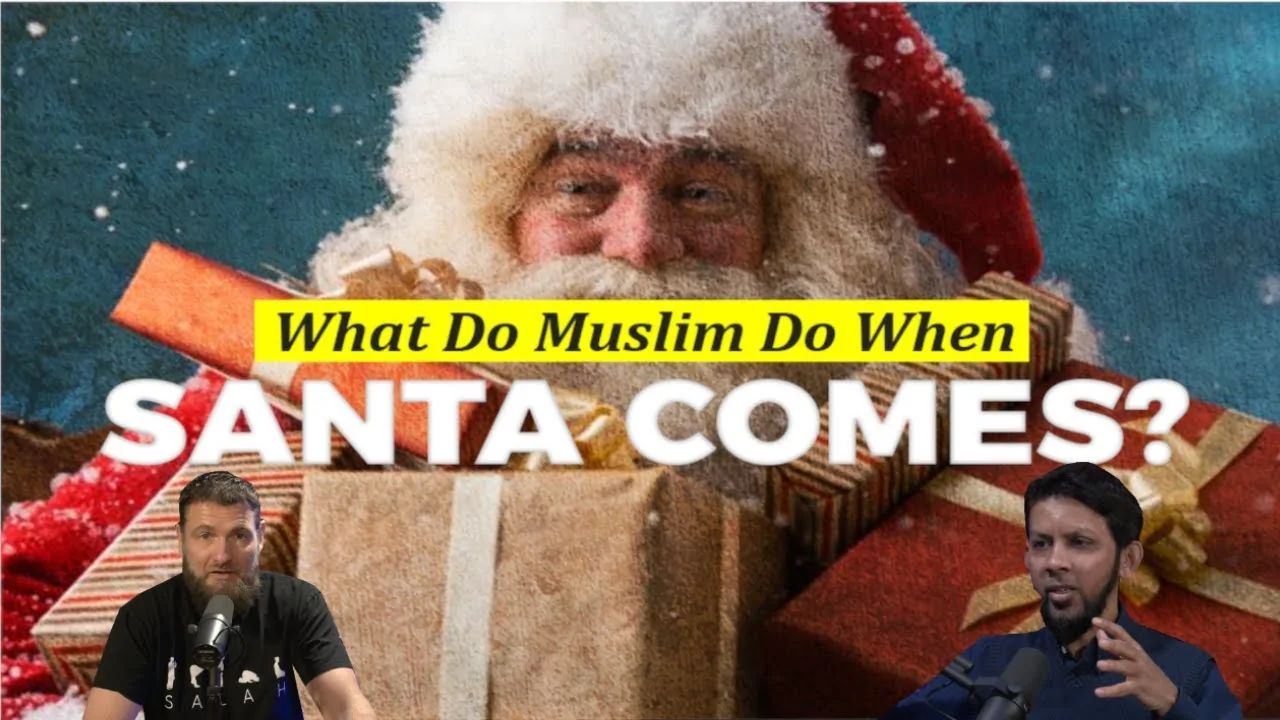
Each December, as shopping malls transform into temples of consumerism and familiar festive imagery spreads across Muslim-majority cities from Beirut to Birmingham, a growing number of Muslims find themselves swept into Christmas celebrations — often framing their participation as harmless cultural bonding or an act of goodwill. In a compelling episode of The Deen Show, scholar Dr. Sabil Ahmed challenges this assumption head-on, reminding believers that informed faith and genuine spirituality require more than good intentions — they require knowledge of history, theology, and the subtle ways cultural assimilation can slowly erode the foundations of Islam. The conversation is not about hostility toward others; it is about Muslims understanding what they stand for and why.
The Profound Irony: Christians Are Unknowingly Celebrating a Muslim Prophet
At the heart of this discussion lies a striking theological point that many overlook entirely: Isa ibn Maryam — Jesus, peace be upon him — was, by the very definition of the Arabic word, a Muslim. Islam means submission to the Creator, and a Muslim is one who submits their will entirely to Allah. Jesus prayed in prostration, fasted, worshipped one God alone, and submitted himself completely — as recorded even in the Bible itself, in John 5:30: “I can of myself do nothing… I seek not mine own will, but the will of the Father which hath sent me.” As Dr. Ahmed explains, the word “Christian” never appears on Jesus’s own lips, and the word “Christianity” does not appear anywhere in the Bible — but the concept of absolute submission to God runs throughout it. When the 2.2 billion Christians worldwide celebrate Christmas, they are, without realising it, honouring the birth of a Prophet of Islam. Beyond this theological dimension, the historical record reveals that December 25th has no Scriptural basis whatsoever — the Bible never names it as the birth date of Jesus. The date was borrowed centuries after his departure from pagan traditions: Mithra, the Persian “son of god,” was born on December 25th, had twelve disciples, was born of a virgin, and was said to have risen on the third day. The early disciples of Jesus — for two full centuries — refused to celebrate birthdays precisely because they recognised it as imitation of paganism. It was only through gradual cultural absorption that the date became attached to the birth of Christ, a warning to every faith community about the creeping power of cultural assimilation.
“When we are saying Merry Christmas, we are actually saying Merry Shirk — we are giving credibility to those celebrations and saying to them: you are committing shirk, and we congratulate you for it. Even though the Muslim doesn’t mean that, that is how it comes out.” — Dr. Sabil Ahmed
- December 25th is not Jesus’s birthday — the Bible is silent on this; the date was borrowed from pagan traditions including figures like Mithra and the Egyptian Osiris-Isis trinity.
- Jesus (peace be upon him) was a Muslim — he submitted his will entirely to Allah, prayed in prostration, fasted, and worshipped only one God, aligning with the core definition of Islam.
- “Christmas” means “Christ’s Mass” — a religious service commemorating a Prophet whose authentic teachings reflect pure monotheism, not the Trinity doctrine imposed on his legacy centuries later.
- Saying “Merry Christmas” carries theological weight — it implicitly endorses the theological framework surrounding the celebration, which attributes divinity to Jesus in direct contradiction to the Quran.
- Devout Christians also reject Christmas — Jehovah’s Witnesses and Seventh-day Adventists refuse to observe it because their own Bible study exposes its pagan, non-Scriptural origins.
- Santa Claus is built on systematic falsehood — the mythology requires actively deceiving children, contradicting both Islamic ethics and the moral teachings of the Bible itself.
How “Innocent Fun” Quietly Dismantles the Next Generation’s Deen
The most persuasive argument Muslims give for participating in Christmas is that it is merely cultural — a chance to bond with neighbours, appear relatable, or give children a sense of festive joy. Dr. Ahmed does not dismiss the sincerity behind such intentions, but he traces a trajectory that carries serious long-term consequences for Islamic identity and guidance. What one generation frames as optional cultural participation becomes, for the next generation, an anticipated ritual — the tree, the presents, the decorated house. By the time grandchildren arrive, the celebration has become quasi-obligatory; a Muslim family without a Christmas tree is now the one that invites questions. This is precisely how pure monotheism — the original faith of Jesus’s own disciples — was diluted over centuries: not through a single dramatic shift, but through the slow, incremental absorption of “innocent” cultural practices from surrounding societies. The inferiority complex that drives some Muslims to participate is real, but it must be named honestly. No one expects a Hindu family to celebrate Eid al-Adha, knowing it involves the ritual sacrifice of an animal they hold sacred; Muslims deserve the same respect for their own doctrinal clarity. Islam grants believers two God-given celebrations — Eid al-Fitr and Eid al-Adha — directly tied to devotion, gratitude, sacrifice, and communal remembrance of the Prophets. Allah declares in Surah Al-Ma’idah (5:3) that this faith has been completed; there is no spiritual vacuum that Christmas needs to fill.
Raising an Educated, Confident Muslim Identity
“The best that we can do is educate them — educate our own families and children — that this is the reality of these celebrations, and that Allah has given us celebrations which are better, attached to the pleasing of God and to the noble examples of the Prophets and the Companions.” — Dr. Sabil Ahmed
The remedy Dr. Ahmed offers is neither withdrawal from society nor confrontation with neighbours — it is education rooted in the Quran and the authentic Sunnah of the Prophet Muhammad, peace be upon him. The Prophet never celebrated his own birthday; his Companions, who loved him more than anyone, followed his example faithfully. The lesson is clear: when the foundations of purpose and faith are solid, cultural pressures lose their pull. A Muslim who truly understands who Jesus was — a Prophet who submitted to Allah, fasted, prostrated in prayer, called humanity to one God, and whose earliest followers wore hijab as the Amish still do today from their own Scriptures — finds that celebrating Christmas is not an act of tolerance but a surrender of identity. The Deen Show episode ultimately serves as a reminder that spirituality without knowledge is vulnerable, that every tradition must be traced back to its source, and that the greatest gift Muslim parents can give their children is not a Christmas tree draped in lights, but a confident, grounded, and loving understanding of who they are, Whom they worship, and what this beautiful, complete faith of Islam truly calls them to be.