
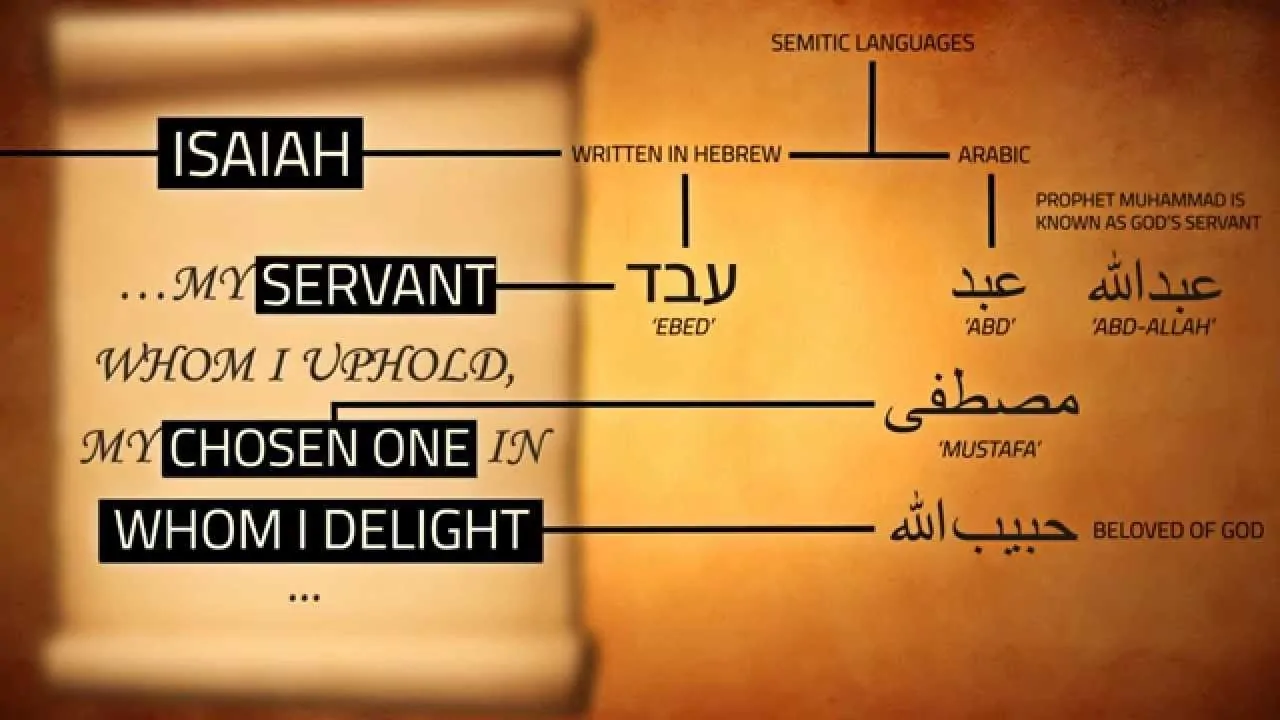
The 42nd chapter of the Book of Isaiah contains one of the most remarkable prophecies in the entire Bible — a detailed description of an Arabian prophet that matches Prophet Muhammad (peace be upon him) with extraordinary precision. From the Hebrew names used for this special servant to the specific geographic locations mentioned, the evidence is so compelling that it explains why Jewish tribes settled in Medina centuries before Muhammad’s birth, awaiting the fulfillment of this very prophecy.
Three Names of Muhammad Hidden in Hebrew
Isaiah describes God’s chosen one using Hebrew words that directly correspond to the Arabic names of Prophet Muhammad (peace be upon him). “Eed” (servant) corresponds to “Abd” — Muhammad is known as Abdullah, God’s servant. “Chosen one” is Mustafa in Arabic — another of Muhammad’s names. “The one in whom God delights” points to “Habibullah” (Beloved of God) — yet another of his blessed names.
“Isaiah uses the Hebrew word ‘Eed’ for servant — the Arabic word is ‘Abd.’ ‘Chosen one’ is Mustafa in Arabic. ‘The one in whom God delights’ is Habibullah. At least three of Prophet Muhammad’s names are mentioned in this single chapter.”
The Geographic Evidence Points Directly to Medina
- Kedar is mentioned by name — Throughout the Bible, Kedar and his descendants are linked to Arabia; Ezekiel confirms that “Arabia and all the princes of Kedar” did business there
- Sela pinpoints Medina — Isaiah says “let the people of Sela sing for joy”; Sela is the name of a famous mountain in the city of Medina
- Jewish tribes settled in Medina — Historical records confirm that Jewish tribes lived in Medina before Muhammad’s arrival, waiting for the prophet foretold in their scriptures
- The Jews taunted the Arabs — Islamic and Jewish historical sources record that Jews in Medina would tell their pagan neighbors: “When our Prophet arrives, we shall obliterate you”
“The question arises: why were there numerous Jewish tribes in Medina? The answer is that the learned Jews were aware of this prophecy in Isaiah and were anxiously awaiting the coming of a new prophet.”
A New Song for All of Mankind
Isaiah speaks of a “new song” — a new law and a new way of worship that will be praised “from the ends of the earth.” This cannot refer to Jesus, who explicitly stated he came not to destroy the Law of Moses but to fulfill it. His disciples continued following the Torah after his departure. The “new song” is Islam — a universal message for all mankind, Jews and Gentiles alike, just as the Quran confirms: “We have sent you, O Prophet, as a bearer of glad tidings and a warner for the whole of mankind.”