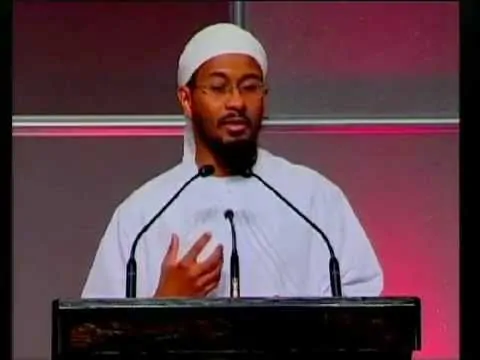
Between the monastic rejection of human desire and the permissive embrace of all things under the banner of personal freedom, Islam charts a precise and purposeful middle path. In this thought-provoking lecture, Shaykh Kamal El Mekki — imam, educator, and one of the most dynamic voices in Islamic dawah today — dissects two extremes that have shaped Western civilization’s troubled relationship with sexuality: the institution of celibacy inherited from early Christian theology, and the sexual revolution of the 1960s that swung the pendulum to the opposite extreme. His central argument is both simple and profound: when human beings abandon divine guidance in their intimate lives, the harm does not stay private — it ripples outward, fracturing families, communities, and the moral fabric of society itself.
Celibacy, Christianity, and the Islamic Alternative
Shaykh Kamal traces the roots of Christian celibacy to a single theological observation — that Prophet Isa (Jesus, peace be upon him) never married. From this starting point, early Christian thinkers concluded that celibacy must represent a higher spiritual state, and as a consequence, sexual intimacy — even within marriage — became associated with impurity, existing solely for procreation. Women, in this framework, came to be viewed as sources of temptation, and Paradise itself was reimagined as a purely spiritual realm, free from anything physical. The contrast with Islam could not be starker: in the Quran, Allah addresses intimacy between spouses with ease and directness, even in the context of Ramadan, reflecting no sense of shame or taboo. Furthermore, the Quran places accountability squarely on Adam for the Garden — not Eve — rejecting the narrative that has historically been used to diminish women. In Islam, marriage is not a concession to human weakness; it is a form of worship, a completion of faith, and a fulfillment of the human fitrah (natural disposition).
“You do not draw nearer to Allah by being celibate. There is no such practice in Islam. The Prophet ﷺ forbade the companion who wanted to take that vow.” — Shaykh Kamal El Mekki
- Celibacy has no basis in Islamic theology — it was never a path to closeness with Allah, and was explicitly forbidden by the Prophet ﷺ
- Early Christian celibacy theology stemmed from misreading Prophet Isa’s unmarried status as the highest spiritual ideal
- This theology led directly to women being portrayed as morally dangerous — a view Islam categorically refutes
- The sexual revolution of the 1960s–70s produced the precise opposite extreme: a society that normalised fornication and dismissed moral boundaries as repression
- Muslims were accused first of being “over-sexed” in the era of Christian puritanism, then of being “too strict” after the sexual revolution — demonstrating that Islam is evaluated against shifting secular standards, not objective ones
- The hijab became a target in both periods: first misread as protection against uncontrolled male urges, then condemned as oppression — both critiques rooted in the same historical confusion about Islamic values
The Cascading Harms of Zina: Society, Women, and the Family
The Shaykh turns his attention to what Islamic scholarship calls zina — illicit sexual relations outside of marriage — and methodically dismantles the modern argument that “no harm is done” between consenting adults. Among the core purposes of Islamic law (Shariah) is the protection of lineage and the preservation of the family unit, and Shaykh Kamal demonstrates through social data how profoundly the abandonment of these principles damages individuals, women in particular, and entire communities. He references studies showing that 82% of teenage mothers are themselves daughters of teenage mothers, that children raised without knowing their biological fathers are three times more likely to be imprisoned, and that psychologists have documented a direct link between poor mother-infant bonding — more prevalent in unstable, fatherless households — and the development of severely antisocial personalities. The harm of zina, he argues, is not a matter of religious sentiment alone — it is measurable, generational, and devastating.
- On society: Widespread zina leads to broken lineage, fatherless children, higher crime rates, and the spread of sexually transmitted diseases — each harm compounding the next
- Zina compounds itself: Communities where it is normalised see rates increase and the age of first sexual activity decrease — a self-reinforcing cycle with real statistical consequences
- On women specifically: Women bear a disproportionate biological and social burden — pregnancy, labour, years of child-rearing — while partners often disappear; teen mothers face social isolation, lower educational attainment, and higher rates of depression
- The objectification trap: When a woman believes her only social value is sexual, she is pressured to perform and commodify herself — a dynamic that systematically undermines her dignity, intellect, and capacity for leadership
- On men: Serial zina desensitises men to intimacy and makes faithful commitment within marriage profoundly difficult; the natural, protective care a man feels for his mother, wife, daughter, or sister gradually erodes
- On infants and children: Stable mother-infant bonding is critical to healthy emotional development; children raised in chaotic, fatherless environments are statistically far more vulnerable to a range of long-term developmental and behavioural challenges
- On the heart: Persistent sin hardens the heart and distances the believer from Allah — the spiritual dimension of harm that no statistic can fully capture, yet every sincere Muslim can recognise
“Allah doesn’t make something haram for no reason. When Allah makes something forbidden, you will typically find that there is a great deal of evil in it.” — Shaykh Kamal El Mekki
What makes this lecture so valuable for Muslims navigating life in the West is not simply the catalogue of harms — it is the clarity of framework Shaykh Kamal provides. Islam’s position on sexuality is not a relic of a repressive past, nor a concession to male dominance, nor a tradition in need of updating to meet contemporary fashions. It is a coherent, compassionate system designed by the Creator who knows human nature best — preserving the dignity of men and women alike, safeguarding the innocence of children, and protecting the social bonds upon which flourishing communities are built. The middle path Islam prescribes, neither the denial of human intimacy through celibacy nor the reckless abandonment of all moral restraint, is not a compromise. It is the sunnah: the precise, purposeful, and deeply merciful guidance of the Prophet ﷺ, as relevant today as it has ever been. May Allah grant us the wisdom and the strength to honour it.