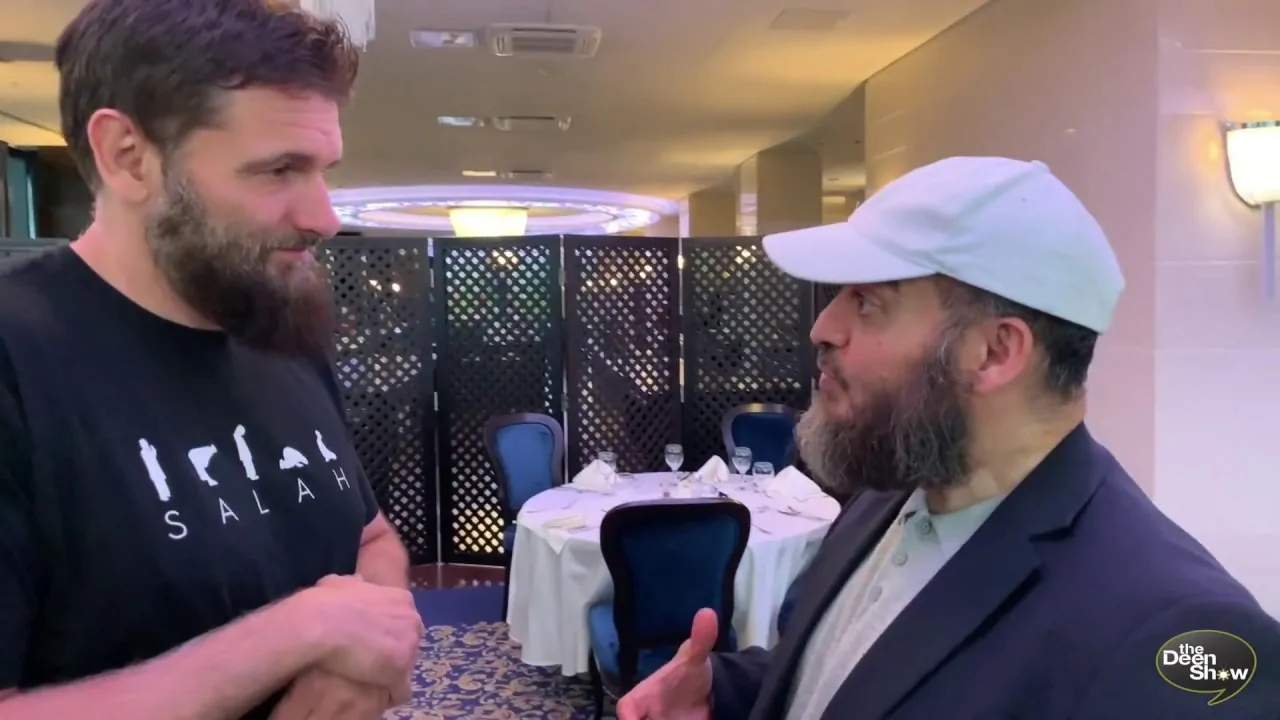
What does a man do when he wakes in the middle of the night, wracked with pain from chemotherapy, uncertain whether he will survive — and finds that no human comfort is adequate? In this deeply moving episode of The Deen Show, filmed in Sarajevo, Bosnia and Herzegovina, Dr. Haitham Al Haddad — Islamic scholar, cancer survivor, and one of Britain’s most recognisable voices on faith and purpose — answers that question from lived experience. Joined by host Eddie and a surprise phone call to Ali Dawah that turns into a warm, brotherly prank, the conversation weaves together raw vulnerability, timeless spiritual wisdom, and a clear-eyed defence of Islam’s most misunderstood concepts — all converging on one unshakeable truth: connection with God is not merely a religious obligation, but the deepest and most irreplaceable form of human medicine.
Success, Sabr, and the Architecture of a Purposeful Life
Drawing on years of study in both Islamic sciences and modern management theory, Dr. Haitham identifies three factors universally cited in leadership literature — and demonstrates that each one maps precisely onto a foundational concept from the Quran and Sunnah. This alignment, he argues, is not coincidence but divine design: Islam addressed the architecture of human success long before any business school codified it. His own cancer diagnosis became the ultimate testing ground for these principles, forcing him to confront mortality with nothing but faith, clarity of purpose, and a direct relationship with his Creator as his anchor. Three patients around him died during treatment; one of them, who had claimed atheism in full health, cried out through his final night: “God help me, God help me” — a raw, involuntary expression of the human soul’s deepest recognition.
- Clarity of Vision (Niyyah — Intention): The Prophet’s ﷺ hadith — “Actions are judged by their intentions” — is not merely a spiritual reminder but a strategic one. Vision begins with knowing precisely what you want to achieve and for whom.
- Commitment (Sabr — Perseverance): Not the passive resignation often mistranslated as patience, but active, forward-driving resolve. As the Prophet ﷺ said: “Sabr is enlightenment” — a luminous, empowering quality that sustains action through hardship.
- Unity (Jama’ah — Networking with Those Who Share Your Vision): The Quranic command to “hold all of you to the Rope of Allah and do not be divided” is a call to strategic community — surrounding yourself with people who reinforce your direction and hold you accountable to your highest purpose.
- Faith as the Irreducible Foundation: In a hospital bed at the darkest hour, Dr. Haitham witnessed something that no secular framework can explain away — every human being, regardless of stated belief, instinctively reaches for God when stripped of all other support. That instinct is not weakness; it is the fitrah, the natural disposition Islam speaks of.
“In the middle of the night you are ill, you are tired, you are down — what are you going to do? You need someone who is powerful to talk to Him, to take your grief and anxiety, to complain to Him. And not only that — He is your Creator, He listens, not just knows — He listens, and He will help you. That will put a lot of peace in your heart.” — Dr. Haitham Al Haddad
Sharia, Spiritual Guidance, and Islam’s Answer to the Modern Mental Health Crisis
Few words generate more reflexive anxiety in Western public discourse than “Sharia” — yet Dr. Haitham dismantles that fear methodically and with characteristic good humour. Sharia, he explains plainly, simply means Islam — the complete, holistic way of life brought by Moses, by Jesus, and completed through the Prophet Muhammad ﷺ as a mercy and guidance for all of humanity. It encompasses prayer, the hijab, family bonds, social justice, and ethical conduct — and yes, a penal code — but that penal code constitutes a fraction of Sharia’s total scope, and its purpose is deterrence, peace, and the protection of society, not cruelty. The Quran was not revealed for Muslims alone; it is addressed to all of humankind — Ya ayyuha al-nas — to give every person guidance, hope, and a framework for flourishing. This universality matters profoundly as the world approaches what experts project will be its leading burden of disease by 2030: mental illness. Dr. Haitham’s diagnosis is direct — the primary cure for spiritual emptiness, anxiety, and purposelessness is connection with Allah, a God who does not merely know of your suffering but actively listens and responds.
“Love is a main element of Sharia. Justice is the main element. Allah says in the Quran: Allah enjoins justice — and if that means going beyond justice, what is that? Mercy — to have mercy and to apply mercy on people, and to treat your relatives with more kindness.” — Dr. Haitham Al Haddad
What unites every thread of this episode — the cancer ward in the darkness of the night, the three keys to success, the defence of Sharia, the joyful prank on Ali Dawah in Sarajevo — is a single, recurring conviction: that human beings are designed for God, and that no self-help system, ideology, or material comfort can substitute for that connection. Bosnia itself stands as living evidence: a community that endured devastating war and emerged, by every witness account, with its faith and its people stronger than before. That is Islam’s testimony through history, and it is the testimony of every person who, like Dr. Haitham, has been brought to their knees by trial and discovered in that position the unshakeable nearness of their Creator. For any non-Muslim watching, for any believer whose faith has been worn thin by doubt or distance, the message of this episode is not a lecture but an invitation — to have a clear vision aligned with divine guidance, to commit to it with everything you have, to seek out a community that walks that path with you, and to know with certainty that the Most Powerful One is listening.