Few questions ignite more passion — or more confusion — among Muslims and non-Muslims alike than the relationship between the Quran and modern science. Can verses revealed fourteen centuries ago really speak to embryology, oceanography, and the spherical shape of the Earth? And if so, how should believers approach these connections without either dismissing them entirely or overstating their implications? In a deeply insightful conversation with Eddie on The Deen Show, Islamic scholar Dr. Jamal Badawi — one of the foremost authorities on Islam in the English-speaking world — offers a framework grounded in intellectual honesty, spiritual maturity, and a profound respect for both divine revelation and human inquiry. His guidance is a timely reminder that Islam has never been at war with reason; it has always invited it.
A Just Balance: How to Approach Quranic Scientific References
“For us as Muslims, the Quran is the ultimate truth because it is the word of Allah, who possesses infinite knowledge and infinite wisdom. We cannot compare His wisdom against the standards of science as if science were the ultimate judge. I would rather say: definitive science, alhamdulillah, seems to have arrived at the same conclusion — after many centuries — that the Quran already stated fourteen centuries ago.” — Dr. Jamal Badawi
- The Quran is first and foremost a book of guidance — not a science textbook, yet it consistently invites believers to reflect on the natural world as a path to deepening faith, certainty, and spiritual purpose.
- Scientific theory is not the same as scientific fact — theories evolve and can be overturned; empirically verified facts (like the spherical Earth) do not. Dr. Badawi urges that only established, reproducible facts be cross-referenced with Quranic verses.
- Never make science the arbiter of the Quran — framing the discussion as “science proves the Quran” subtly inverts the hierarchy of knowledge and risks shaking the faith of Muslims when theories are later revised or discredited.
- Scientific discoveries can legitimately increase iman — when confirmed facts align with Quranic descriptions revealed long before their discovery, they serve as powerful supplementary evidence of the Quran’s divine authorship, particularly for sincere truth-seekers.
- Avoid far-fetched or forced interpretations — claiming, for example, that the Quranic word for a tiny speck refers to nuclear fission is intellectually dishonest; the Quran addresses people in language they can understand, and overreaching causes far more harm than good to the message of Islam.
Dr. Badawi’s approach reflects what Islamic tradition calls wasatiyyah — the balanced middle path. He fully acknowledges the legitimate concern of scholars who caution against tying Quranic truth to shifting scientific consensus, while simultaneously affirming the Quran’s own directive in Surah Fussilat (41:53): “We will show them Our signs in the horizons and within themselves until it becomes clear to them that it is the truth.” The discipline required is precise: a scientific theory — such as the theory of evolution, which remains actively debated even among its proponents — is not the same as a verified, reproducible fact. Only the latter offers intellectually honest ground for drawing meaningful parallels with Quranic ayat. And even then, the purpose is never to place the divine word on trial before a human court, but to marvel with gratitude at how the all-knowing Creator could articulate, in a 7th-century Arabian context, truths that humanity would only confirm centuries later.
Signs in the Universe and Within Ourselves: Quranic Miracles That Defy Human Authorship
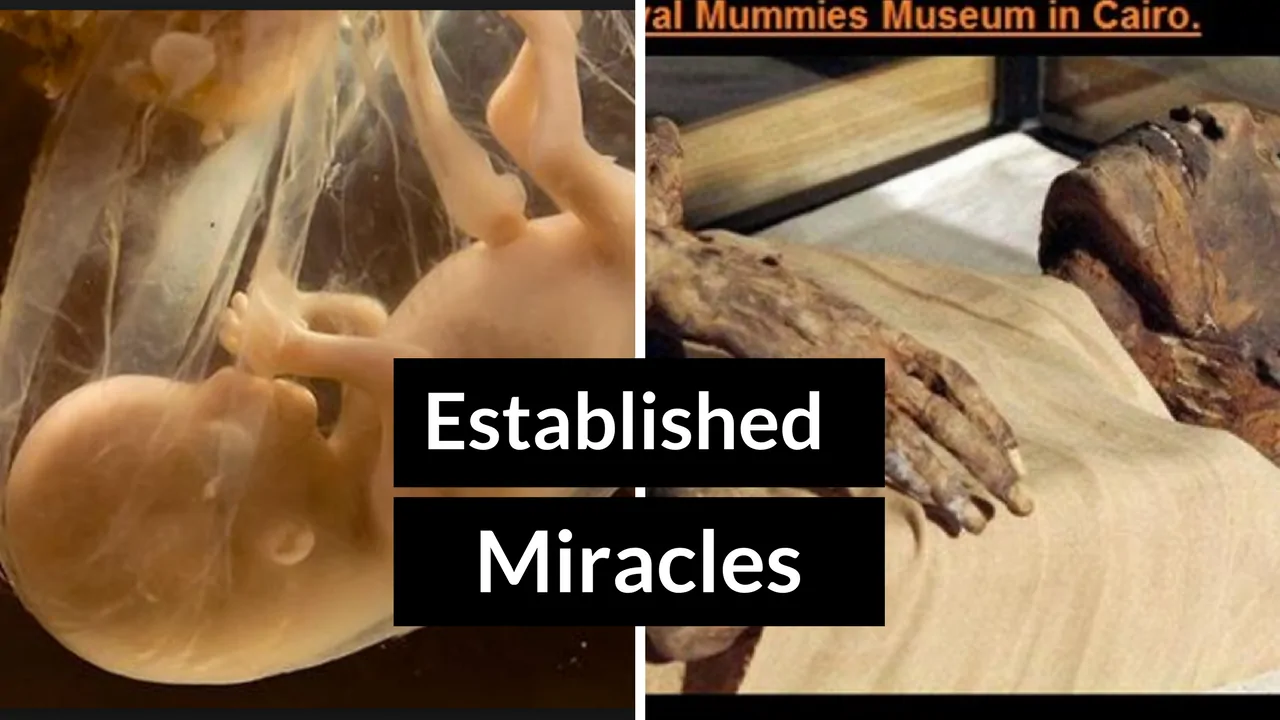
When Eddie invites Dr. Badawi to share specific examples of Quranic scientific references that no person fourteen centuries ago could plausibly have known, the examples are nothing short of breathtaking. In Surah Az-Zumar (39), Allah describes “coiling the night over the day and coiling the day over the night” — language that is only coherent if the Earth is spherical, a concept that was condemned as heresy in medieval Europe. Surah Al-Mu’minun (23:12–14) describes the stages of embryonic development with a precision that could only be fully appreciated after the invention of the electron microscope — including the mingling of male and female genetic contributions at fertilisation, the clinging of the fertilised egg to the uterine wall, and even an allusion to the genetic determination of inherited traits and predispositions; a fact that utterly confounded the preformation theories dominant until the 17th century. Dr. Keith Moore, a globally renowned professor of human anatomy at the University of Toronto whose textbooks have been translated into dozens of languages, expressed utter amazement upon reviewing these Quranic verses, testifying that nothing remotely comparable existed in any prior scripture or scientific literature. The oceanographic miracle of two bodies of water meeting but not mixing — witnessed where the Gulf Stream travels thousands of miles while maintaining its distinct temperature, and where the fresh waters of the Nile retain their sweetness even as they flow into the salt waters of the Mediterranean — is described in the Quran as two seas separated by an unseen barrier, a phenomenon only confirmed by modern oceanography. Perhaps most striking is the Quran’s declaration in Surah Al-Hadid (57:25) that iron was “sent down” — a phrase that astrophysics now validates, since iron cannot be produced within ordinary stars and must arrive on Earth through cosmic events such as supernovae and meteoritic impact. These are not poetic flourishes; they are substantiated facts that, as Dr. Badawi carefully notes, leave no intellectually honest room for coincidence.
Dialogue Over Debate: Sharing the Message of Islam with Wisdom and Compassion
“It should not really be a debate with the psychology of who’s the winner and who’s the loser — because everybody is a loser unless we listen to one another. Rather than focusing on differences, let us capitalise on our common ground: the love of God, social justice, family, spirituality, and the purpose of life.” — Dr. Jamal Badawi
Beyond the remarkable intellectual terrain of Quranic science, Dr. Badawi’s conversation closes on a note that speaks directly to every Muslim engaged in sharing the message of Islam with the world. Drawing on decades of interfaith dialogue with Christians, Jews, and diverse faith communities, he makes a compelling case for conversation over confrontation — for building bridges through shared values of justice, family, spirituality, and the profound human search for meaning and purpose, rather than endlessly rehearsing theological differences. His measured, dignified response to those who have labelled Islam as evil is a masterclass in wisdom: do not confuse the authentic, timeless teachings of Islam with the failings of individuals who deviated from those noble principles, just as no reasonable person would judge Christianity by the Crusades, Judaism by occupation, or Buddhism by ethnic violence. Islam across fourteen centuries produced art, architecture, medicine, mathematics, and moral philosophy that catalysed the European Renaissance — a civilisational contribution that history itself bears witness to. The path forward, Dr. Badawi teaches us, is not name-calling or polemics, but the sincere, respectful human connection that has always been the hallmark of prophetic da’wah: invite with wisdom, speak with evidence, listen with humility, and trust that guidance ultimately rests with Allah ﷻ alone. May we be among those who carry this message with the same balance, depth, and compassion that Dr. Jamal Badawi has modelled throughout a lifetime of scholarship and service to this beautiful faith.