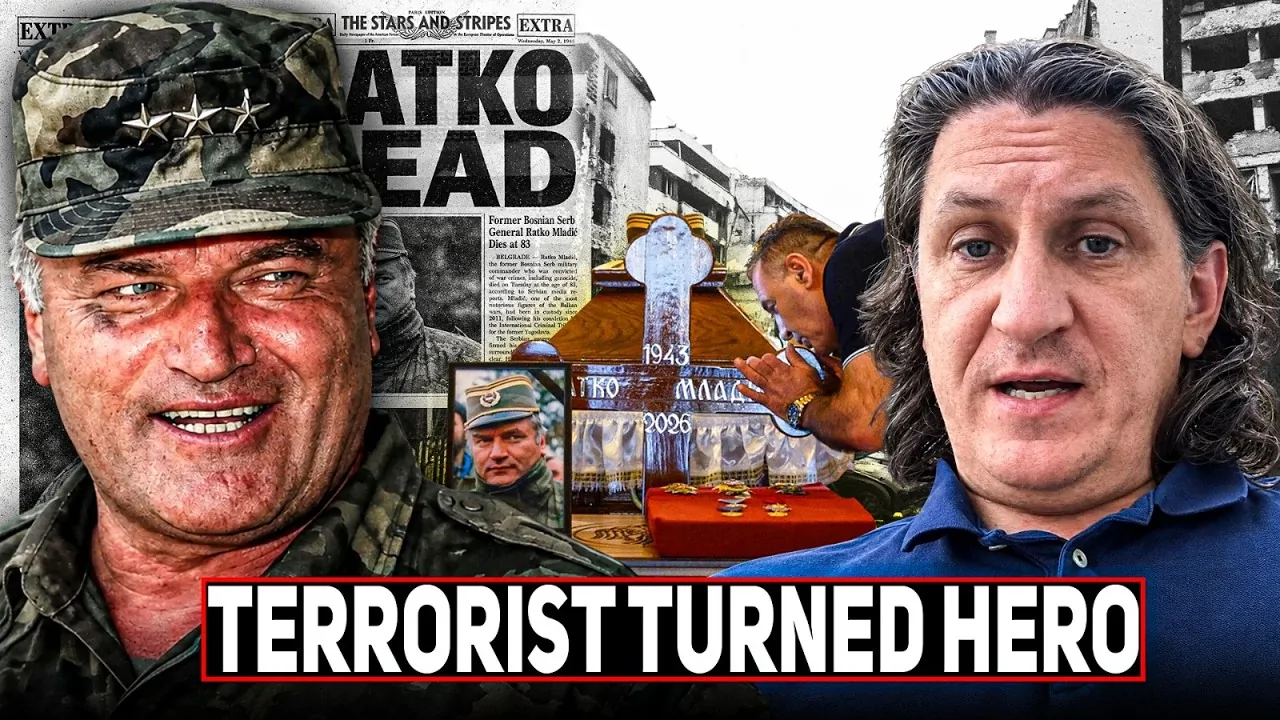
How does a man convicted of genocide — sentenced to life imprisonment by an international tribunal established unanimously by all 15 members of the UN Security Council — come to be treated like a living deity by millions of his own people? In this unflinching episode of The Deen Show, host Eddie sits down with Haroon Mehmedovich, a Bosnian analyst and advocate, to examine one of the most disturbing moral inversions of the modern era: the veneration of General Ratko Mladić, the “Butcher of Bosnia,” as a Serbian national hero — or, as he notoriously declared himself over an air traffic control radio channel, the “Serbian God.” Understanding how this happened is not merely an exercise in Balkan history; it is a confrontation with the mechanics of nationalist ideology, collective memory, and the ease with which human beings will worship power over truth.
Convicted by the World, Worshipped at Home
- Mladić was tried and convicted by the International Criminal Tribunal for the former Yugoslavia (ICTY) — a court distinct from the ICC, established specifically to prosecute Balkan war crimes, with thousands of pieces of forensic evidence, mass grave data, military documents, and survivor testimony presented over years of proceedings.
- The UN Security Council voted unanimously — 15 to 0 — to establish the tribunal, with Russia, China, France, the United Kingdom, and the United States all in agreement, making dismissals of “Western conspiracy” deeply difficult to sustain on rational grounds.
- Despite a life sentence for genocide, crimes against humanity, and war crimes, Serbian Orthodox priests offered him blessings; millions of Serbs in Bosnia, Serbia, and the diaspora openly regard him as a defender of Serbian civilisation.
- Street vigils held in his honour have featured supporters kissing his photograph and kneeling before his image — behaviour that, as Haroon Mehmedovich pointedly observes, resembles acts of worship rather than civic commemoration.
- He himself reinforced this quasi-divine self-image, reportedly announcing over air traffic control: “Here, Ratko Mladić — the Serbian God.”
“He put it on himself — the name. Over air traffic control, talking: ‘Here, Ratko Mladić. I am the Serbian God.’ That is what he announced and reported.”
A Century of Greater Serbia Ideology and the RAM Plan
To understand why Mladić is celebrated rather than condemned within certain communities, Haroon traces the ideology back over a hundred years to the concept of “Greater Serbia” — an ethnically homogeneous Serb state encompassing Bosnia, parts of Croatia, and surrounding territories. This was not a fringe movement but a sustained political project, embodied earlier by Chetnik leader Draza Mihailovic during the Second World War, who is similarly venerated as the greatest Serbian nationalist hero despite presiding over mass killings of non-Serbs. By the 1980s and early 1990s, this ideology had crystallised into what became known as the RAM Plan — a blueprint to ethnically remove Bosniaks from territories designated for a Greater Serbia. Mladić was not a soldier simply following orders; he was the chief military architect and primary executor of that plan, overseeing virtually every major war crime committed in Bosnia between 1992 and 1995. Within this nationalist framework, the disturbing internal logic becomes visible: the more non-Serbian lives destroyed, the greater the claim to ethnic “achievement” — which is precisely why higher body counts confer higher hero status among those committed to the ideology.
The Crimes That Demand Remembrance — Srebrenica, Sarajevo, and Foča
Under Mladić’s direct command, an estimated 31,000 civilians were killed — a figure covering only a portion of the atrocities he oversaw. Srebrenica, where over 8,000 Bosniak Muslim men and boys were systematically executed in July 1995, stands as the worst act of genocide on European soil since the Holocaust. The siege of Sarajevo — the longest siege of a capital city in modern warfare — was conducted under his authority. In Foča and surrounding areas, witnesses documented mass rape and sexual violence committed by Serb soldiers and Montenegrins against Muslim women and girls as a deliberate weapon of ethnic cleansing. Forensic evidence, mass graves, military documents, Mladić’s own handwritten notebooks, and the testimony of both Serb and Bosnian survivors together formed the evidentiary foundation of his conviction. Haroon also situates the 1990s slaughter within a longer pattern: genocide against Bosniaks had already occurred between 1941 and 1945, meaning the Bosnian War was not an aberration but the latest chapter in a recurring, generational assault on Muslim life in the Balkans — with mass graves still being uncovered to this day.
“This is a continuously ongoing genocide. Every few years, more mass graves are uncovered. They are still hopeful of forming an ethnically pure Greater Serbia — this has been going on for generations.”
From an Islamic perspective, faith compels us to bear witness to injustice rather than avert our eyes from it. Islam teaches that every soul carries inherent dignity — karama — bestowed by Allah, and that accountability before Him is absolute, regardless of what earthly courts, governments, or nationalist crowds proclaim. The transformation of a convicted genocidaire into a national deity is not simply a political curiosity; it is a profound spiritual warning about what unfolds when ethnicity and tribalism displace conscience, truth, and the fear of God. Our deen — our way of life — is rooted in haqq (truth), and our guidance reminds us that oppression, however loudly celebrated by the powerful, is never forgotten by the Creator. Remembering Srebrenica, Sarajevo, and the women of Foča is not only an act of historical justice — it is an act of faith. We ask Allah to grant mercy to all the victims, strength and healing to all who survived, and the courage of honest reckoning to all who seek truth in a world that too easily rewards the glorification of violence over the quiet, enduring dignity of accountability.