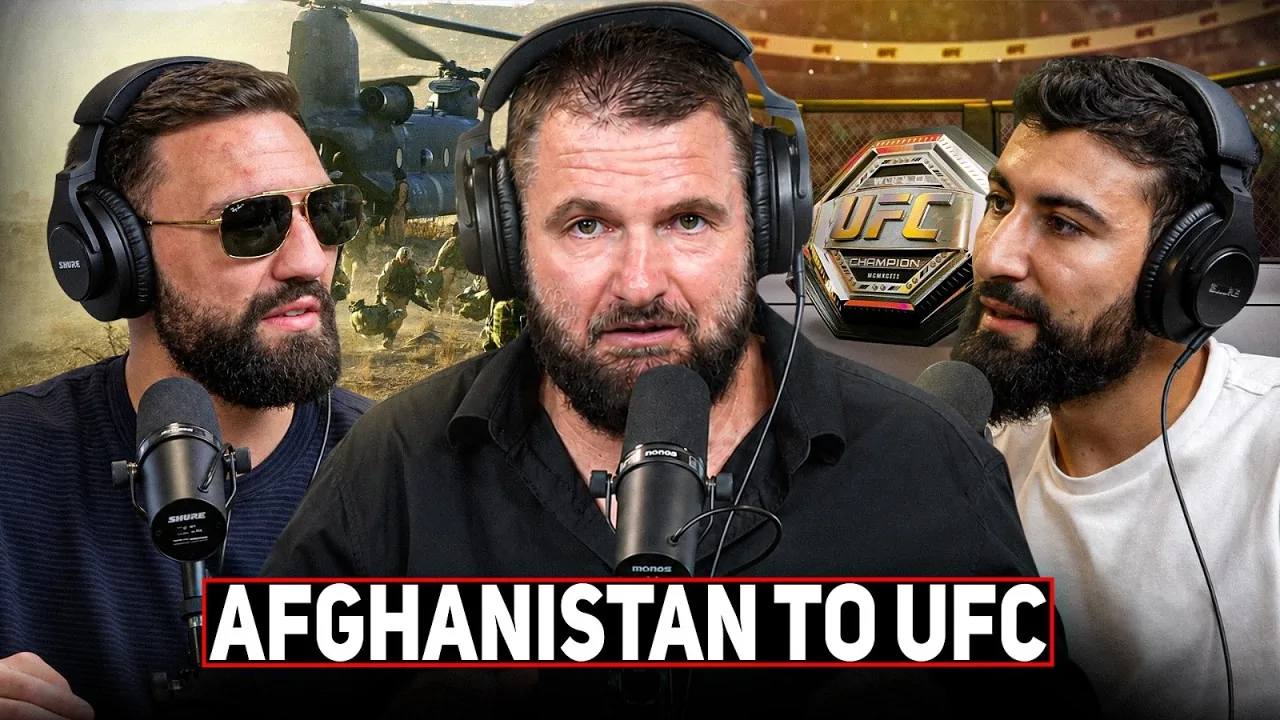
What happens when a family flees Soviet bombs in Afghanistan, survives refugee camps in Pakistan, and builds a new life in London — all while holding fast to Islam as their anchor? The Basharat brothers, Jawed and Fared, answer that question not with words alone, but with their lives. From tents in Peshawar to the lights of the UFC and PFL, theirs is a story of resilience forged by faith, shaped by a father who sacrificed three years apart from his family to pave a better future, and powered by parents who made tawakkul — reliance on Allah — as natural as breathing. In this episode of The Deen Show, host Eddie speaks with both brothers about displacement, identity, spirituality, and what it truly means to carry Islam into the heart of the West.
From Refugee Camps to London: A Father’s Sacrifice and the Foundation of Faith
The Soviet invasion of Afghanistan in 1979 triggered one of the largest refugee crises of the twentieth century, pushing millions across the border into Pakistan overnight. The Basharat family was among them. Growing up between Afghan villages, refugee camps near Peshawar, and eventually London, the brothers experienced a world most people can scarcely imagine — drawing water from wells, never having seen a tap, and arriving at Bahrain airport only to be terrified by an elevator when a stranger stepped in and seemingly vanished. Their father left for England alone when Fared was just two months old, spending three years separated from his family while securing asylum and working to bring them over — the kind of quiet, generational sacrifice that rarely makes headlines but shapes everything. When the family finally reunited and settled in London, their father’s rule at home was absolute: speak Pashto, eat on the floor with your hands, wear Afghan clothes, and when the prayer time comes, pray. The result was remarkable — when the brothers returned to Afghanistan in 2006, villagers were stunned that a family living in England had preserved their traditions more faithfully than those who never left.
- The 1979 Soviet invasion displaced millions of Afghans overnight, forcing the Basharat family into refugee camps near Peshawar for over a decade.
- Their father endured three years of separation from his young children to secure asylum in England and build a path for the family — a son just two months old when he departed.
- Arriving in London meant encountering running water, elevators, and bathroom door locks for the very first time — everyday blessings most people never stop to consider.
- Both parents consistently attributed everything — ease and hardship alike — to Allah, instilling deep tawakkul that the brothers describe as the greatest gift they ever received.
- Returning to Afghanistan for family visits grounded them in their roots — a practice they strongly recommend for any Muslim family raising children in the West who want their children to hold on to their identity.
“Everything is from Allah. When things get hard, it is from Allah. When things get easy, it is from Allah. That programming in my head — I always had reliance on Allah. That only comes from my parents, and that is the biggest blessing I’ve got in my whole life.” — Jawed Basharat
Inside the Octagon and Beyond: Representing Islam on the World Stage
Growing up Muslim in post-9/11 London was not without its trials. The brothers describe a climate of heightened suspicion and media-fuelled hostility that made public displays of Islamic identity far more fraught than they are for the younger generation today. Yet rather than retreating from their faith, they carried it into some of the most improbable arenas — including the Las Vegas strip, where witnessing the hollowness of a life centred on gambling and alcohol only deepened their iman. Inside the UFC, they refused to stay silent when Islam was misrepresented. When a fellow fighter called Jawed a “terrorist” at the weigh-ins — a moment that went viral — he responded not with rage but with controlled, deliberate purpose inside the octagon, methodically dominating the fight for fourteen minutes before submitting his opponent at the final moment. Their presence in the sport also opened unexpected conversations: non-Muslim fighters expressed surprise at learning that Muslims honour and revere Jesus, peace be upon him; trainer Dewey Cooper publicly accepted Islam just weeks before the episode aired; and their teammate Arman Sarukyan expressed a desire to visit Afghanistan himself. The da’wah was never a speech — it was a way of being.
- Post-9/11 London presented real social hostility toward Muslims, but the brothers argue today’s loudest anti-Muslim voices are a minority amplified by social media algorithms — not a true reflection of British society.
- Las Vegas strengthened rather than weakened their faith — the contrast between Islamic values and the excess on the strip gave them all the clarity they needed about the path they had chosen.
- When remarks were made about Islam publicly, the brothers corrected the speaker respectfully but firmly: “When you’re talking about Islam, it’s very dear to billions of people in their hearts — check your facts.”
- Trainer Dewey Cooper’s shahada confirms what the brothers have always understood: consistent, principled conduct in public life is among the most powerful forms of dawah.
- Afghan hospitality — keeping reserves of food for guests even when you have little for yourself — defies every negative media narrative about the Afghan people and reflects the deep generosity embedded in Islamic culture.
“Would you believe my iman got way stronger when I went to Las Vegas — because I would see the lifestyle that people had in the strip area, gambling and alcohol and everything, and I would look at them and say: this is exactly what I don’t want to turn out like.” — Fared Basharat
The story of the Basharat brothers is ultimately a testament to the power of an Islamic upbringing rooted in sincerity rather than performance. Their parents did not lecture them about faith from a distance — they modelled tawakkul in refugee camps, in cramped London flats, and across every hardship that followed. That foundation — salah established from a young age, an unshakeable belief in Allah’s decree, and a culture of honour and hospitality drawn from their Afghan heritage — became the ground beneath their feet in every fight, every public confrontation, and every quiet moment of self-reflection. For Muslim families watching this episode, the invitation is clear: know your deen, study it, practice it, and feel it — not as a cultural inheritance alone, but as a living, transformative relationship with Allah that can carry your children through refugee camps, through the corridors of professional sport, and into lives of genuine purpose, guidance, and meaning.