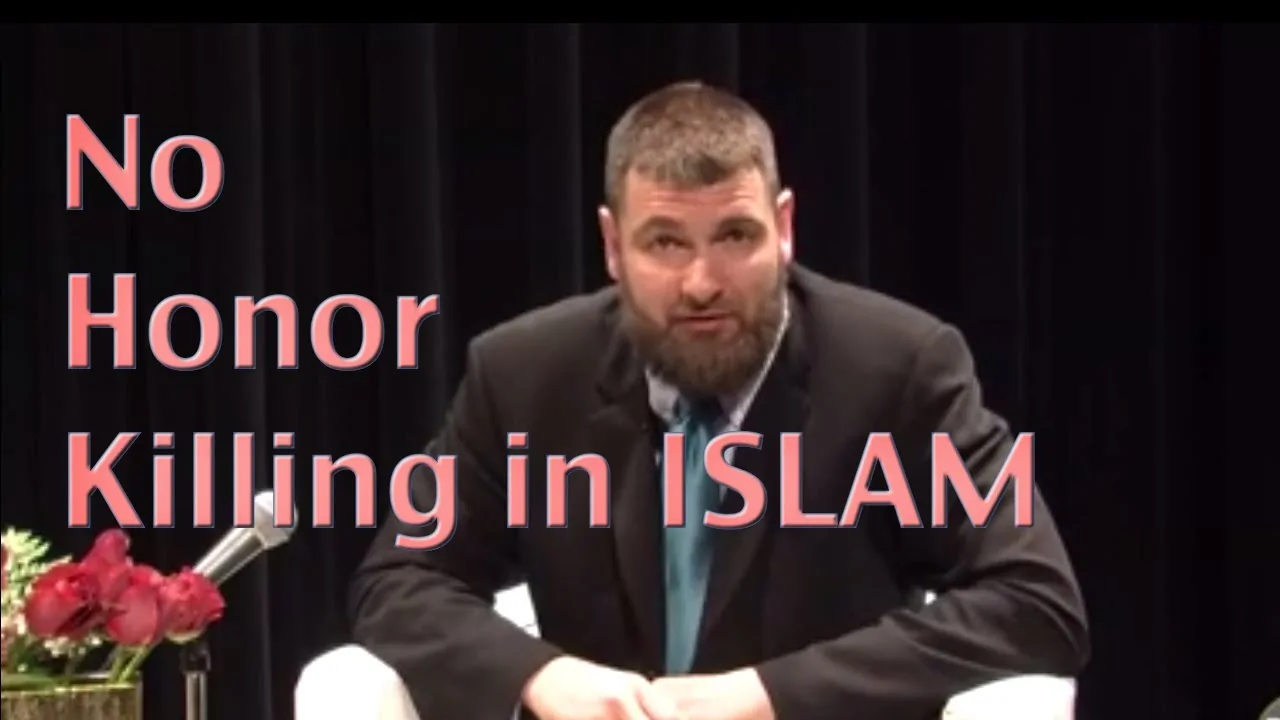
Every year, harmful practices are wrongly attributed to Islam — and few are more damaging or more misunderstood than honor killings and forced marriages. In this episode of The Deen Show, a former U.S. Navy serviceman who embraced Islam decades ago after encountering the Quran for the first time, and who now teaches Islamic Studies to nearly 900 students weekly while completing a Doctorate in Education, addresses these questions head-on. Having personally navigated the tension between imported cultural baggage and authentic Quranic guidance, his perspective offers something rare: the clarity that only comes from having studied Islam from the outside in, without the assumptions that cultural inheritance brings. At its core, this discussion is a reminder that Islam is a complete, timeless way of life rooted in divine guidance and spiritual purpose — and that practices rooted in jahiliyyah (pre-Islamic ignorance) are not Islam, no matter how long they have been carried by Muslims.
Honor Killings Have No Basis in Islam — They Are a Crime Against It
“And whoever kills a believer intentionally, his recompense is Hell to abide therein; and the Wrath and the Curse of Allaah are upon him, and a great punishment is prepared for him.” — Qur’an, Surah An-Nisa 4:93
Allah ﷻ declares in the Quran that killing one innocent soul is as grave as killing all of humanity, and saving one soul is as noble as saving all of humanity. This single principle obliterates any religious justification for so-called “honor killing.” Islamic law does prescribe certain hadd (prescribed) punishments for specific, proven moral crimes — but the scholarly consensus across all major schools of jurisprudence is absolute and unambiguous: only the legitimate ruler or his lawfully appointed deputy may ever carry out such a punishment, never a private individual, family member, or tribal elder. Even in cases where a hadd might theoretically apply, four male witnesses to the act itself — or a free, uncoerced personal confession repeated multiple times — are required as legal proof. In most “honor killing” cases, not even an accusation has been properly investigated, let alone proven before any authority. The pre-Islamic Arabs buried their daughters alive out of tribal superstition and cultural shame — and the Quran came, in part, to eradicate exactly this. The guest notes, with sound historical grounding, that similar “honor” violence was practiced among non-Muslim Americans as recently as the late 19th century, demonstrating that this is a cross-cultural product of human ignorance, not a feature of Islamic faith or spirituality.
- Killing unlawfully is among the gravest sins in Islam — condemned explicitly in the Quran and authentic Hadith, with the most severe divine warning attached
- Only the legitimate state may punish: Islamic scholars are unanimous that no individual can carry out a hadd punishment — doing so is itself a criminal transgression against Allah’s law
- Proof standards are extraordinarily high: four male witnesses or a free, uncoerced confession are required — suspicion, rumor, or family accusation do not meet the legal threshold under any scholarly interpretation
- Individual moral accountability is absolute: the Quran teaches that no soul carries the burden of another’s sin — “family shame” as a motive for violence has zero standing in Islamic law
- Honor killing is pre-Islamic: it originates from jahiliyyah ignorance and tribal custom, not from divine revelation, and is documented historically across many non-Muslim cultures worldwide
Forced Marriage and Women’s Rights: What the Quran Actually Commands
Islam was revealed into a society where women were treated as inheritable property — when a husband died, his wife, daughters, and household could be claimed by male relatives as part of an estate. The Quran abolished this practice entirely, and Surah An-Nisa explicitly prohibits compelling a woman to marry against her will. A nikah (marriage contract) in which the bride has not given genuine, free consent is not a valid Islamic marriage — full stop. The cultural practice of arranged marriage, common across many Muslim communities, is not equivalent to forced marriage: when parents facilitate introductions and propose matches in societies where men and women do not freely mix, they are providing a lawful path toward a halal union. The line Islam draws is consent, and that line is firm. Beyond forced marriage, the guest highlights the broader methodology that every Muslim needs for navigating the boundary between culture and religion: refer any practice first to the Quran, then to the authenticated Sunnah of the Prophet Muhammad ﷺ, then to verified scholarly consensus. If a practice cannot be traced to any of these sources, it should be treated with caution. This framework — elegant in its simplicity — allows a bedouin with no formal education and a PhD-holding astrophysicist to reach the same understanding of what carries divine weight and what does not.
- Women’s free consent is a legal condition: a forced nikah is invalid in Islamic law — the bride’s genuine agreement is not optional, it is required for the marriage to be valid
- Arranged versus forced marriage are distinct: parental involvement in finding a compatible spouse is permissible and common; compelling someone into a contract is categorically prohibited
- Pre-Islamic inheritance of women was abolished: the Quran specifically dismantled the custom of inheriting widows and daughters as household property
- The verification formula: Quran → Sunnah of the Prophet ﷺ → scholarly consensus (ijma’) → scholarly interpretation (ijtihad). If a practice is absent from all four, distance yourself from it
- Culture has its proper place: family togetherness, care for the elderly, hospitality, and community solidarity are genuine Islamic goods found in many Muslim cultures — the key is that culture must serve Islam, not replace it
Islam in the Front Seat: A Timeless Guidance for All of Humanity
“Culture needs to be sitting in the back seat, not in the front seat. Islam needs to be sitting in the front seat — that should be the driving force. Then culture should be something that goes ahead and enhances your Islamic morals, values, and teachings.” — The Deen Show guest
The Quran was not revealed for 7th-century Arabia alone. Allah ﷻ declared at its completion: “Today I have perfected your religion for you” — addressed not to the Arabs, not to any single tribe or ethnicity, but to all of humanity, for all time until the Day of Judgment. This is a living, dynamic guidance that deepens as human knowledge expands: the same text that early Muslims read for spiritual direction now yields insights about embryology, hydrology, and atmospheric phenomena that modern science has only recently confirmed — signs of a Creator whose knowledge encompasses all of creation. For new Muslims entering the faith and encountering cultural practices they cannot reconcile with sound reason or clear Quranic teaching, the guest’s counsel is compassionate and practical: take it slowly, seek knowledge from those with more of it, verify everything against primary sources, preserve the genuinely beautiful aspects of your heritage, and release — gradually, patiently, over years — the parts that conflict with Islamic values. For established Muslims welcoming those new to the faith, the reminder carries equal weight: your cultural customs belong to you, but they are not requirements of the religion — teach from the Quran and Sunnah first, and remain open to discovering that some inherited practices may have no Quranic or prophetic basis at all. Honor killings and forced marriages are not expressions of Islamic faith — they are distortions of it, relics of a pre-Islamic ignorance that divine revelation came to correct — and the antidote has always been the same: knowledge, guided by revelation, grounded in the recognition that Allah ﷻ alone sets the boundaries, and that mercy, justice, and human dignity are the defining hallmarks of the path He has chosen for us all.