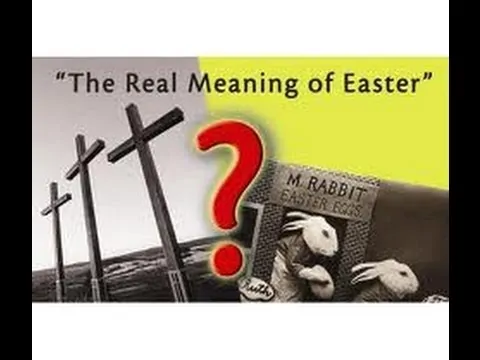
Every spring, billions of people celebrate Easter with eggs, bunnies, and chocolate — yet ask the average person what these symbols have to do with Jesus, and they will struggle to answer. That is not a coincidence. In this eye-opening episode of The Deen Show, historian and Islamic scholar Dr. Abdulhakim Quick — a PhD graduate of the University of Toronto and author of Holiday Myths — traces Easter back to its pre-Christian pagan roots, examines what Islam actually teaches about Jesus (peace be upon him), and explains why sincere seekers of spiritual truth deserve a clearer picture. For Muslims, Jesus is not a stranger. No one can be a Muslim without believing in him as a mighty Messenger of God, sent to the Children of Israel with the same eternal message every prophet before him carried: worship the Creator alone.
Jesus in Islam: A Prophet of Pure Monotheism
The Islamic understanding of Jesus (known in Arabic as Isa, the Semitic form of his name) is rooted in what Dr. Quick describes as the unbroken stream of tawhid — pure, undivided monotheism. From Abraham to Jacob, Moses to Jesus, and finally to the Prophet Muhammad (peace be upon all of them), every messenger arrived with one foundational call, confirmed in the Quran (16:36): “We have sent to every nation a messenger that they worship one God and stay away from false gods.” Jesus himself, according to both the Gospel record and the Quran, never claimed divinity. He healed the sick, gave sight to the blind, and performed miracles — but always said: “I did this by the permission of God. I am a vessel of the power and mercy of the Creator.” He was a humble carpenter whose real appearance — curly hair, skin described in biblical texts as “like burnt brass” — bore no resemblance to the famous Sistine Chapel image painted by Michelangelo using his own uncle as the model. The message mattered far more than the image, and that message was unambiguous monotheism. The Quran also addresses what happened at the crucifixion directly, in a verse Dr. Quick quotes as the word of the Creator Himself:
“They did not kill him and they did not crucify him, but it was made to appear to them that they did.” — Quran, Surah An-Nisa (4:157)
- Islam honours Jesus as one of the greatest messengers of God — belief in him is a pillar of Islamic faith
- Jesus never explicitly called people to worship him as God, nor claimed to be the literal biological son of the Creator
- The Quran points to his humanity simply: “They (Jesus and his mother) used to eat food” — a being who eats, hungers, and is sustained is created, not the Creator
- Islam holds that Jesus was raised by God, was spared the humiliation of crucifixion, remains alive, and will return before the Day of Judgement
- The religion Jesus practised was submission to one God — the very definition of Islam
Where Easter Really Comes From: Pagan Spring Cults and the Amalgamation of Beliefs
The name Easter itself reveals its origins. Dr. Quick explains that across northern Europe, the spring solstice was celebrated through a nature cult devoted to a goddess called Eostre (or Aestray) — a deity of fertility and renewal whose wand, it was believed, turned the dead world of winter green again. This is why Easter’s symbols — eggs, rabbits, lilies, chicks — are not symbols of resurrection theology but of fertility and the natural cycle of life. When the followers of Jesus encountered these deeply embedded European traditions, something historically predictable happened: amalgamation. The narrative of death and resurrection was layered over the existing pagan spring festival so that both nature-worshippers and those carrying remnants of Jesus’s message could celebrate side by side. Dr. Quick draws a parallel to the cult of Mithras — a pre-Christian deity whose followers observed Sunday as his sacred day, placed ashen marks on their foreheads, practised communion with bread and wine, and believed he was the son of God who sacrificed himself for humanity. These practices preceded Jesus by centuries, yet were absorbed into the tradition that would bear his name. Similarly, the doctrine of the Trinity — Father, Son, and Holy Spirit — was not a new revelation but traces back to Platonic philosophy, ancient Egyptian theology (Horus, Isis, and Osiris), and Hindu concepts that long predated Christianity. This historical record is not an attack on sincere Christians; it is an invitation to separate what Dr. Quick calls “folk culture from revelation” — to ask what the prophets themselves actually taught, stripped of the centuries of mythological overlay.
The Call Back to Pure Guidance: Fitrah, Direct Prayer, and the Straight Path
“We want to go back to the pure teachings that would be in line with the original teachings of Abraham, Jacob, Moses, Jesus, and Muhammad — peace be upon them all. That is the family of Islam. We don’t see a difference between ourselves and the original pure followers of Moses, the pure followers of Jesus. We are all originally coming from the same source.” — Dr. Abdulhakim Quick
One of Islam’s most spiritually clarifying gifts to humanity is what Dr. Quick describes as direct access to the Creator — no priests, no intermediaries, no intercessors between the human soul and God Almighty. The Prophet Muhammad (peace be upon him) taught that every child is born on the fitrah, a natural, innate disposition toward the oneness of God. It is environment, culture, and society that pulls a person away from that factory setting. In an age of information overload, competing ideologies, and rampant worship of wealth, status, and desire, Dr. Quick’s call is quietly radical: humble yourself, investigate the original sources, and pray directly to the One who created you. Muslims repeat this in every unit of every prayer — Ihdina as-sirat al-mustaqim, “Guide us to the straight path” — not as a formality, but as an acknowledgement that guidance is a gift from God alone, not something manufactured by ritual, inherited by birth, or purchased by performance. For anyone who has felt that Easter, Christmas, and the theology built around them do not quite satisfy the soul’s deeper question — for those unsettled by the Trinity, drawn to the figure of Jesus but unable to accept his divinity — the Islamic perspective offers not a foreign religion but a return to the religion of Jesus himself: pure, direct, unmediated worship of the one God who created the heavens and the earth, who existed before all things, and who is far beyond any human or natural quality we could attribute to Him. That is the message the prophets never deviated from, and it remains, as Dr. Quick closes, the teaching human beings most need to return to in this turbulent age.