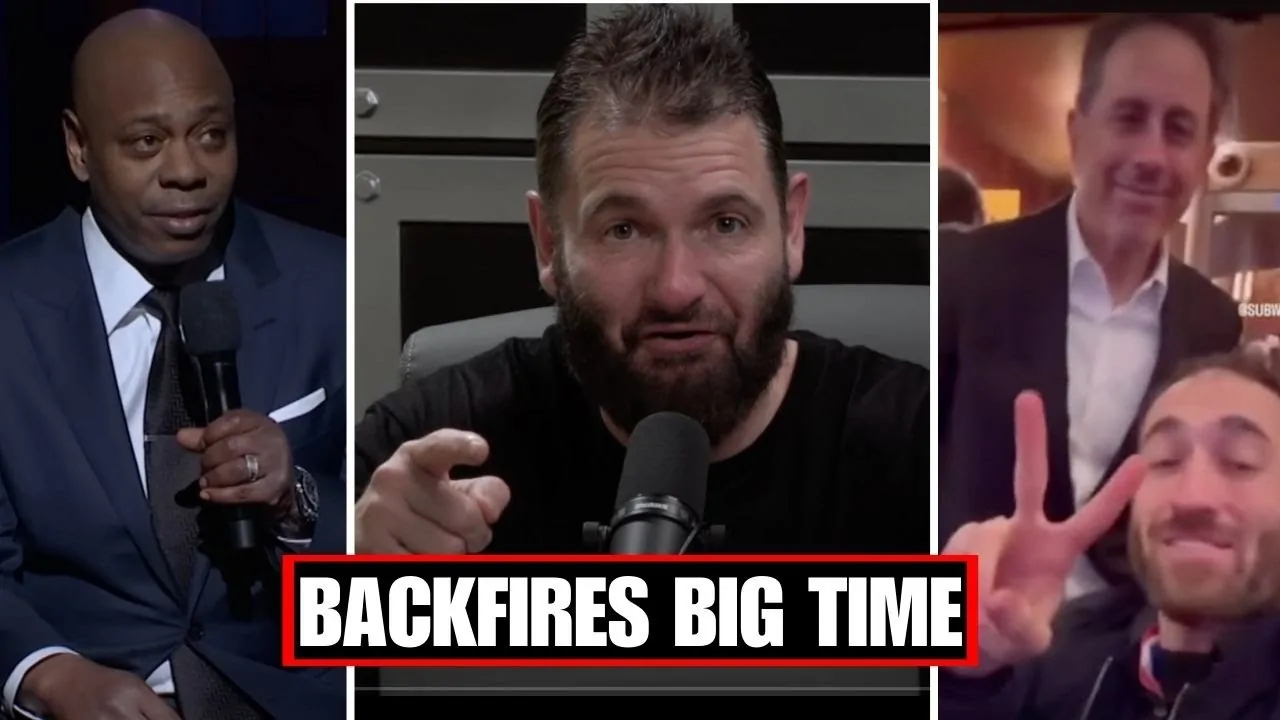
What does it reveal about a person — or a civilization — when they can no longer find empathy for the displaced, the grieving, or the innocent? In a single episode that has resonated deeply with viewers of faith and conscience, The Deen Show places two of America’s most recognizable comedians side by side and asks that very question. Jerry Seinfeld, confronted by a fan asking about Palestine, offered three blunt words: “I don’t care.” Dave Chappelle, recounting his own spiritual journey through the Middle East, described being moved to tears by a former American president’s act of moral courage — a moment that cut through the noise of politics and touched something profoundly human. In Islam, the Prophet Muhammad ﷺ described the believers as one body: when one part suffers, the whole body responds. The contrast between these two men is not simply about celebrity opinion — it is a mirror held up to all of us, asking how much of our humanity we have quietly allowed to be extinguished.
The Courage to Care: Dave Chappelle, Jimmy Carter, and the True Standard of Greatness
Dave Chappelle was in the Middle East during a period of deep personal and spiritual searching — stepping away from Hollywood to find purpose and meaning beyond the spotlight. It was there that he witnessed something he said he would never forget: former President Jimmy Carter, despite being warned by the Israeli government that entering the Palestinian territories was “too dangerous” and that they could not protect him, went anyway. He walked through those streets with little to no security, surrounded by thousands of Palestinians who cheered him on — a former leader of the most powerful nation on earth choosing solidarity over safety, principle over protection. Chappelle described the image bringing tears to his eyes, and his words carry a moral clarity that is rare in public life:
“I don’t know if that’s a good president, but that right there — I am sure is a great man.” — Dave Chappelle
- Empathy is not political — it is human. Chappelle’s response to Carter’s courage was not ideological; it was instinctive, rooted in recognising shared dignity across division and distance.
- Spiritual searching opens the heart. Chappelle’s time away from fame seeking purpose and guidance made him more attuned to others’ suffering — proximity to sincere reflection draws us closer to our shared humanity.
- Contrast reveals character. Seinfeld’s “I don’t care about Palestine” is rendered all the more stark when placed beside Chappelle’s tears — wealth and fame cannot substitute for a conscience.
- Islam’s call to empathy is universal. The Quranic principles of adl (justice) and rahmah (mercy) apply to all of humanity. Standing for the oppressed is an act of faith and a mark of genuine spiritual health.
- History remembers those who chose courage over comfort. Carter’s walk into Palestinian territory with no security detail was not just political bravery — it was a human being refusing to look away.
When Hate Devours Itself: The Miami Shooting That Mainstream Media Refused to Cover
Perhaps the most disturbing story in the episode is one that barely registered in the mainstream press — and the silence itself is the story. In Miami, a man opened fire on two individuals inside a vehicle, unleashing not two shots, not four, but seventeen rounds — because he believed they were Palestinian. They were not. The two victims were Jewish men, and yet upon recovering in hospital, they took to social media to post “death to Arabs.” Three complete strangers, all united by a shared ideology of dehumanisation, all ultimately consumed by it: the shooter so blinded by hatred he could not tell friend from enemy, and the victims so conditioned by that same ideology they deflected blame onto the very people they had been taught to despise. The host raises the question that every person of conscience should sit with: if the shooter had an Arabic name — if he had any connection to Islam — would the FBI have been called immediately? Would it have led every news bulletin across the country? The answer, felt if not spoken, is obvious.
“Do not forget your humanity, and please have empathy for displaced people — whether they’re in the Palisades or in Palestine.” — The Deen Show
This is where blind hate ultimately leads: not to victory, not to security, but to a self-consuming spiral in which the ideology being so fiercely defended destroys those who carry it. From an Islamic perspective, the Quran is unequivocal — the unjust taking of a single innocent life is as if all of humanity has been killed, and its preservation is as if all of humanity has been saved (Surah Al-Ma’idah, 5:32). True faith, genuine spirituality, and sincere guidance all point in the same direction: toward seeing the human being in front of you, regardless of their background, language, or origin. This episode is not ultimately about Jerry Seinfeld or Dave Chappelle — it is about a choice available to every one of us, every single day. The heart that has grown hard toward one group of suffering people does not stop there. But the heart that remains open, that refuses to stop caring even when the world makes it costly to do so, reflects something the Quran calls fitrah — the innate human nature that recognises truth, feels compassion, and leans toward justice. May Allah ﷻ keep our hearts alive to the suffering of all people, and may we never become so captured by ideology, tribalism, or apathy that we forget the sacred humanity in every soul He created.