
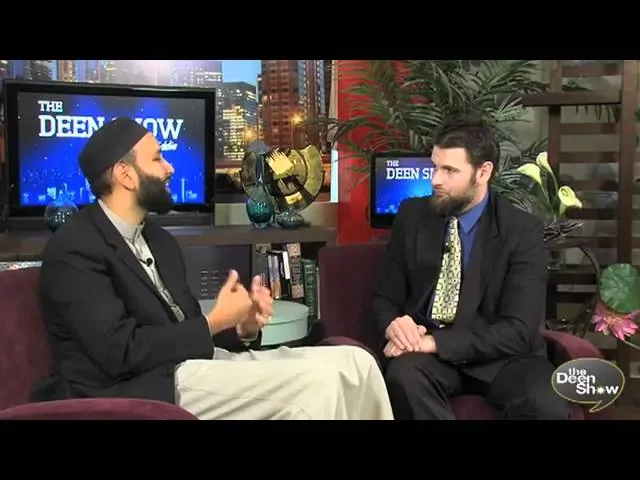
Every time a Muslim says alhamdulillah — through a flat tyre, a difficult marriage, financial hardship, or even the best day of their life — they are making a profound theological statement: that all praise, in every condition, belongs to Allah alone. This is not a cultural habit or an empty phrase. It is the very foundation of Islamic spirituality, a lived acknowledgement that every faculty we possess, every breath we draw, and every blessing we enjoy flows entirely from the One who created us. In a world saturated with distraction — entertainment, ambition, social noise — the question Sheikh Omar Suleiman poses cuts straight through: Are you actually being grateful? Not just in words, but in worship, in obedience, and in the daily orientation of your heart toward your Creator?
Shukr and Dhikr: Gratitude as the Core of Worship
“And if you should count the favors of Allah, you could not enumerate them. Indeed, Allah is Forgiving and Merciful.” — Quran 16:18
The Arabic concept of shukr (gratitude) in Islam goes far beyond saying thank you. It means recognising that the source of every single blessing — your eyesight, your ability to blink, the food you eat, the limbs you move — is Allah subhanahu wa ta’ala. Sheikh Omar Suleiman illustrates this through the story of Ibrahim Adam, a great scholar of Islam, who was once approached by a man asking permission to sin. The scholar’s response was striking: sin against Allah in a place He cannot see. The man replied that Allah sees everywhere. Then sin in a place that does not belong to Him. But everything belongs to Allah. Then sin without using the limbs, the sustenance, and the provision He gave you. The man fell silent — because the very capacity to disobey is itself a gift from the One being disobeyed. This is why the scholars said that gratitude is not merely an emotion but a total posture of the self: your heart acknowledges the blessing, your tongue praises Allah, and your limbs obey Him. It is also why Shaytan’s primary strategy was never violence or fear — it was ingratitude. His challenge to Allah was explicit: You will not find the majority of Your servants to be grateful. Disobedience is born from ingratitude; obedience is born from gratitude. Key lessons from this section include:
- Gratitude in Islam is active, not passive — it manifests in worship, obedience, and remembrance of Allah (dhikr).
- Even the ability to thank Allah is itself a blessing — one scholar noted that if you die saying alhamdulillah, you still owe Allah an alhamdulillah for granting you that very ability.
- Shaytan’s weapon is ingratitude — when we forget Allah’s favours, we become susceptible to disobedience, just as teenagers who forget the sacrifice of their parents stop honouring them.
- The Quran commands the pairing of dhikr and shukr — Allah says: Remember Me; I will remember you. And be grateful to Me and do not deny Me (2:152).
- No single blessing is singular — the blessing of a hand contains hundreds of blessings; the blessing of a mother contains thousands; gratitude, when sincere, multiplies your perception of Allah’s generosity.
When Blessings Become a Trial: The Danger of Forgetting Allah After Receiving
One of the most sobering patterns Sheikh Omar describes is that of a man who came to Islam at the lowest point of his life — sleeping in his car, estranged from his son, without a penny to his name. He embraced the faith, prayed, attended Jumu’ah, sought the company of righteous brothers, and began to build a life rooted in tawakkul. Allah opened doors: a business, financial stability, and eventually a restored relationship with his son. Yet once the blessings arrived, the prayer slipped. The adhan became an irritation. The gratitude that had been so vivid in hardship evaporated in comfort. This is precisely what the Quran warns against — and precisely the subtlety that is so easy to miss.
“And [remember] when your Lord proclaimed: If you are grateful, I will surely increase you [in favour]; but if you deny, indeed, My punishment is severe.” — Quran 14:7
The profound insight Sheikh Omar draws from this ayah is that gratitude brings increase — but increase does not automatically bring gratitude. The Prophet Muhammad ﷺ illustrated this in a du’a asking Allah to grant expansion in his home — not for a bigger house, but for barakah in the small one he had. Contentment rooted in gratitude creates a felt sense of abundance; the relentless chase for more, without gratitude, creates an emptiness that wealth cannot fill. The Prophet ﷺ also reminded us that if the son of Adam were given a valley of gold, he would want another — because the heart only finds its rest in the remembrance and gratitude of Allah. True faith in Islam is evidence-based and intellect-engaging: it asks us to look at the created world, reflect on the inestimable favours surrounding us at every moment, and consciously direct our lives back toward the One who gave them. To be Muslim is to make that conscious choice — not by birth or habit alone, but through a living, grateful, obedient relationship with Allah. May Allah make us from the grateful, the shaakireen, and grant us the blessing of meeting Him while our hearts are full of His praise.