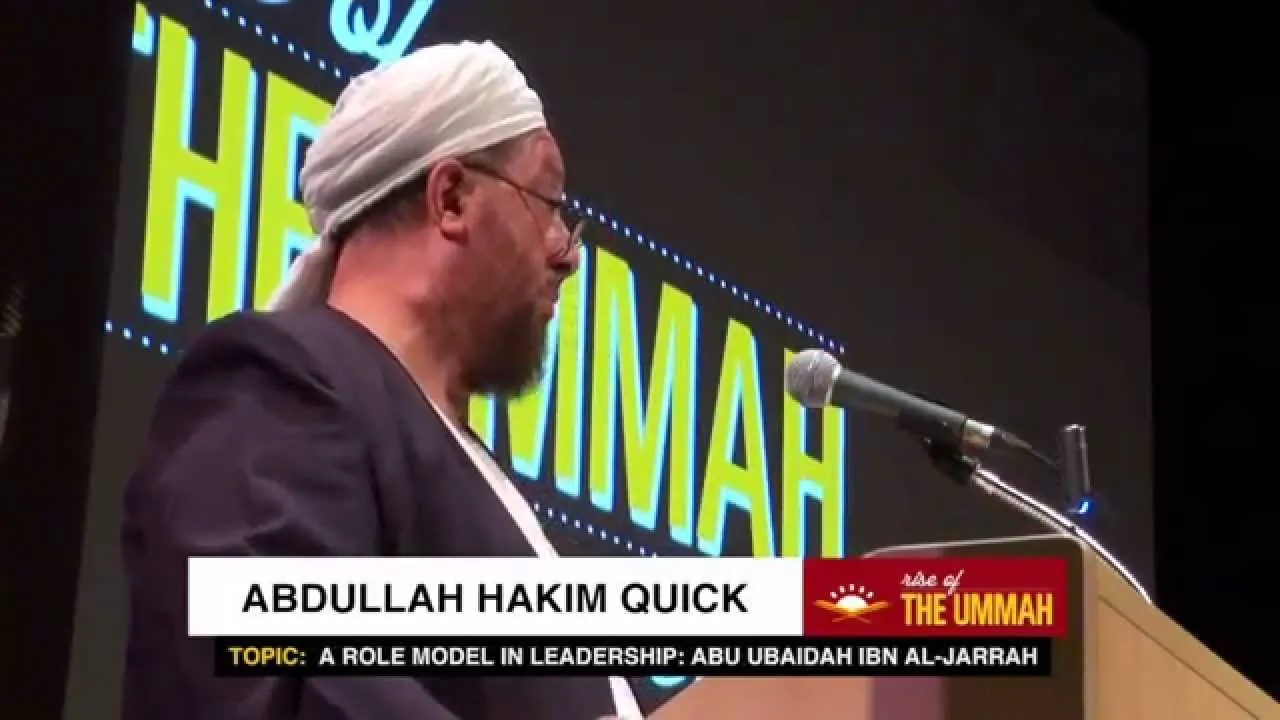
In a world of rising political tensions, environmental crises, and a Muslim ummah that grows ever larger yet often struggles to find coherent direction, the question of leadership has never been more urgent. Dr. Abdullah Hakim Quick — historian, social activist, and Director of Outreach for the Canadian Council of Imams — brings a powerful answer from the earliest generation of Islam: Abu Ubaidah ibn al-Jarrah (radiyaAllahu anhu), one of the most underappreciated companions of the Prophet Muhammad (peace be upon him). In this episode of The Deen Show, Dr. Quick makes the case that Abu Ubaidah’s life is not merely a historical footnote but a living blueprint — one that Muslim youth today desperately need to rediscover, study, and embody as the ummah navigates one of the most consequential crossroads in its history.
The Character of Abu Ubaidah: Where Humility and Strength Become One
What made Abu Ubaidah (RA) extraordinary was not military brilliance alone — it was a rare, almost paradoxical combination of qualities that Islam recognises as the hallmark of genuine leadership. He possessed profound modesty and a shyness that could be mistaken for weakness by those who did not understand Islamic spirituality, yet in moments of crisis he was described as the bright edge of the sword — fierce, focused, and unflinching. He was easy to approach, warm in company, and never made those around him feel judged or suspected. His truthfulness was such that when you spoke to him, he received you at face value, entirely free of prejudgment or cultural bias. Dr. Quick contrasted this with the extremes visible today: leaders who project intimidating power on one side, and those so meek they are pushed aside on the other — reminding the audience that the balanced quality of polite humility combined with principled strength is precisely what this generation is called to cultivate as a matter of faith and purpose.
- Hayaa (modesty) as a strength, not a weakness: In Islam, shyness means knowing one’s place before Allah and acting accordingly — while still rising to meet danger with full courage when called.
- No prejudgment of others: Abu Ubaidah (RA) did not judge people by their tribe, nationality, or appearance — a radical quality of spiritual innocence in a world that defaults to pre-judgment and suspicion.
- Complete loyalty to Islam over tribe: At a time when tribal allegiances defined identity entirely, his primary loyalty was to the brotherhood of believers — not ethnicity, bloodline, or cultural belonging.
- Commitment with flexibility: Deeply grounded in faith, yet flexible enough to engage non-Muslims with justice, live among them, and carry the mercy of Islam to them without compromising a single principle.
- No greed for power or position: He never campaigned for leadership. He waited patiently, understanding that the most qualified — not the most ambitious — should lead the believers.
- Extraordinary patience under hardship: On long military campaigns he sustained himself on a single date per day — breakfast, lunch, and dinner — without complaint or wavering in his guidance and loyalty.
“In Islam, a shy person is not a weak person. Shyness means you know when to speak and when to be silent — but in the face of danger and falsehood, Abu Ubaidah was described as the shining side of the sword.” — Dr. Abdullah Hakim Quick
What Abu Ubaidah’s Legacy Demands of Muslim Youth in This Generation
Dr. Quick situates this lecture within a sobering global reality: the Muslim ummah is rising in numbers and possesses immense collective wealth, universities, and technology — yet crushing poverty, disunity, and spiritual drift persist within its ranks simultaneously. He draws a powerful parallel with Sultan Muhammad al-Fatih, whom his teachers prepared from early childhood for the mission of opening Constantinople, channelling his growth with deliberate direction and spiritual guidance. Rising in number, Dr. Quick warns, is not enough — rising without direction is like a sleeping giant stumbling awake with no compass. The real lesson Abu Ubaidah’s life holds for Muslim youth lies in his final counsel before his death during the great plague: establish the foundations of Islam properly; remain united as one body; do not conceal the truth from those who lead you; and do not be deceived by the glitter and vanity of this world. This generation — diverse in nationality, language, and background, uniquely positioned across every continent — carries an amanah (trust) that no previous generation of Muslims has held in quite the same form, and the qualities of Abu Ubaidah (RA) are the very qualities needed to fulfil it.
“Commitment and flexibility — that is what we need. Completely committed to Islam, yet flexible enough to go among people of other faiths, deal with them justly in their societies, and establish the justice and mercy of Islam through your very life.” — Dr. Abdullah Hakim Quick
The life of Abu Ubaidah ibn al-Jarrah (RA) is a mirror that reflects both the heights Islam asks us to reach and the grounded, human character required to get there. He was not a superhero of legend — he was a man who chose, again and again, to place loyalty to Allah and His Messenger above comfort, tribal pride, personal ambition, and even physical safety. For Muslim youth navigating identity crises, institutional disunity, and a world pulling in a hundred directions at once, his example offers not a nostalgic fantasy but a timeless, practical model of faith in action — proof that strength and humility are not opposites, that commitment and openness can coexist, and that real leadership begins with the quiet reformation of one’s own self. As Dr. Quick reminds us, the answer to the question of what will replace the broken systems of this world begins not in politics or economics alone, but in building generations who carry the qualities Abu Ubaidah (RA) embodied so completely: truthful, humble, unafraid, united, and firmly rooted in the eternal foundations of Islam.