Of the billions of books ever written, none has been read more widely — or understood less accurately — than the Quran. In this episode of TheDeenShow, host Brother Eddie sits down with Dr. Sabil Ahmed to address that paradox directly: clearing misconceptions, answering the hardest intellectual objections, and building a cumulative case for why the Quran is not a human composition but the verbatim word of Allah (SWT), revealed as divine guidance for all of humanity — from heads of state to the person quietly searching for meaning and purpose in their own life. At a time when misinformation about Islam and its scripture spreads unchecked, this conversation offers Muslims a stronger footing and non-Muslims a fair, evidence-based introduction to the book that has shaped the faith, spirituality, and worldview of nearly two billion people.
The Quran Names Its Own Author — and No Other Scripture Does the Same
One of the most overlooked yet decisive arguments for the Quran’s divine origin is what the book says about itself. In Surah As-Sajdah (32:2), Allah declares the revelation to be from “the Lord of the Worlds” — naming Himself as Author with an authority and clarity found nowhere else in religious literature. Dr. Ahmed, who has personally studied the Old and New Testaments, the Hindu Vedas, Sikh scripture, and Buddhist texts, finds no comparable statement anywhere. Not one of the 27 books of the New Testament — from Matthew through Revelation — contains a passage where God explicitly claims authorship over that writing. The Quran goes further still: in Surah Al-Hijr (15:9), Allah not only claims revelation but guarantees preservation — a promise that has held intact for over 1,400 years. Unlike other scriptures that were altered over time, the Quran can be reconstructed in its entirety from the memories of millions of hafidh worldwide, should every physical copy vanish from the earth. Previous prophets were given miracles bound to their time and people — the parting of the Red Sea, the virgin birth, survival from the whale — witnessed only by those present. The Quran’s miracle, by contrast, is eternal, available to every generation, and open to scrutiny by any person on earth.
“The Quran, sent for all of humanity — for everyone, from the President of the United States to the President of every country — is the most widely read book in the world, but arguably the most misunderstood and misrepresented.”
- Divine authorship explicitly declared: Surah As-Sajdah (32:2) names Allah as the Author — a direct claim no book of the New Testament makes for God.
- Preservation promised by the Creator Himself: Surah Al-Hijr (15:9) is a living prophecy — the Quran stands today letter-perfect, memorised by millions across every continent.
- Unique among world scriptures: No other holy book combines authorial declaration, a self-preservation promise, and an open falsification challenge in a single text.
- Miracles of prior prophets were time-bound: The Quran’s miracle transcends the boundaries of time, space, and people — making it the ultimate and final miracle sent to mankind.
The Unanswered Challenge: Why Arabic Masters Chose War Over Words
The 7th-century Arabian Peninsula was the golden age of Arabic eloquence — every city had its poets, every tribe prided itself on linguistic mastery. In English literature there was one Shakespeare; in that era, Dr. Ahmed observes, there were many Shakespeares on every block. Into that culture of supreme literary competition, Allah issued a graduated, eternal challenge: first in Surah Al-Isra (17:88), daring all of humanity and jinn combined to produce the likeness of the entire Quran; then narrowing to ten surahs in Surah Hud (11:13); and finally, in Surah Al-Baqarah (2:23), challenging anyone to produce just one surah — even among the Quran’s shortest, which contains as few as three verses. The scholars explain that anything composed in the Arabic language falls into one of three categories — poetry, prose, or a combination — yet when the Prophet Muhammad ﷺ recited the Quran, the Arabs found it transcended all three, existing in a dimension of composition entirely its own. Like engineers presented with a five-dimensional structure while only capable of designing in three dimensions, they were left speechless. Motivated, resourceful, and linguistically supreme, the opponents of Islam chose to fight 27 battles rather than sit down and write a counter-surah — because they could not. Even Abu Lahab, the Prophet’s own uncle prophesied in Surah Al-Masad to die as an enemy of Islam, had years to simply pretend to accept the faith and expose the prophecy as false — yet he never did, because even he could not bring himself to openly mock what left him, in private, without an answer.
“No one can claim what the Quran is claiming — with all the additional evidences — for it to be coming from the Creator Himself.” — Dr. Sabil Ahmed
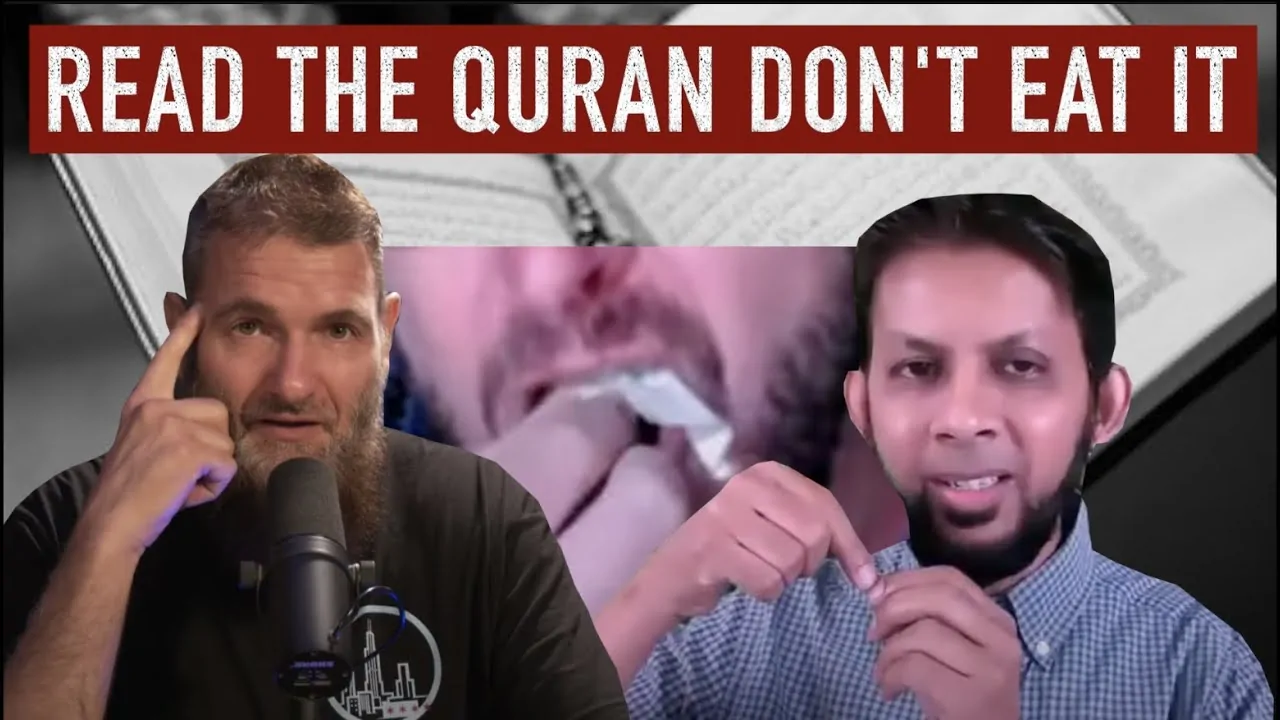
The Quran was never sent to be recited without comprehension, treated as a cultural relic, or — as Brother Eddie pointedly notes in this episode — “eaten” rather than understood. It is a book of guidance, of signs, of living proof — and the weight of the evidence it carries deserves honest, open-hearted engagement. For Muslims, this conversation is a reminder that the faith we hold rests on rational, verifiable foundations that have withstood fourteen centuries of scrutiny. For the sincere seeker of any background, the invitation remains what it has always been: read the Quran with sincerity, reflect on its claims, examine the evidence, and allow the word of the Almighty to speak for itself. In a world saturated with noise and misinformation, that quiet, deliberate engagement with divine revelation may be the most important act of spiritual courage any person can undertake.