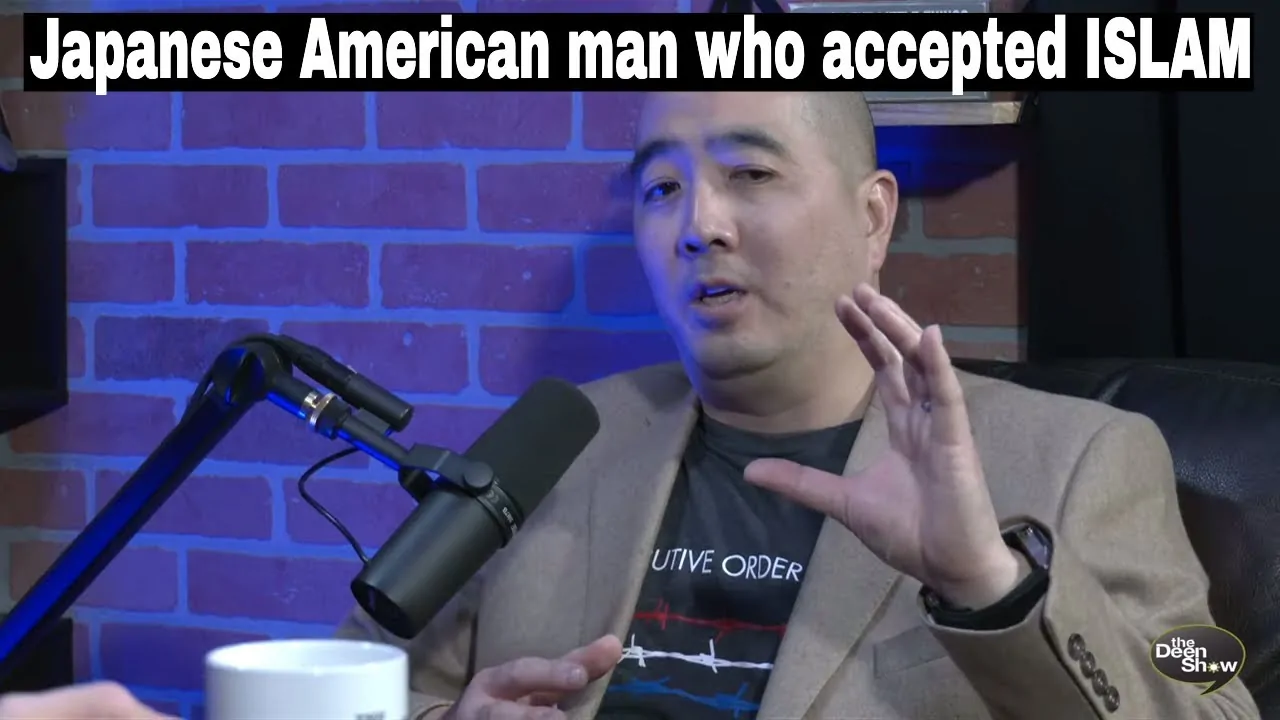
In 1942, the United States government issued Executive Order 9066, ordering over 120,000 people of Japanese ancestry — two-thirds of them American-born citizens — to abandon their homes, their businesses, and their livelihoods and report to makeshift holding sites carrying nothing but what fit in their hands. What followed is one of the most harrowing chapters of American history, a chapter that has been largely forgotten — and as guest Bryan Ozaki warns in this compelling episode of The Deen Show, that forgetting is precisely what makes it dangerous today. As rhetoric around Muslim registries, travel bans, and the surveillance of Islamic communities has re-entered mainstream political discourse, the question is no longer abstract: could history repeat itself?
America’s Concentration Camps: The Truth Behind the “Relocation Centers”
Bryan Ozaki’s parents were both incarcerated during World War II. His father’s family, from Seattle, was initially housed in horse stalls at a racetrack — given burlap bags to stuff with hay for bedding — before being transported by train with shades drawn to the Minidoka camp in the desolate desert of Twin Falls, Idaho. His mother and grandmother were separated from her father, who was sent to a Department of Justice camp in Santa Fe, and shuffled between three different camps throughout the war. Every internee was stripped of their name and issued a numbered tag. There was no trial, no hearing, no legal recourse — just a notice on a wall ordering them to appear at a designated location with what they could carry. The guard towers at these camps faced inward, not outward. Whatever the government claimed, this was never about protection. Businesses, farms, and properties were seized or sold for almost nothing; they were never returned. When survivors were finally released, they received $25 and a train ticket. Decades later, the Reagan administration issued $20,000 reparations to surviving internees — something Ozaki’s father described simply as a slap in the face.
“There was a lot of wartime hysteria, there was a lot of fear, there was already an anti-Asian sentiment happening way before 1941 — and this was just an excuse.”
- Over 120,000 Japanese Americans were forcibly incarcerated — actual numbers may be higher, including individuals brought from Alaska and Peru
- Two-thirds were US-born citizens whose constitutional rights were suspended without evidence of wrongdoing
- Families arrived at horse stalls, open fields, and state fairgrounds before permanent camps were built — makeshift barracks with tar paper walls that let in dust and snow
- Internees were stripped of their names and assigned numbered identity tags, reducing them to figures in a ledger
- Homes, farms, and businesses were stolen or sold for almost nothing and never recovered
- The generational trauma was so severe that Ozaki’s own parents refused to speak about the camps for decades — he had to painstakingly pull the history out of them
Recognising the Pattern: Solidarity, Islam, and the Urgent Lessons of the Present
When the Muslim travel ban was announced, Japanese American survivors and their descendants were among the very first to mobilise in solidarity — because they recognised the pattern immediately. The same fear-mongering, the same portrayal of an entire people as a threat, the same reduction of a diverse community to a dangerous monolith. As Ozaki makes clear, Muslims in America today — just like Japanese Americans in the 1940s — are citizens, soldiers, professionals, and neighbours. Yet media narratives and political rhetoric have manufactured a suspicion that rests on no evidence, just as wartime hysteria manufactured suspicion of Japanese Americans with no proof of disloyalty. What makes this episode particularly striking is Ozaki’s own spiritual journey: raised in a Buddhist household, having spent more than half his life among Muslims and defending Islam against misinformation long before he himself embraced it, he accepted Islam and describes the faith as giving him purpose, clarity, and a deep sense of his responsibility to serve humanity — all values that flow directly from the Quran, the Sunnah, and the Islamic principle that standing against injustice is an act of worship.
“Muslims are perceived as the other — but a Muslim can be Irish, Japanese, Mexican, Italian, white American. A Muslim is one who submits to the will of God, just as Jesus, Moses, Abraham, and Muhammad, peace be upon them all, did.”
The Quran reminds us that killing one innocent soul is like killing all of mankind — a principle that stands in absolute contrast to the indiscriminate violence and collective punishment that have historically been weaponised against vulnerable communities. Islam is not bound to any race, geography, or culture; it is a universal path of submission to Allah that transcends every constructed boundary of “us” and “other.” The lesson Bryan Ozaki carries from his family’s harrowing ordeal — and from his own journey to this faith — is both simple and urgent: ignorance breeds fear, fear breeds hatred, and hatred left unchallenged produces atrocities. Studying this history is not an academic exercise; it is an obligation for every person of conscience, every believer who understands that we will be questioned on the Day of Judgement not only for what we did, but for what we allowed to happen in silence. May Allah grant us wisdom to see through division, courage to stand on the side of justice, and sincerity to serve His creation as He has commanded us.