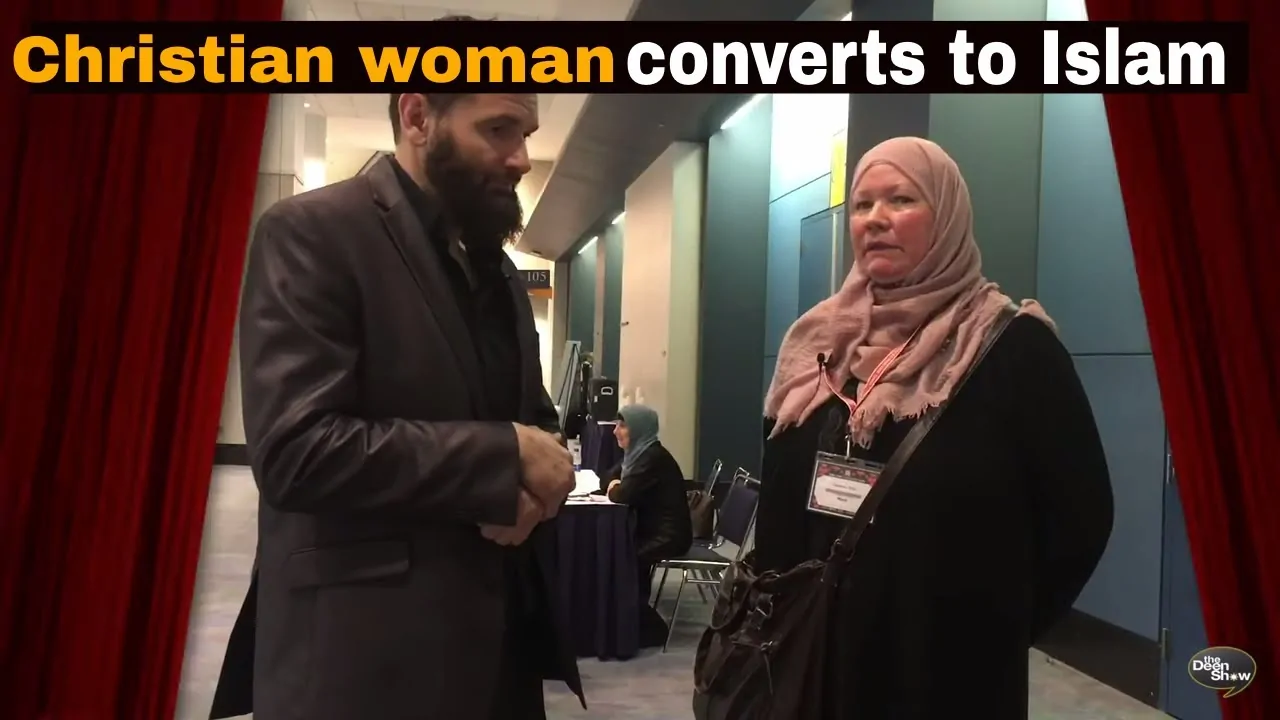
What does it take for a woman raised in secular Germany, who once stood at the threshold of a convent, to embrace Islam? For Suzanne, the answer was a quiet but persistent hunger for the Divine — one that neither a secular upbringing nor the walls of the church could fully satisfy. Her journey, shared on The Deen Show, is a powerful reminder that guidance is from Allah alone, and that He reaches those He wills in the most unexpected of ways. She took her shahada in 1989, and over thirty years later, she has not looked back once.
A Spiritual Hunger That Crossed Continents
Suzanne grew up in Germany in a household with no religious practice — her parents never attended church. Yet in her teenage years she sensed something profound beyond the visible world, a quiet pull toward the Creator. At 16, and against her parents’ wishes, she took her confirmation in the church — her first deliberate step toward God. By 18, she had enrolled in a Catholic nursing college surrounded by nuns who had devoted their lives entirely to a higher purpose, and something about that total surrender resonated deeply. She even made a private vow: if she had not found a life partner by the time she finished her three-year education, she would become a nun. Then, as only Allah’s plan unfolds, a year before she graduated, she met her husband — an Egyptian man who introduced her to Islam for the very first time. Having grown up in all-white German neighbourhoods, she had never encountered Arabs, the Quran, or the Deen before. After graduating in 1986, she moved to Egypt, immersing herself in the faith and its people. A month before her marriage in 1989, she took her shahada. When asked whether she carried any regrets, her answer was the most telling part of her story.
“My only regret is that I didn’t find it earlier.”
- Suzanne grew up in a secular German household yet felt a deep spiritual pull from a young age, showing that fitrah — the innate inclination toward the Creator — transcends culture and upbringing.
- She took her Christian confirmation at 16 against her parents’ wishes, demonstrating early courage in pursuing her spiritual convictions.
- Surrounded by nuns during her nursing training, she genuinely considered devoting her life to God through religious vocation — a longing Islam would ultimately fulfil more completely.
- She met her Egyptian husband through what she describes as divine providence, the encounter that first opened the door to Islam.
- She moved to Egypt in 1986 to deepen her understanding of the faith before formally accepting Islam in 1989, one month before her marriage.
- Good companionship — fellow reverts and righteous born Muslims — was, in her own words, the single most important factor in keeping her steadfast across the decades.
The Hijab, Inner Conviction, and the Example of Maryam
For the first two or three years after her conversion, Suzanne’s family tolerated her new faith because there was no visible outward change. The moment she put on the hijab, however, the dynamic shifted — and her family, up to the time of this interview, had still not fully accepted her as a practising Muslim. Yet for Suzanne, the hijab was never a point of contention — it was an act of love and conscious emulation of the noblest of women: Maryam, the mother of ‘Isa (peace be upon them both), who herself dressed with modesty and devotion to God. As a mother of two daughters, she was unequivocal: she had never forced the hijab upon them, because she understood that it must emerge from sincere love of Allah, not social obligation. The advice she offered sisters struggling with the hijab was both compassionate and spiritually grounded — take your time, build your knowledge of the Deen, become strong in your faith first, because wearing the hijab is not the challenge; keeping it on with conviction is the real test. She also called on non-Muslims in Europe — especially those shaped by a media narrative hostile to Islam — to approach the faith with an open mind, visit a mosque, ask questions freely, and above all, ask the Creator Himself for guidance.
“You cannot put on the hijab to please friends around you. You need to have the love for Allah and the religion enough to say: I am feeling comfortable and strong wearing the hijab.”
Suzanne’s story is ultimately a testimony to the universality of Islam’s call — reaching across language, culture, and background to touch every heart that sincerely seeks truth and purpose. She arrived at the door of Islam not through family pressure or cultural inheritance, but through her own spiritual search, a God-given curiosity, and the mercy of a Creator who guided her step by step. For Muslims navigating doubt or societal pressure, her journey offers a quiet but firm anchor: build your love for Allah first, and let that love be the foundation for every act of worship and every sacrifice you make for His sake. And for those still searching — from Germany, from Europe, from anywhere in the world — her final words remain the most profound invitation: ask the Creator for guidance, because He, and He alone, is the One who truly guides.