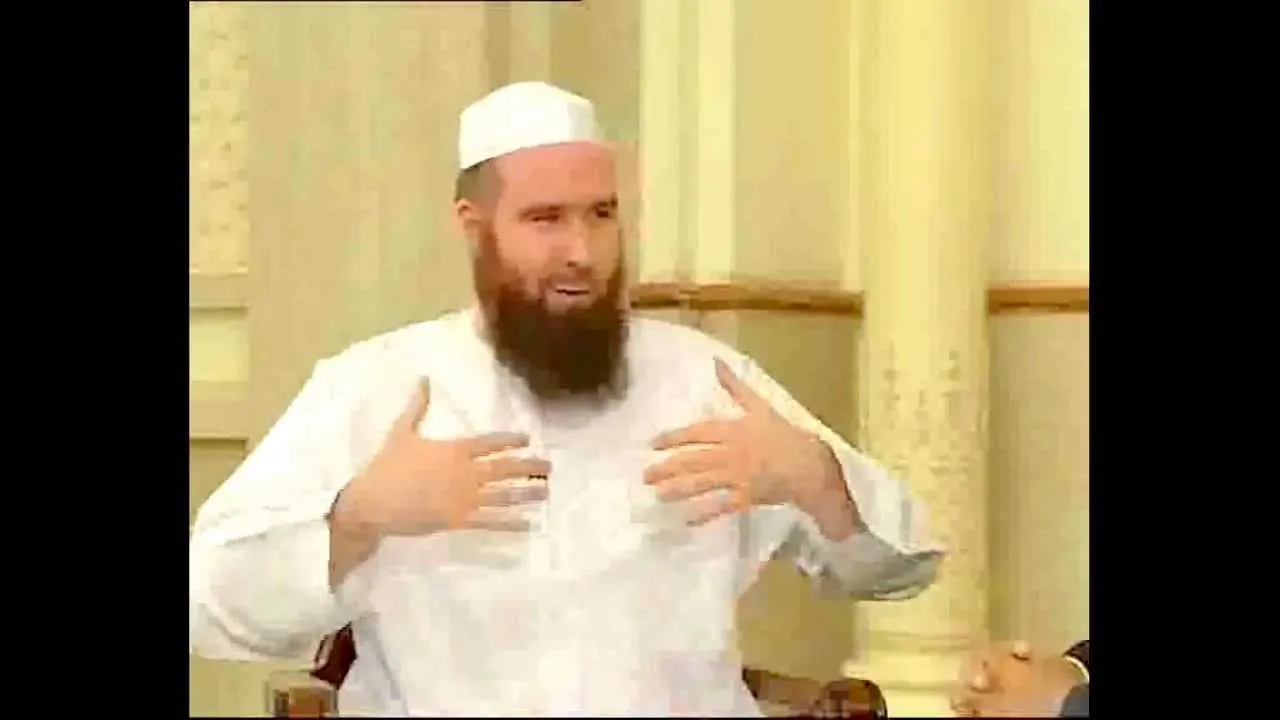
Some of the most profound journeys begin not with grand plans, but with a missed appointment. In January 1994, an 18-year-old Irish-American Catholic from the suburbs of Washington DC — raised on catechisms, the Trinity, and a lifestyle heading in entirely the wrong direction — sat down in a stranger’s living room, heard the Quran for the first time, and had a question burning in his heart: Can I, as a white man, even be a Muslim? That young man was Abdur Raheem McCarthy, and what followed was a journey of faith, sacrifice, and spiritual transformation that would carry him from the streets of Northern Virginia all the way to the Islamic University of Madinah. His story is a powerful reminder that Allah’s guidance arrives through the most unexpected of doors — and that the search for truth, purpose, and authentic spirituality is written into every human soul.
When a Missed Appointment Becomes a Divine Appointment
Abdur Raheem grew up in a good, hardworking Irish-American Catholic family, but by the age of 18, he had drifted far from the values his parents had tried to instil in him — dropping out in 11th grade, getting into trouble, and running with a crowd that could only lead to sorrow. Then came a chain of small, seemingly random events: his friend forgot their appointment, the Sega game had been taken to another house, and there was nothing to do but sit in a quiet living room and listen to a strange, beautiful recitation playing from a cassette tape. That recitation was the Quran. When he walked in and asked the friend’s father — a man who had himself embraced Islam a decade earlier — his very first question was whether a white man could be a Muslim. The answer was immediate and expansive: Islam is for all of mankind, regardless of race, colour, or background. Weeks later, a car accident without a driver’s licence forced him to stay home for a week — just long enough to finally open and read Islam: The Religion of Truth in a single sitting on a Thursday night. The concept of Tawheed — Islamic monotheism, the absolute oneness of Allah — pierced through the confusion of the Trinitarian theology he had grown up with. For the first time, the idea of One God, undivided and incomparable, resonated with something deep in his fitrah. He picked up the phone the very next morning and went to the Islamic Center in Washington DC, where he stood before the congregation and made his Shahada.
“Whether you’re black, brown, white — even if you’re purple and pink — Islam is the religion for all of mankind.” — Abdur Raheem McCarthy, recalling the words that answered his very first question about faith
- Tawheed was the turning point: The clarity of Islamic monotheism — One God, without partners, division, or intermediaries — immediately resonated with Abdur Raheem in a way the Trinity never had, and it remains the cornerstone of Islamic faith for every new Muslim.
- Divine decree works through ordinary moments: A forgotten appointment, a missing video game, a car accident without a licence — each apparent inconvenience was, in hindsight, part of a greater plan guiding him toward Islam.
- Islam’s purity laws left a deep impression: Reading about how Muslims cleanse themselves thoroughly before prayer — sitting down, using water, protecting the sanctity of their worship — resonated with him personally and reflected the dignity that Islam restores to daily life.
- The Shahada was declared publicly at the Islamic Center in Washington DC in January 1994, in front of the congregation — a public affirmation of a private conviction already settled in his heart.
- Two weeks later, Ramadan began — and he fasted the entire month without difficulty, a blessing he attributes entirely to the mercy of Allah in welcoming a new Muslim into the fold.
- Islam is a universal religion: As Abdur Raheem’s story illustrates, the media-driven misconceptions about Islam — that it belongs to one race or culture — collapse entirely when a person investigates the religion directly and honestly.
The Transformation That Cannot Be Hidden
One of the most compelling dimensions of Abdur Raheem’s journey is not simply that he accepted Islam, but how swiftly and visibly that acceptance changed him — and how those around him could not help but notice. His family, initially cautious, were won over not by theological argument but by the unmistakable transformation in his character. His grandfather, overheard on the phone with an old friend, captured it with disarming simplicity: “I don’t know what this Islam is… but he comes home on time, he’s respectful, he does his chores, he’s left his bad friends — whatever it is, I like it.” His mother’s only condition was equally uncomplicated: “As long as it makes you a better person.” The friends were a more difficult chapter. The pull of his old life was visceral — he would feel physically sick with the urge to go back to the streets. The decisive turning point came when he overheard one of those former friends say: “He claims he’s a Muslim, but there’s been no change — he’s just like us.” Those words landed like a lightning bolt and became the catalyst for a genuine, uncompromising commitment to his new faith. He grew his beard, adopted Islamic dress, gave up his gold chains and diamond earring, walked 2.7 miles to Fajr prayer in the cold, and eventually left America altogether to seek Islamic knowledge — first in Sudan, then through the Arabic Institute for Non-Native Speakers in Madinah, and finally graduating from the faculty of Da’wah and Usool ad-Deen at the Islamic University of Madinah after years of dedicated study under more than a hundred scholars.
“Islam is not difficult — we’ve just left something for something greater. And we know we get that something greater in the Hereafter. That’s what we’re striving for.” — Abdur Raheem McCarthy
The story of Abdur Raheem McCarthy is ultimately a story about the fitrah — the innate human disposition toward truth, purity, and closeness to the Divine that Islam describes as being woven into every soul at birth. From an Irish-American teenager wearing a gold cross who knew Islam only through headlines and misconceptions, to a graduate of one of the world’s most prestigious Islamic universities who teaches in Arabic, lectures across Khartoum, and has guided countless others toward the faith — his journey is a living testimony to what sincere guidance can do. For anyone searching for purpose, for anyone who senses that the life they are living does not match the life they were created for, his message carries a quiet urgency: Allah’s guidance can reach any heart, at any moment, through any door — even a borrowed book, a broken-down car, and a question asked in a stranger’s living room. The path to Islam is wide enough for every sincere seeker, regardless of their past. All it requires is an open heart and the willingness to bear witness — Ash-hadu an laa ilaaha illallah, wa ash-hadu anna Muhammadan rasulullah.