Fourteen hundred years before the advent of modern embryology, the Qur’an described the development of the human embryo with a precision that continues to astonish scientists and believers alike. At a time when the dominant understanding of human reproduction was rooted in myth and speculation, the divine revelation delivered to Prophet Muhammad ﷺ contained verses so anatomically accurate that their full significance could not be appreciated until the invention of the electron microscope and the era of advanced imaging technology. This convergence of spiritual guidance and scientific discovery is not coincidence — for those who reflect, it stands among the most compelling signs of the Qur’an’s divine origin, and a profound invitation to deepen one’s faith, purpose, and understanding of the human journey as designed by its Creator.
Between the Backbone and the Ribs: A Qur’anic Precision Science Has Only Recently Confirmed
Among the most striking passages in the Qur’an on this subject is Surah At-Tariq (86:5–7), in which Allah (سبحانه وتعالى) declares: “So let man see from what he is created! He is created from a water gushing forth, proceeding from between the back-bone (as-sulb) and the ribs (at-taraa’ib).” Classical scholars of Quranic exegesis — including Imam at-Tabari, Imam al-Qurtubi, and Ibn Kathir — engaged in careful scholarly debate over the precise anatomical meaning of sulb (backbone) and taraa’ib (ribs), with the weight of opinion holding that the verse describes the origins of both male and female reproductive material. Modern embryology has vindicated this reading in a remarkable way: the primordial cells of both the testes and the ovaries first form in the embryo in the region between the backbone and the ribs — precisely the anatomical area specified by the Qur’an — before migrating downward to their permanent locations in the body. Even after that descent, the arterial blood supply, venous drainage, lymphatic vessels, and controlling nerve pathways for both the testes and ovaries all trace back to that same region, as established by contemporary anatomy.
- The word sulb refers to the man’s spinal column; taraa’ib refers to the ribs — forming the region where reproductive cells first originate during embryonic life.
- Modern embryology confirms that gonadal cells (both testicular and ovarian) form between the backbone and the lowest ribs, then descend — testes to the scrotum, ovaries into the pelvis.
- The blood supply, nerve connections, and lymphatic drainage of the reproductive organs all continue to originate from this same region, even after the organs have fully descended.
- The Qur’anic use of bayna (“between”) — specifying a region, not a single structure — is not only linguistically eloquent but embryologically exact.
- This description was revealed 1,400 years before these facts were established through modern medical research and clinical anatomy.
“Can there be any doubt, after all this, that the testes and ovaries receive nourishment and blood from, and are connected to nerves that come from, between the backbone and the ribs? The material for formation of the sperm in the man and the eggs in the woman comes from an area between the backbone and the ribs, in addition to the fact that the sperm and eggs develop from cells that originate between the backbone and the ribs. So this verse is a complete miracle… The word ‘between’ is not only eloquent; it is also scientifically precise.” — Dr. Muhammad ʿAli al-Baarr, Khalq al-Insaan bayna at-Tibb wa’l-Qur’aan
Three Stages, One Truth: The Qur’an’s Sequential Map of Life in the Womb
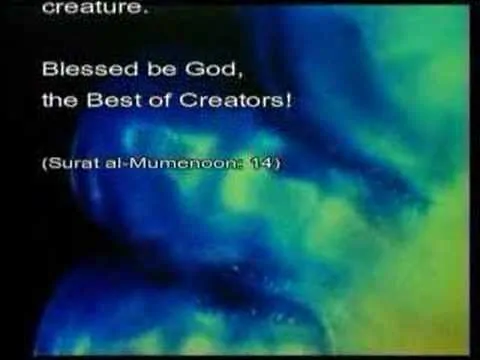
Beyond the origin of reproductive cells, the Qur’an maps the entire arc of embryonic development with a sequential detail that mirrors what modern textbooks describe as the three phases of intrauterine life — pre-embryonic (first 2.5 weeks), embryonic (up to the 8th week), and fetal (from the 8th week to birth) — a classification arrived at only through decades of scientific research and advanced imaging. Surah Al-Mu’minun (23:14) states: “We then formed the drop into a clot, and formed the clot into a lump, and formed the lump into bones, and clothed the bones in flesh, and then brought him into being as another creature — Blessed be God, the Best of Creators.” Until very recently, scientists believed that bones and muscles developed simultaneously in the embryo. The latest research has overturned that assumption entirely: bone tissue forms first, and muscle tissue develops around it afterwards — precisely the order the Qur’an described fourteen centuries ago. Surah Az-Zumar (39:6) adds a further layer, stating that Allah “creates you stage by stage in your mother’s wombs in a threefold darkness” — a description that maps onto the three anatomical layers surrounding the foetus: the amniotic sac, the uterine wall, and the mother’s abdominal wall. Each verse, when examined through the lens of contemporary embryology, yields a depth of spiritual and scientific meaning no human author of the seventh century could have possessed.
“All the information that we have so far regarding the development of the embryo in the mother’s womb has emerged from scientific research in the last 30 to 40 years, and this new information has enabled more new miracles of the Qur’an to be grasped.”
For the believer, the embryological verses of the Qur’an are far more than intellectual curiosities — they are a summons to deeper faith, humility, and spiritual reflection on the nature of creation and the wisdom of its Creator. The same God Who fashioned each human being from a drop of fluid, Who ordered the precise biological architecture of bones before flesh, and Who designed the reproductive system to trace its origins to a narrow region between the backbone and the ribs, is the One Who has prescribed a complete and merciful way of life through His final revelation. Islam has always encouraged the honest study of creation as an act of worship — the understanding that rigorous inquiry into the natural world leads, for those who reflect sincerely, back to the acknowledgement of an All-Knowing, All-Wise God. In an age of doubt and materialism, the Qur’an’s embryological precision stands as an enduring sign: a Book that understood the human body before humanity understood itself, and that continues to offer guidance, meaning, and spiritual purpose to every soul willing to look inward and reflect.