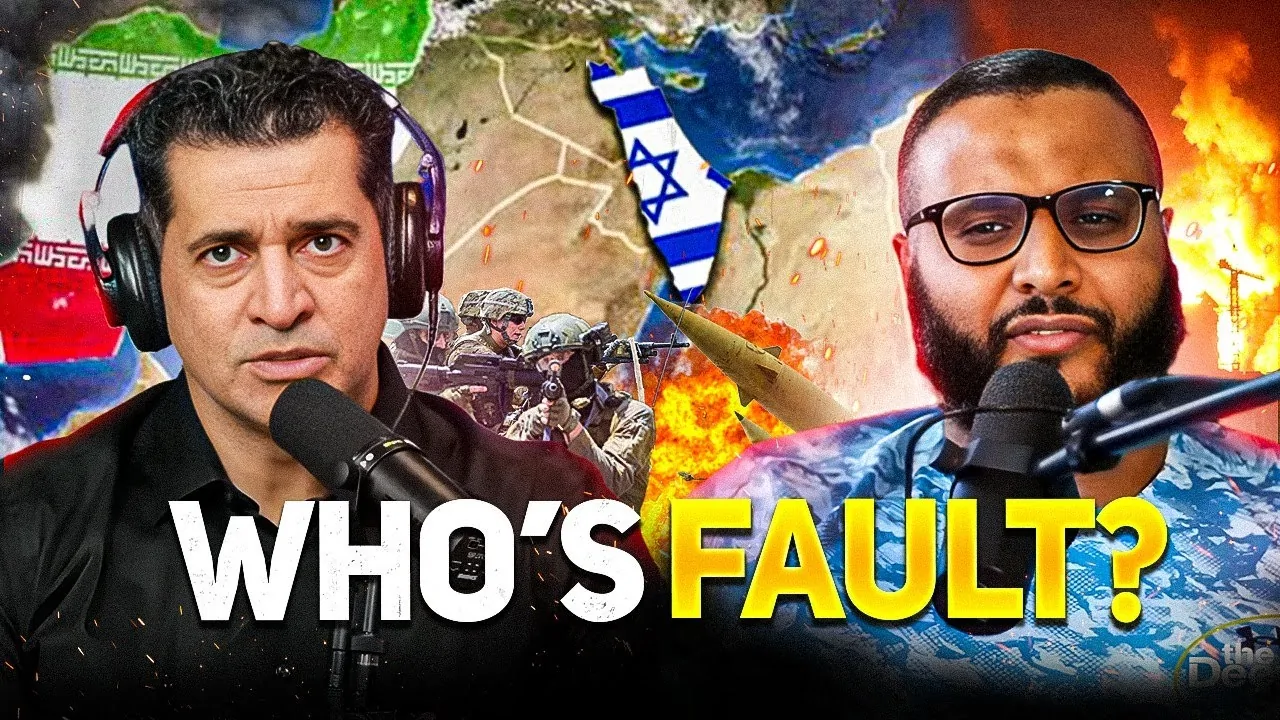
When public figures speak with confidence about history, politics, and religion without the knowledge to back it up, the consequences reach far beyond embarrassment — they shape the beliefs of millions. In a recent exchange that has since gone viral, Mohammed Hijab dismantled a deeply flawed historical argument made by Patrick Bet-David, who claimed there were no major wars in the Middle East during the Shah of Iran’s reign between 1948 and 1979 — apparently unaware that this exact period contains some of the most consequential conflicts in modern history. For Muslims and non-Muslims alike who care about truth, accuracy, and principled discourse, this moment serves as a powerful reminder of why historical literacy and intellectual humility are not optional extras in public debate — they are obligations.
A Factual Blunder of Historic Proportions
Patrick Bet-David, speaking with apparent authority, posed what he believed to be a rhetorical knockout: if Israel were truly the cause of Middle Eastern chaos, why was there no major war during the Shah’s era? The problem is that his entire premise was factually inverted. Mohammed Hijab, drawing on readily available historical record, dismantled the claim point by point, noting that the period Bet-David chose to highlight was in fact one of the most war-saturated in the region’s modern history. Far from supporting his argument, Bet-David had inadvertently selected the most devastating counterexample possible — and no one in his studio caught it.
- 1948 Arab-Israeli War: Fought at the very founding of Israel, involving multiple surrounding Arab nations — squarely within the period Bet-David claimed was peaceful.
- 1956 Suez Crisis: A major international conflict involving Egypt, Israel, Britain, and France over control of the Suez Canal.
- 1967 Six-Day War: One of the most dramatic and decisive military conflicts of the twentieth century, reshaping the entire region.
- 1973 Yom Kippur War: A large-scale coordinated offensive by Egypt and Syria against Israel, with global geopolitical repercussions.
- All four conflicts occurred before 1979 — the very period Bet-David insisted was free of major war.
“He said what major war was there between 1941 and 1979 in the Middle East — not realising that the most major wars were in that exact time period. This is such an embarrassment.” — Mohammed Hijab
Knowledge, Humility, and the Islamic Imperative of Truth
Islam places seeking knowledge — ilm — among the highest of virtues. The Prophet Muhammad ﷺ urged believers to pursue knowledge from the cradle to the grave, and Islamic scholarship has always demanded rigour, source verification, and the humility to acknowledge the limits of one’s understanding. What this episode illustrates is the precise opposite of that tradition: a wealthy, platform-empowered individual speaking as an authority on history, politics, and religion without the foundational knowledge those subjects require. Mohammed Hijab’s rebuke was not simply a point-scoring exercise — it was a principled call for intellectual accountability. He made clear that financial success does not confer expertise, that surrounding oneself with yes-men compounds ignorance rather than checking it, and that the Muslim community will continue to hold such voices to account with evidence, not just emotion. This is da’wah in the truest sense: defending truth with knowledge, calm confidence, and a willingness to engage directly.
“Having money and having knowledge are two separate things. Having money doesn’t mean that you have intelligence and knowledge. You cannot buy intelligence.” — Mohammed Hijab
The deeper lesson here extends well beyond one viral clip. In an era of algorithmically amplified misinformation, where confident voices routinely outpace careful ones, Muslims — and indeed all people of conscience — are called to be guardians of truth. The Islamic tradition of nasihah (sincere counsel) demands that we correct errors not out of arrogance, but out of a genuine concern for what is right. Whether in discussions of geopolitics, Islamic faith, or the lived experience of Muslim communities, accuracy is an act of worship. Bet-David still has the opportunity to do what any person of integrity would do: retract, correct, and commit to raising the standard of discourse on his platform. The door to honest dialogue, as Mohammed Hijab made clear, remains open — but it begins with the humility to say, “I was wrong.”