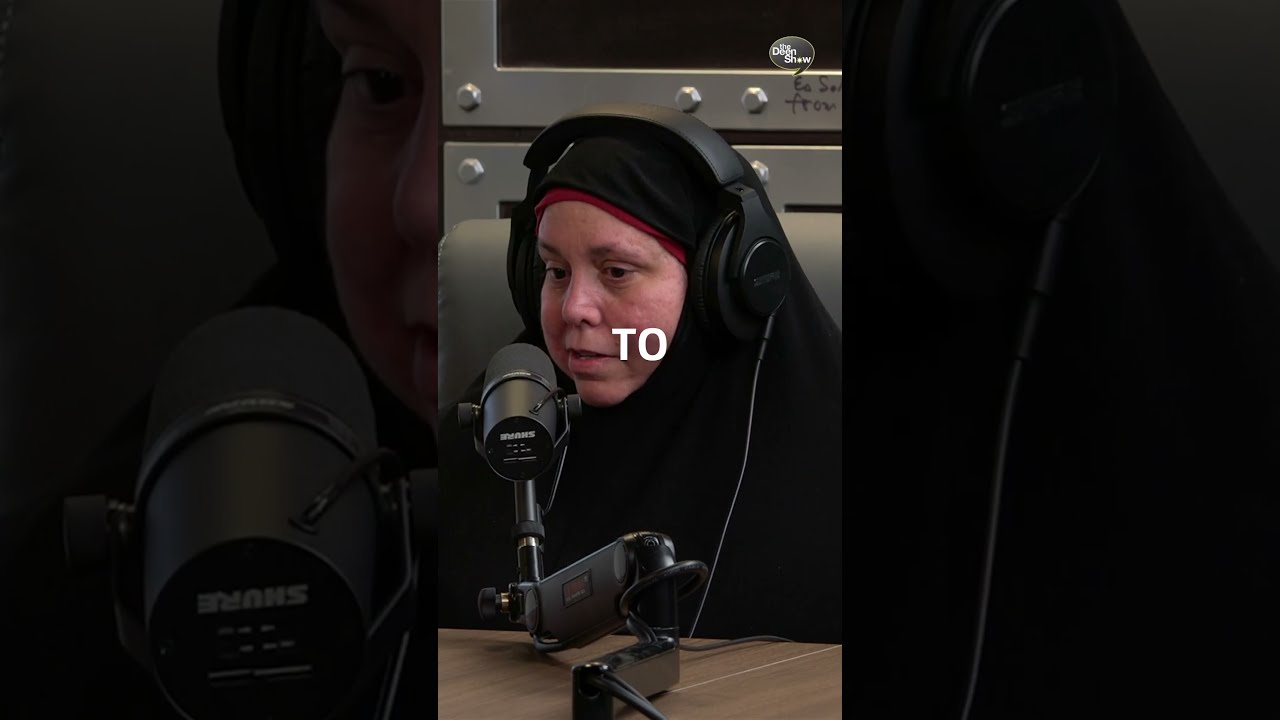

Few questions in theology carry more urgency than this: did God — the Creator of the heavens and the earth, beyond all human limitation — truly beget a son? For Muslims, engaging this question is an act of love, not hostility. No Muslim is a Muslim without believing in ‘Isa ibn Maryam (Jesus son of Mary), peace be upon him; he is honoured in Islam as one of the mightiest messengers, born of a miraculous virgin birth, given the Injeel (Gospel), and deeply beloved in every Muslim heart. Yet genuine love for a prophet means following what he actually proclaimed — not elevating him beyond his own words. Jesus, peace be upon him, called himself the “Son of Man.” The doctrine of “begotten Son of God” came later, from councils and creeds, not from his own lips. In this compelling episode of The Deen Show, Dr. Laurence Brown — a Cornell and Brown University graduate, Doctor of Divinity, PhD in religious studies, and a man who journeyed from atheism through Christianity to Islam after years of sincere study — presents five reasons, drawn from Christian scripture and church history itself, that challenge this foundational doctrine at its core.
Reasons 5 to 3: When Scripture, Language, and History Contradict the Doctrine
Dr. Brown’s investigation starts where most believers never look: the literal definition of the word “begotten.” In any standard dictionary, “begotten” means to procreate as a father — implying a carnal act. When Christians are pressed on whether they believe God had a physical relationship with Mary, virtually all recoil at the suggestion, recognising the blasphemy of such a claim. And yet that is precisely what the word means. If the term must be stripped of its literal meaning to suit theological comfort, the honest question becomes: why use it at all? Moving to reason four, the doctrine of “begotten not made” was not taught by Jesus or his companions — it was formulated at the Council of Nicaea in 325 CE, more than three centuries after Jesus, peace be upon him, had departed. Gregorious, the patriarch of Constantinople, reportedly called the Nicene Council’s pronouncements “the words of a drunken man.” Reason three draws directly from the Old Testament: in Psalms 2:7, God addresses David — not Jesus — saying, “You are my son; today I have begotten you.” If Jesus is the only begotten Son of God, how does this same divine language appear centuries earlier in reference to David? The phrase “sons of God” and “children of God” recurs throughout scripture as a metaphorical expression, one that all of ancient Israel used to describe their relationship with the Divine — not a literal biological claim reserved for one individual.
- Reason 5: The literal definition of “begotten” implies procreation as a father — a claim virtually all Christians reject when confronted directly, yet the word remains embedded in their creed.
- Reason 4: The doctrine of “begotten not made” emerged from the Council of Nicaea in 325 CE — a political and theological assembly, not a teaching of Jesus or his direct disciples — and was described by a leading Church patriarch as incoherent.
- Reason 3: Psalms 2:7 applies the word “begotten” to David centuries before Jesus, fatally undermining the claim that Jesus is the only begotten Son — the Bible’s own text contradicts the exclusivity the doctrine requires.
“You do not draw closer to God by exceeding the reality. If the prophet is saying ‘I am a man, I am not the Son of God,’ and yet you elevate him in status to the Son of God — this is not going to win you points in the Hereafter.” — Dr. Laurence Brown
Reasons 2 and 1: The Greek Word That Undermines Everything — and What Your Own Bible Confirms
Reason two takes the argument into the original Greek manuscripts. The word translated as “only begotten” is monogenēs — found nine times in the Bible. In three passages in Luke (7:12, 8:42, and 9:38), this same word is used for individuals other than Jesus, and in those instances translators do not render it as “only begotten.” More decisively, in Hebrews 11:17, monogenēs is applied to Isaac — yet Ishmael was born fourteen years before Isaac, and the Bible itself records God recognising Ishmael as Abraham’s son (Genesis 16:11, 16:15, 17:23, 17:25). How can Isaac be the “only begotten” son of Abraham when his older brother existed and was divinely acknowledged? The inconsistency reveals a deliberate theological agenda — the word is translated selectively to support a pre-determined doctrine, not faithfully to the text. The number one reason, however, requires no knowledge of Greek, no church history, and no Islamic scholarship: simply read a modern scholarly Bible translation. The Revised Standard Version, the New Revised Standard Version, the New International Version, the Good News Bible, the New English Bible, and the Jerusalem Bible have all removed “only begotten” from their text. These are the most widely sold and most academically rigorous translations in existence — and their scholars recognised the term was not supported by the earliest manuscripts, including the Codex Vaticanus and Codex Sinaiticus, both discovered after the King James Version was compiled in 1611.
- Reason 2: The Greek monogenēs (“only begotten”) is translated inconsistently — applied to non-Jesus figures in Luke without the “only begotten” rendering, and used for Isaac in Hebrews 11:17 despite Ishmael being born fourteen years prior and recognised by God himself as Abraham’s son.
- Reason 1: The most scholarly modern Bible translations — NRSV, NIV, Good News Bible, Jerusalem Bible — have already removed “only begotten” from their text, recognising it as textually unsupportable based on the earliest available biblical manuscripts.
- On capitalisation: The capital “S” in “Son of God” is a translator’s interpretive choice — none of the 5,400+ manuscripts from which the Bible is translated, whether Hebrew, Aramaic, or Greek, contain any capitalisation whatsoever.
- On the Trinity’s internal contradictions: If the Son proceeds from the Father, he cannot logically be co-eternal with him; if Jesus prayed to God, he cannot be co-equal with the Being he was beseeching — the doctrine of the Trinity fractures under its own terms.
“If you are a Christian, you do not need to trust me. Trust your own Bible. You will find that the biblical scholars themselves have removed this from the biblical text — they recognise that it is illegitimate.” — Dr. Laurence Brown
What these five reasons converge on is a truth that Islam has always affirmed with clarity and beauty: Jesus, peace be upon him, was exactly what he said he was — a human being, a prophet, bearing divine revelation, teaching tawheed (the absolute Oneness of God) and preparing hearts for the final messenger. Muslims do not diminish Jesus by calling him a prophet; they honour him as he deserved to be honoured, without addition, without distortion, and without the burden of doctrines that neither he nor his earliest followers ever professed. Dr. Brown himself captures it with moving sincerity when he says that by becoming Muslim, he did not leave Jesus behind — he found a deeper, purer way to follow him. The path of the prophets, from Ibrahim to Musa to ‘Isa to Muhammad, peace be upon them all, is one unbroken road of submission to the One God, each messenger carrying the light a step further. Islam is not the abandonment of that spiritual journey — it is its completion. For anyone sincerely asking whether the faith they hold reflects the reality God intended, the guidance of Allah is never far from the heart that seeks it with honesty, humility, and an open mind.