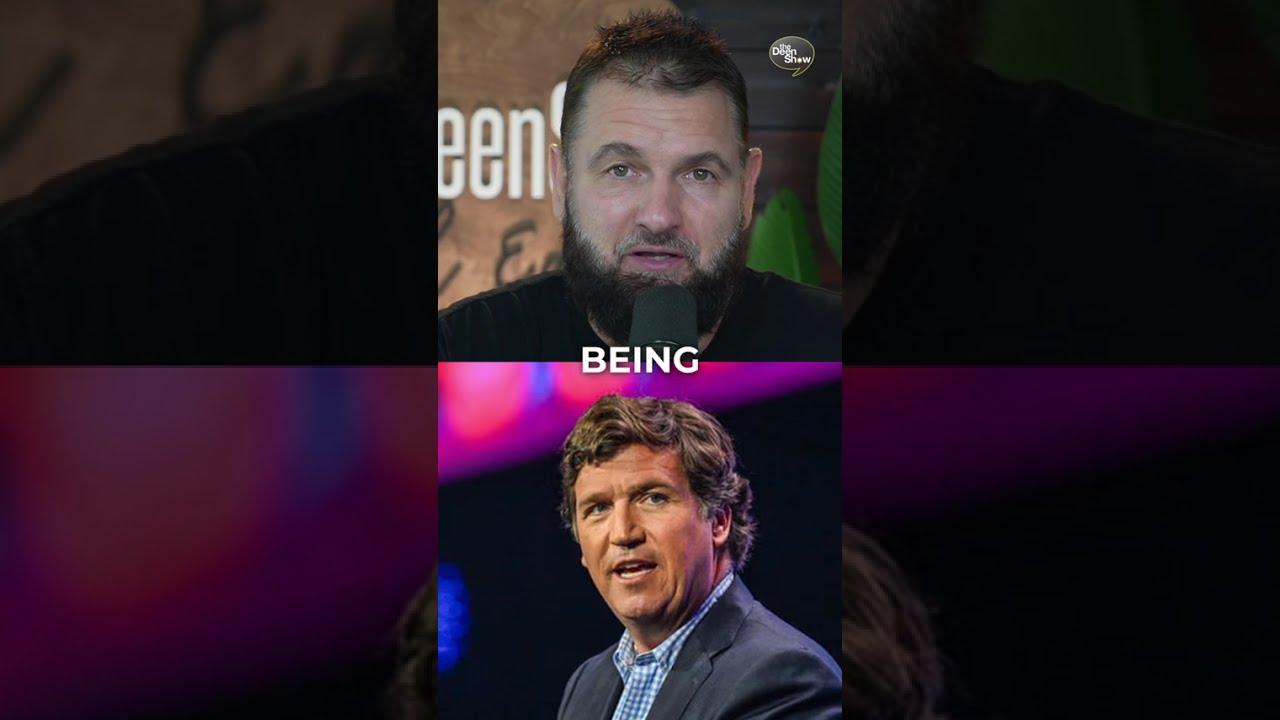
When a major podcast declares that “Islam is taking over the world” and a prominent conservative commentator claims Christianity is “the most tolerant religion — it’s not even close,” Muslims have a choice: ignore the noise or respond with evidence, reason, and clarity. In this powerful episode of The Deen Show, host Eddie sits down with Muhammad Ali of Muslim Lantern to do exactly that — dissecting the wave of misinformation coming from the PBD Podcast co-hosts and conservative commentator Charlie Kirk, who was booked on the program but ultimately ghosted the interview. What unfolds is a masterclass in critical thinking, Islamic spirituality, and the kind of honest dialogue that the billion-dollar Islamophobia industry does not want you to hear.
The “Tolerance” Claim Falls Apart Under Historical Scrutiny
The assertion that Christianity is history’s most tolerant religion sounds bold on a podcast stage — but it collapses the moment history is allowed to speak. Muhammad Ali walks through the evidence methodically: the Crusades, the Spanish Inquisition, and the medieval torture devices still exhibited in Belgrade’s museums — breast rippers, iron gags, knuckle screws, and the infamous “Witch’s Chair” — all deployed in the name of Christian religious authority. The distinction that emerges from this conversation is crucial for anyone interested in faith, purpose, and the honest study of religion: what passes for “Christian tolerance” today is not Christianity at all — it is liberalism, the secular philosophical tradition rooted in John Stuart Mill’s harm principle. True, doctrinally-grounded Christianity, as Muhammad Ali points out, offers no tolerance for disbelief: salvation is exclusive, and there is no theological room for neutrality. Islam, by contrast, has historically extended legal protection to Christians and Jews as People of the Book under Shari’ah — a fact that contrasts sharply with the invented “Judeo-Christian” alliance now being used to frame Muslims as civilizational outsiders.
“We are the little voice out there in a whole billion-dollar hate industry — the Islamophobia industry — and we feel compelled to address this absurdity with references, with evidence, with rationality. That’s how we do it every time.” — Muhammad Ali, Muslim Lantern
- Medieval torture exhibitions in Belgrade confirm that instruments like the Breast Ripper and Iron Gag were used by Inquisition-era authorities — not Islamic governance
- The so-called “Judeo-Christian” alliance is theologically incoherent: the Talmud describes Christians as idolaters liable for execution under Jewish law, while Christianity requires belief in the Trinity that Judaism rejects as polytheism
- What modern commentators call Christian “tolerance” is secular liberalism — a post-Enlightenment value system, not a Biblical one
- Under Islamic governance in the Ottoman Empire, non-Muslims — including the very populations fleeing Inquisition-era Europe — found legal protection and religious freedom
- An undercover Israeli Channel 13 reporter dressed as a priest was spat on five times in five minutes by Orthodox Jewish Israelis in the Old City — yet Muslims are branded the intolerant ones
The Archaeological Evidence Gambit and What Islam Actually Teaches About Jesus
Charlie Kirk’s argument that archaeological evidence in Israel proves Christianity’s truth is examined with the same rigorous, evidence-based approach that Islamic scholarship has always demanded. The critique is devastating: the earliest complete manuscript of the Bible — the Codex Sinaiticus — dates to nearly 400 years after Jesus (peace be upon him), written by unknown authors with no chain of narration. There is zero manuscript evidence from the first century, and the fragments that exist in the second century contain no significant theological content. Pointing to a body of water and saying “this is where Jesus walked on water” is not archaeology — it is hearsay dressed in academic language. Meanwhile, the Quran and the authenticated Sunnah offer Muslims the most rigorously preserved religious transmission in human history, with chains of narration (isnad) traceable back to eyewitnesses. And here lies one of Islam’s most misunderstood gifts to the interfaith conversation: Muslims love and revere Jesus (peace be upon him) — belief in him as a prophet of Allah is a pillar of Islamic faith. A Muslim cannot be a Muslim without affirming Jesus. It is Islam, not the so-called Judeo-Christian alliance, that genuinely honours the prophets.
“We say Jesus, peace be upon him — we love him. You cannot be a Muslim if you don’t believe in Jesus. Subhan Allah, we’re the ones being called the enemy.” — Eddie, The Deen Show
- The oldest complete Bible manuscript (Codex Sinaiticus) dates ~400 years after Jesus, with no author attribution or chain of transmission
- Tens of thousands of contradictory Biblical manuscripts exist — acknowledged by Biblical scholars like Bart Ehrman
- Visiting a site and being told “Jesus did X here” is not archaeological proof — it is tradition, and Islamic scholarship applies the same critical standard to its own traditions
- Belief in Jesus (peace be upon him) as a prophet is a requirement of Islamic faith — Muslims are among the most consistent defenders of his prophethood
- Charlie Kirk was booked on The Deen Show but did not appear — the invitation remains open; the evidence-based conversation has no reason to fear scrutiny
What this episode makes unmistakably clear is that the misinformation being spread about Islam is not born of ignorance alone — it is, in many cases, a deliberate strategy fuelled by well-funded political interests that benefit from keeping Christians and Muslims divided and suspicious of one another. The Muslim community does not need validation from those who shift positions based on political winds. As the Quran reminds us, the guidance of Allah is sufficient, and the truth of Islam stands on its own merits — through reason, through history, through an unbroken chain of preserved revelation, and through the lived reality of 1.8 billion Muslims worldwide. For anyone genuinely seeking faith, purpose, and spiritual truth, the invitation is simple: study Islam with an open mind, use the reason Allah gave you, and let the evidence speak. The door to understanding has always been open — and episodes like this one exist precisely to hold it wider.