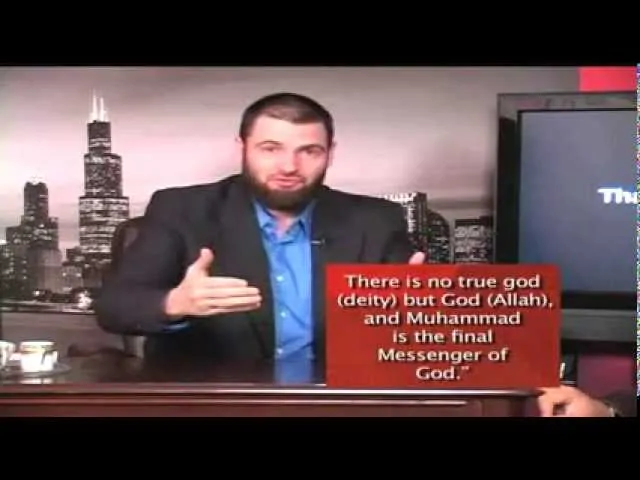
Few questions in contemporary discourse carry as much weight — or as much misinformation — as this one: does Islam actually teach its followers to be violent? For many sincere seekers of truth, spiritual guidance, and genuine faith, the relentless media portrayal of Islam as synonymous with terrorism has become a real barrier to understanding one of the world’s most complete and mercy-centered ways of life. In this episode of The Deen Show, Sheikh Waleed Basyouni — holding a PhD in Islamic Theology and serving as Imam at the Clear Islamic Center in Houston, Texas — addresses this head-on, drawing from the Quran, authentic hadith, and over fourteen centuries of Islamic scholarship to deliver a clear, evidence-based answer: not only does Islam not sanction violence against innocents, it explicitly and unequivocally forbids it, and the Prophet Muhammad ﷺ himself warned his followers against extremism as one of the gravest threats they would ever face.
What the Prophet Muhammad ﷺ Taught About Extremism and the Sanctity of Every Human Life
Long before 9/11 dominated global headlines, senior Islamic scholars in Saudi Arabia issued a formal fatwa — a binding religious ruling — that specifically condemned hijacking aircraft, bombing civilian areas, and suicide attacks, stating that nothing in Islamic law could ever justify such acts. This ruling was not a political reaction; it reflected a principle the Prophet Muhammad ﷺ himself had emphasized during his farewell sermon at Hajj — one of the most significant addresses in Islamic history — when he warned his entire ummah against the dangers of religious extremism. A man once came to the Prophet ﷺ and asked whether he could kill a man he caught in an act of transgression against his household; the Prophet answered that he would be held accountable, because the law belongs to governance, not to individual rage. That same Prophet ﷺ taught that a woman entered Hellfire for killing a cat — making any reading of Islam as permissive toward killing innocent human beings not just incorrect, but an inversion of the religion’s most foundational values.
“Be aware of extremism — that concept of being overly excited and extreme existed in all nations before Islam. As a Prophet informed by God about previous nations and the problems they had, he warned his companions and followers against it emphatically, in his farewell sermon and on multiple other occasions.”
— Imam Waleed Basyouni, PhD, Imam of the Clear Islamic Center, Houston
- Islam forbids spreading corruption in the earth: Killing innocents, destroying societies, and targeting civilians are categorically prohibited in Islamic law — not edge cases, but core prohibitions.
- The Prophet ﷺ built a society of law, not vengeance: Pre-Islamic Arabia was consumed by tribal bloodshed; the Prophet replaced it with a structured, lawful civil society where individuals could not take justice into their own hands.
- Quranic verses must be read in full context: Surah 9:5, frequently cited to suggest Islam commands killing non-Muslims, was revealed about specific hostile polytheists who had broken a peace treaty and were actively at war — not a general command for all time. The Prophet subsequently conquered Mecca and released its people freely, demonstrating precisely how that verse was meant to be applied.
- Extremists twist texts — but are rarely motivated by theology: Those who commit violence in the name of Islam are primarily driven by political grievance, social alienation, and revenge — they use religious language as a veneer over motivations that have little to do with sincere faith or Islamic scholarship.
- Mainstream Islamic scholarship has always condemned terrorism: Muslim scholars oppose extremism not for optics or politics, but out of sincere concern for justice, for the souls of the misled, and for the integrity of the religion itself.
Understanding Jihad, Coexistence, and Islam’s True Message to the World
One of the most consequential misunderstandings — spread both by hostile media and by those with little Islamic education — is the idea that any individual Muslim can unilaterally declare “jihad” and take violent action. Islamic law is categorical: the rules of war, the declaration of conflict, and the conduct of armies fall entirely under the authority of legitimate state leadership, Islamic governance, and military command. It is a constitutional matter, not a personal one. Beyond this, Islam holds a remarkable historical record of coexistence: when Jewish communities fled massacre across medieval Europe, they found safety in the Muslim lands of Morocco, Turkey, and North Africa. When the Crusaders entered Jerusalem, they slaughtered people of all faiths — while Muslim rule had historically protected Christian and Jewish communities and their rights. Islam, as Imam Basyouni notes, was among the very first religious and legal traditions in history to formally codify protections for religious minorities living under Muslim governance — not as a modern concession, but as a founding principle rooted in the Quran itself.
“Allah does not forbid you to deal justly and kindly with those who fought not against you on account of religion nor drove you out of your homes. Verily, Allah loves those who deal with equity.”
— Surah Al-Mumtahinah (60:8), The Noble Quran
The honest seeker of truth — whether approaching Islam for the first time or seeking to reconcile what they have seen in the news with what the faith actually teaches — deserves a grounded, scholarly answer, and that answer is consistent across fourteen centuries of Islamic knowledge: Islam is a complete and merciful way of life whose message was sent as a rahma, a mercy, to all of mankind. The extremist groups that commit violence in the name of Islam are a loud, isolated, and theologically bankrupt minority — condemned not just by Western governments, but by the Muslim scholars who know this tradition most deeply and who understand that the souls of the misguided are also a responsibility. Seeking knowledge about Islam through the Quran read in full context, through the authentic life of the Prophet ﷺ, and through qualified Islamic scholarship is the most powerful antidote to misinformation — and for those standing at the threshold of faith, the call of Islam is not one of fear and violence, but of purpose, guidance, and the profound peace that comes from worshipping one God, living with justice, and extending mercy to the whole of creation.