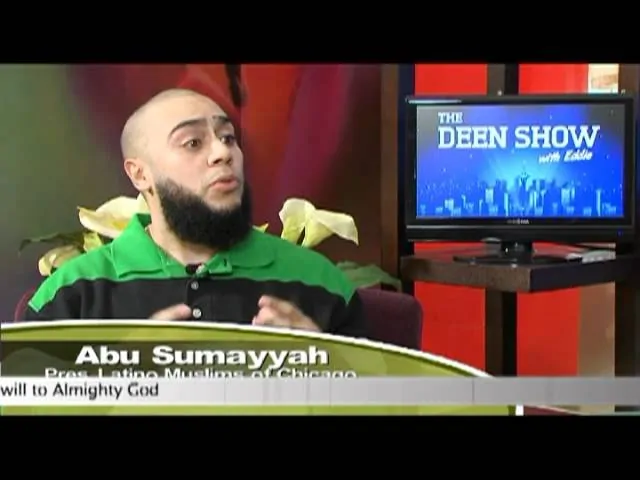
Few conversion stories carry the raw honesty of Wesley LeBron — a Latino Muslim raised in a devout Pentecostal household in New Jersey, who drifted through the streets, the Zulu Nation, and a sincere cover-to-cover reading of the Bible before arriving at the faith of Abraham, Moses, Jesus, and Muhammad ﷺ. His journey to Islam was not accidental. It was driven by one persistent, God-given question: if Jesus himself bowed his face to the ground and prayed to God (Matthew 26:39), why should I pray to Jesus? That question — rooted in spiritual honesty and a fitrah untouched by years of street life — eventually led Wesley, now known as Abu Sumayya, to pronounce the Shahada and begin a life of purpose, peace, and genuine worship of the One Creator.
From the Streets to the Search: A Journey Through Pentecostalism, the Zulu Nation, and Tawheed
Wesley was raised by his deeply religious grandmother in a Pentecostal Christian home. As a teenager, he began pulling away — not from God, but from the doctrine of worshipping Jesus. “I started to think about Jesus Christ, him being a man walking on the earth,” he explained, “and I had a problem worshipping him.” That honest theological discomfort sent him drifting toward street life, drug dealing, and eventually the Zulu Nation — a New York-based organization led by Afrika Bambaataa that mixed hip-hop culture, government conspiracy theories, and spiritual eclecticism. It was there that a Puerto Rican Muslim brother named Aziz approached Wesley and his friend Edgar after a meeting and invited them home for tea — and a conversation about Allah. Aziz explained that Allah has no father, no son, no family, no partners; that He is the Creator of the heavens and the earth and everything in existence. Wesley’s reaction was immediate: “In my teens this is what I believed.” Aziz gave him a book on Tawheed — the Oneness of God — by Bilal Philips. Wesley, Edgar, and a friend read it together, then read about the Nation of Islam, the Five Percenters, and every available source they could find. But before accepting anything, Wesley insisted on one final, sincere test: he read the entire Bible from cover to cover, highlighter in hand, and brought every difficult verse to his pastor and family clergy. The answers were never satisfactory. When Wesley asked the pastor how Jesus — whom the church called God — could cry out “My God, my God, why hast Thou forsaken me?” on the cross, the pastor’s response was simply: “Son, you just have to believe.”
“I said a God has given us a mind — to tell me I just have to believe and there’s no proof, there’s no evidence? Jesus is calling upon a God; you’re telling me to call upon Jesus. I find it more comfortable to call upon the God that Jesus called upon.”
- Wesley grew up Pentecostal but instinctively resisted worshipping a man — a sign of innate fitrah (the natural human disposition toward monotheism)
- The Zulu Nation, despite surface-level Islamic references, was a gang with no authentic Islamic foundation — Africa Bambaataa had departed from Islam and created his own spiritual concoction
- Wesley read the Bible cover-to-cover with genuine sincerity before comparing it to the Islamic concept of Tawheed — his search was thorough, not impulsive
- The book on Tawheed by Bilal Philips was the pivotal text: the Oneness of God, free from partners, equals, and intermediaries, matched exactly what Wesley had believed in his heart since adolescence
- The Shahada — “I bear witness that there is no god worthy of worship except Allah, and that Muhammad ﷺ is His final messenger” — is the same declaration carried by every prophet from Abraham to Moses to Jesus (peace be upon them all)
- Watching the film The Message about the Prophet Muhammad ﷺ gave them additional certainty before they formally accepted Islam that night
Islam Worked Where Nothing Else Could: Transformation, Family, and Life After 9/11
After taking the Shahada, Wesley and his friends were still new Muslims navigating old habits — drinking, smoking, lingering street connections. Brother Aziz delivered the decisive challenge: “You can’t have your cake and eat it too. You can’t accept the truth but do the opposite of the truth.” He directed them to find a mosque in New Jersey. After two nervous visits to a Palestinian masjid where everything was in Arabic — prompting Wesley’s humorous “I’m Puerto Rican, I don’t want to be Arabic” — two Guatemalan brothers pointed them to an American mosque a mile away. That mosque, and its imam, became Wesley’s second home. The turning point came one night at 3 a.m., mid-party, when Wesley stepped outside and looked up at the moon and stars. The Quranic story of Ibrahim (peace be upon him) — contemplating the sun, moon, and stars before concluding that only Allah, Who does not set or weaken, deserves worship — struck him with clarity. He told his friends to leave. He cut off every negative influence, made the masjid his anchor, and within months the transformation was undeniable. His family — who had worried, pleaded, and failed to change him through every other means — watched speechless as the drinking stopped, the womanizing stopped, the chaos ceased. His father, encountering a Muslim at a hot dog stand after 9/11, told the man his son was Muslim. The man asked what he thought of Islam now. His father replied: “I can sleep at night.”
“Nothing worked. Nothing worked. But Islam worked. Islam worked.”
- The mosque became Wesley’s daily refuge — he would go to work, come home, and go straight to the masjid to learn, pray, and build righteous character
- He studied at the prestigious Islamic University of Madinah — motivated not just by knowledge but by a desire for complete personal transformation
- He returned to the United States after 9/11 to support his wife (the only other Muslim in his family) and to defend the true image of Islam to relatives who feared the worst
- Islam’s teachings on war are unambiguous: no killing of innocent civilians, no suicide bombings, no destruction of homes or trees — only proportionate defense against those actively fighting you
- Muslims honor Jesus (peace be upon him) as a prophet and messenger; Surah Maryam (Chapter 19 of the Quran) details his miracles and the life of his mother with more depth than many Christians realize
- Wesley’s name change to Abu Sumayya — “servant of the Provider, father of Sumayya” — reflects the Islamic practice of names as living reminders of one’s obligations to Allah and family
Wesley LeBron’s story is more than a personal reversion — it is a mirror held up to the universal human search for meaning, accountability, and a God worthy of sincere worship. He did not stumble into Islam out of rebellion or identity politics. He arrived through honest questioning, rigorous comparison, street-hardened skepticism, and a heart that refused to settle for “just believe” as an answer. The message he carried back from Madinah — that our lives must revolve around God, not God around our convenience — is precisely the call of every prophet from Adam to Muhammad ﷺ. For anyone watching from the outside, wondering whether the discipline of Islam is worth the effort, Wesley’s father offered the most grounded answer possible: he could finally sleep at night. If you are searching for spiritual grounding, for guidance that transforms not just beliefs but behavior, and for a faith that answers the hardest questions rather than deflecting them, Wesley’s journey is an invitation to look — with open eyes and an honest heart — at what Islam truly teaches.