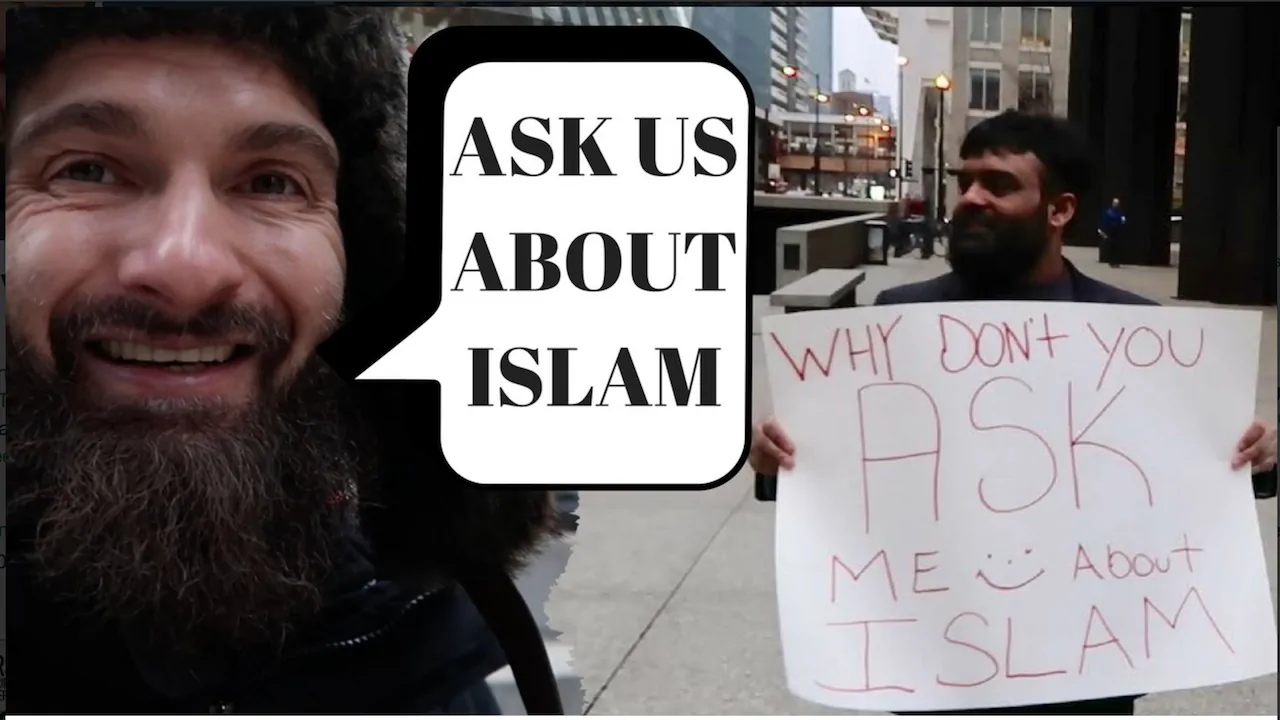
The streets of downtown America became an unexpected classroom when Eddie and his companions stepped out with a sign bearing a simple, direct challenge: “Why Don’t You Ask Me About Islam?” In an era when misinformation about Islam flows freely from media personalities paid to spread fear, and when the political climate has made the Muslim community a convenient target for division, the initiative was both urgent and necessary. Rather than retreating from public discourse, these Muslims invited honest, open dialogue — with passersby, with curious strangers, with people whose only exposure to Islam had come through sensationalised news cycles and voices deliberately hostile to the faith. The message was clear: Islam is a living reality for nearly two billion people worldwide, and if you genuinely want to understand it, there is one obvious and logical source.
Ask the Source: Why Islamophobes Cannot Speak for Muslims
“If I want to learn about America, I’m not going to go to China and ask a Chinese person what America is — I’m going to come to America and ask an American. So I expect non-Muslims to come to Muslims and ask them what is Islam. Don’t go to the radicals, because when I come to America, I don’t go to the drug dealer and the rapist to ask what is America — I go to the knowledgeable people.”
This analogy, offered by one of the Muslim participants during the street conversations, captures the core logic behind the entire dawah campaign. Across the exchanges filmed that day, several recurring misconceptions surfaced — and were addressed with calm, evidence-based clarity rooted in Islamic knowledge and universal reason. The notion that Islam is a religion of violence was challenged not with defensiveness, but with facts: FBI statistics reveal that Muslims accounted for only 5% of terrorist attacks on American soil after 9/11, while white supremacist groups were responsible for over 42%. Research by Dr. Robert Pape, whose book Dying to Win serves as a reference work for military and intelligence agencies worldwide, found that more than 50% of suicide bombings globally were carried out by non-Muslims, and that over 90% of such attacks were driven by foreign occupation — not religious ideology. The real obstacle to understanding Islam, as the participants made clear, is not the faith itself, but the deliberate distortion of it by fringe voices amplified by partisan media and profiteering Islamophobes.
- Go directly to Muslims for knowledge about Islam: Self-proclaimed critics of Islam are often paid commentators with a financial incentive to misrepresent the faith — authentic understanding comes from learned Muslims and primary Islamic sources.
- Islam requires belief in and respect for Jesus (peace be upon him): Muslims cannot be Muslim without loving and honouring Prophet Jesus — the Quran even contains an entire chapter named after his blessed mother, Maryam.
- Jihad has three distinct and carefully defined dimensions: A state-level just-war doctrine governed by legitimate authority, the universal right of individual self-defence, and the inner spiritual struggle — none of which authorise vigilante violence.
- Extremism is a human problem, not an Islamic one: The KKK operated under a Christian banner, the Tamil Tigers (LTTE) were predominantly Hindu, and Buddhist monks perpetrated ethnic violence in Myanmar — no religion endorses the crimes of its extremists.
- The purpose of life in Islam is worship and service: Every created thing has a purpose; the human being — the most complex of all creation — was made to worship the One Creator and to serve humanity in fulfilment of that worship.
- All prophets brought the same message: Adam, Noah, Abraham, Moses, Jesus, and Muhammad (peace be upon them all) called humanity to the same truth — submit to the Creator alone and do not worship the creation.
- Compassion for the oppressed is integral to Islamic faith: Islam commands believers to help those in need; refugees forced from their homes by violence deserve humanitarian protection, not collective punishment.
Jihad, the Purpose of Life, and the Timeless Message of Every Prophet
One of the most misrepresented concepts in media coverage of Islam is Jihad — a word whose legal precision and spiritual depth are entirely lost in translation. As explained in this street conversation, Jihad in the political sense is an authority vested in the Muslim government, not in individuals; just as no single American state can unilaterally declare war on a foreign nation, no individual Muslim or rogue group holds the authority to wage offensive war in the name of Islam. Beyond the political, the conversation turned to the deepest question of all — the purpose of life itself. Every object around us, from the shoelaces on our shoes to the complexity of the cosmos, was designed with a purpose; human beings, the most intricate of all creation, are no different. Islam’s answer, offered with clarity amid the bustle of a busy street, is that the purpose of life is to submit to and worship the One Creator — the same God worshipped by every prophet from Adam to Muhammad, peace be upon them all. Helping the poor, standing against oppression, feeding the hungry — in Islam, all of these acts of service to humanity are themselves acts of worship, falling beneath the great umbrella of serving God and fulfilling the reason for which we were created.
“Islam is the way of life that demands a man or a woman submit their will to the will of the Creator. A Muslim is defined as a person who willfully submits themselves to God — and everything you do that God loves is an act of worship.”
What this street encounter ultimately demonstrates is that direct, human-to-human dialogue about faith is irreplaceable — and that when people engage with Islam honestly, setting aside manufactured fear and media-driven narratives, the conversation becomes rich, respectful, and genuinely transformative. The faith that produced Muhammad Ali’s humanitarian legacy, that carries an entire chapter honouring the mother of Jesus, that commands its followers to show kindness to peaceful non-Muslims as an obligation from God, is not the religion being described in the headlines. Islam does not ask the world to accept it on blind authority; it invites sincere inquiry, open hearts, and the courage to seek knowledge from its rightful source. The same monotheistic message delivered by every prophet throughout human history — worship the Creator alone, serve humanity, pursue justice, embody mercy — remains as urgent and as beautiful today as it has ever been. If you carry questions about Islam, its spirituality, its guidance, or its vision for a just and compassionate society, there is no shortage of knowledgeable, welcoming Muslims ready to engage — with patience, evidence, and the warmth of a faith whose very name means peace.