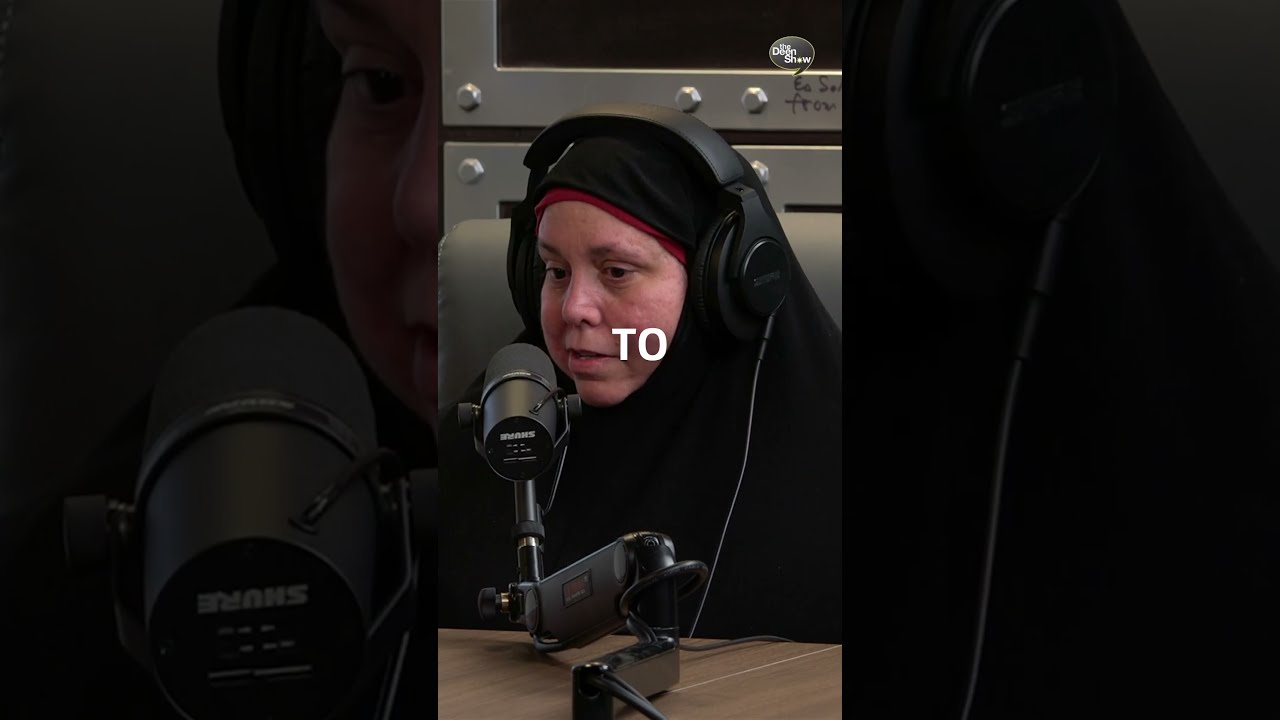
One of the most profound questions a sincere seeker can ask is deceptively simple: what is God’s name? Across the Abrahamic faiths, humanity has wrestled with names like Yahweh, Jehovah, and Allah — each carrying weight, history, and theological baggage that shapes how billions of people understand the Creator of the heavens and the earth. In this episode of The Deen Show, host Eddie sits down with Imran, President of the Islamic Research Education Foundation, to cut through centuries of linguistic confusion and theological drift, offering a clear, evidence-based examination of what God’s name truly is, where it came from, and how Islam provides the most coherent and preserved answer to this fundamental question of faith and spirituality.
Yahweh, Jehovah, and the Hebrew Roots of God’s Name
The journey into God’s name begins in the Hebrew scriptures. The name “Yahweh” — rendered in Hebrew as the four consonants Y-H-W-H (the Tetragrammaton) — appears over 6,700 times in the Old Testament, yet its precise meaning and pronunciation remain disputed to this day. It traces to the root word hayah (H-Y-H), meaning “to be” or “I am that I am” — the answer given to Moses (peace be upon him) in Exodus when he asked God to reveal His name. However, because Jews considered the name too sacred to utter, it was replaced in recitation with the Greek term Adonai, meaning “my Lord.” The confusion deepened in the 9th century CE when a scholar named Gesenius artificially combined the vowels of Adonai with the consonants Y-H-W-H, creating the hybrid “Jehovah” — a word that never existed in any original scripture. Meanwhile, the Hebrew term Elohim — grammatically a plural of respect — was used in the Old Testament to refer not only to God but also to angels, demons, and celestial beings, making a fixed definition of the divine impossible to pin down through these texts alone. Key takeaways from this discussion include:
- The name Yahweh (YHWH) is a causative verb form, not a proper noun — it describes God’s self-existent nature rather than naming Him distinctly.
- “Jehovah” was constructed in the 9th century CE by artificially grafting vowels from Adonai onto the Hebrew consonants — it has no basis in the original revelation.
- Elohim, the common Hebrew word for God, is also used in the Bible for dead spirits, demons, and celestial beings — making it an unreliable name for the One True God.
- The Torah as it exists today was compiled under the Documentary Hypothesis from multiple contested sources with contradictory pictures of God — including one source that depicted God walking in the Garden of Eden and designing clothes for Adam and Eve.
- In contrast, Al (Hebrew) and Alah (Syriac) are linguistically close to Allah in Arabic — confirming that Arabic-speaking Jews and Christians historically used “Allah” as their word for the Almighty God long before the revelation of Islam.
“The God who created the Muslims is the same God who created the Jews and the Christians — a Jew will agree, a Christian will agree, and we Muslims have no objection. But what a Muslim is very strong on is the belief in Allah, subhanahu wa ta’ala.” — Imran, President of the Islamic Research Education Foundation
Jesus, the Trinity, and What the Bible Actually Says
No Muslim is a Muslim unless he believes in Jesus Christ, peace be upon him — this is a cornerstone of Islamic faith, not a footnote. Islam reveres Jesus as a mighty messenger of Allah who, by Allah’s permission, healed the blind, cured lepers, and gave life to the dead. However, the critical Islamic position — one firmly supported by the Bible itself — is that Jesus never once claimed to be God. In the Gospel of John (5:30), Jesus states plainly: “I can of my own self do nothing.” This single verse, Imran argues, is sufficient to disprove the divinity claim, since the Almighty God does everything by Himself and is dependent upon no one. Multiple other passages — John 5:37, John 10:29, John 14:28, John 17:3–4, and Matthew 20:17–18 — show Jesus explicitly distinguishing himself from God. As for the Trinity, the word does not appear even once in the Bible. The closest verse — in 1 John 5:7–8 of the King James Version, which speaks of the Father, Son, and Holy Ghost — was rejected by 52 eminent Christian scholars backed by 32 denominations in the Revised Standard Version, where it was moved to the footnotes as a known corruption and human insertion. This is not a Muslim claim; it is the finding of Christian scholarship itself. The concept of Tawheed — the Islamic understanding of God’s absolute, undivided oneness — stands in clear relief against this backdrop of textual uncertainty and contradiction.
“Say: He is Allah, the Only One. Allah, the Eternal and Absolute. He begets not, nor was He begotten. And there is none comparable unto Him.” — Surah Al-Ikhlas, Quran 112:1–4
Allah — The Most Beautiful Name of the One True God
The name “Allah” was not invented by Prophet Muhammad, peace be upon him. His own father was named Abdullah — “servant of Allah” — before any revelation was received, confirming that the name Allah was the standard Arabic name for God among Arabs, Jews, and Christians alike, as documented in the Encyclopaedia Britannica. Arabic-speaking Christians and Jews referred to the Almighty as Allah long before Islam, and historians note that Coptic Christian groups circled the Ka’bah calling it “bait Allah” — the house of Allah. In Islam, Allah has revealed Himself through 99 beautiful names and attributes, each describing an aspect of His perfection: Al-Hayy (the Ever-Living), Ar-Rahman (the Most Merciful), Al-Khaliq (the Creator). The Quran provides what scholars describe as the most comprehensive definition of God in all of theology: Surah Al-Ikhlas (Chapter 112), four verses that serve as a universal litmus test — any concept of God that cannot fit these four lines is simply not Allah. He is One, absolute, self-sufficient, without parents, without offspring, and without equal. This is the God of Ibrahim, Musa, Isa, and Muhammad — peace be upon them all — the same God who created the universe, who knows what is in every heart, and who is exalted above His creation while closer to us than our jugular vein. Whoever seeks guidance with a sincere heart, open to truth beyond what they inherited, will find in the name of Allah a clarity that no other theological tradition in history has preserved with such purity, integrity, and timeless power. Call upon Him — He is the Most Loving, the Most Merciful, and He responds to those who call.