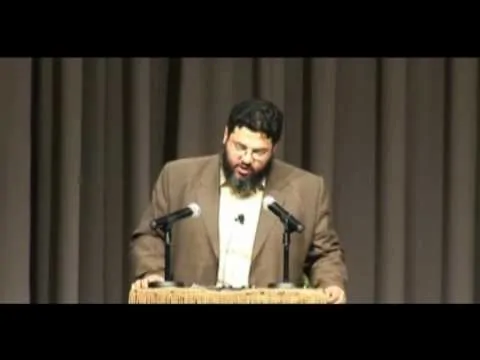
Few topics demand more honesty from Muslim communities than the question of religiously justified violence. At Ilm Fest New York 2009, Shaykh Waleed Basyouni — Islamic theologian, Imam of Clear Lake Islamic Center in Houston, and member of the Assembly of Muslim Jurists in America (AMJA) — addressed this challenge with the directness it deserves. His talk was not a defensive exercise in public relations, nor a blanket condemnation aimed at satisfying headlines. It was a sincere, scholarly call to awareness: to understand where extremism comes from within a fringe minority, why Islam unambiguously rejects it, and why every Muslim — especially in the West — must be equipped to recognise and resist it before it takes root in hearts and minds around them.
A Minority That Cannot Be Ignored — Why Silence Is Not an Option
Shaykh Waleed was precise in framing his audience from the outset: he was speaking specifically about a small minority within Sunni Islam who have embraced violence as a religious act — not about Muslims broadly, not about other faith communities, and not about legitimate resistance movements. These individuals do not represent mainstream Islamic scholarship, mainstream dawah organisations, or the overwhelming majority of Muslims anywhere in the world. And yet, their influence spreads through books, the internet, and audio recordings, reaching young Muslims who may lack the theological grounding to identify the deception within it. The Shaykh offered a striking illustration of why small numbers cannot be dismissed: if 99.9% accuracy were considered sufficient, twelve newborns in America would be handed to the wrong parents every single day; twenty thousand incorrect drug prescriptions would be written each year; two planes at O’Hare Airport would make unsafe landings daily. When scaled across a global Muslim population of over a billion, even a tiny fraction of radicalised individuals represents a real and serious harm — to innocent lives, to Muslim communities, and to the integrity of the faith itself. More dangerous still, ideological sympathy with extremist ideas — agreeing with their grievances while stopping short of violence — is not a safe middle ground. It is, as Shaykh Waleed warned with clarity, the very first step on a path that, once entered, has no brakes.
“Prevention is much better than cure. If we can educate ourselves and protect ourselves from these ideologies, then whenever we come across someone carrying them — or a website promoting them — we know how to protect our heart and our mind from being among the extreme ones. You want to protect yourself not because you are afraid your IP address will be flagged, but because you love your faith and you love your soul.” — Shaykh Waleed Basyouni
- Extremism crosses every boundary — it has appeared among the wealthy and the poor, the educated and the uneducated, men and women, across different races, nations, and religious communities throughout history.
- Islam’s Shariah sets clear ethical limits — crossing those limits through unlawful violence is not a grey area of interpretation but an established prohibition (haram), categorised in classical fiqh as fasad fil-ard (spreading corruption in the earth).
- The earliest Muslim scholars condemned violent extremism decisively — historically labelling such groups Ahl al-Bid’ah (people of innovation) and Ahl al-Sayf (people of the sword), and refusing them the title of Ahl al-Sunnah.
- Scholarly fatwas against terrorism predate 9/11 by decades — scholars including Shaykh Ibn Baz issued rulings explicitly forbidding hijackings, kidnappings, and bombings against both Muslims and non-Muslims more than thirty years before the attacks.
- Modern extremist groups recycle ancient arguments — the same misused Quranic verses and hadith used by fringe movements over a thousand years ago are being deployed today, and students of Islamic theology can identify and refute them.
- Partial sympathy is still dangerous — agreeing with extremist ideology while rejecting its methods is itself the gateway through which radicalisation begins, and it should never be treated as a harmless position.
Where Extremism Grows — and What Authentic Islam Has Always Taught
Shaykh Waleed identified several interlocking factors that have historically allowed extremist movements to flourish: prolonged armed conflicts in Muslim-majority lands that normalise violence; widespread political oppression and social injustice that drives desperate reactions; and the selective misuse of the Islamic heritage — a vast and rich body of knowledge — to extract verses and hadith out of context in support of violent agendas. He made a point that deserves to sit with every Muslim: the distinction between Islam as a religion and individual Muslims who fall into criminality or ideological distortion is not a retreat from accountability — it is a theologically honest statement. Among Muslims, as in any human community, there are doctors and engineers, students and scholars, and yes, there are also criminals and misguided individuals. Islam as a deen does not bear responsibility for the sins of those who claim its name while violating its core principles. Allah subhanahu wa ta’ala commanded in the Quran: “Do not wish to spread corruption in the earth — indeed, Allah does not love those who spread corruption.” The Prophet Muhammad ﷺ warned his ummah with unmistakable urgency, repeating three times: “Beware of extremism, beware of extremism” — and declared that those who cross the lawful limits are the ones destroyed, cut off from success in this life and the next.
“Islam is not a religion of extremism, and it is not a religion of terrorism. We may have Muslims who happen to be extremists — and you should not feel offended by acknowledging that truth. There will always be misguided people in every community. Our role is to isolate them, to combat their ideas with knowledge, and to protect our families and our youth from their ideology.” — Shaykh Waleed Basyouni
What Shaykh Waleed leaves every listener with is not despair but a call to purposeful responsibility. Extremism, he cautioned, will persist until the Day of Judgement — it is among Shaytan’s most effective tools for corrupting sincere hearts by wrapping a distorted sense of religious duty around a core of violence. The answer is not to look away from the problem, nor to feel shame in naming it. The answer is knowledge — grounded, mainstream, scholarly Islamic guidance that equips every Muslim with the spiritual and intellectual tools to recognise manipulation, reject false calls to arms, and stand firm in the mercy, justice, and wisdom that have always defined this faith at its heart. Every Muslim who truly loves this deen, and who understands the weight of the trust placed in this ummah, owes it to their community — and to Allah — to engage with this conversation openly, honestly, and without fear.