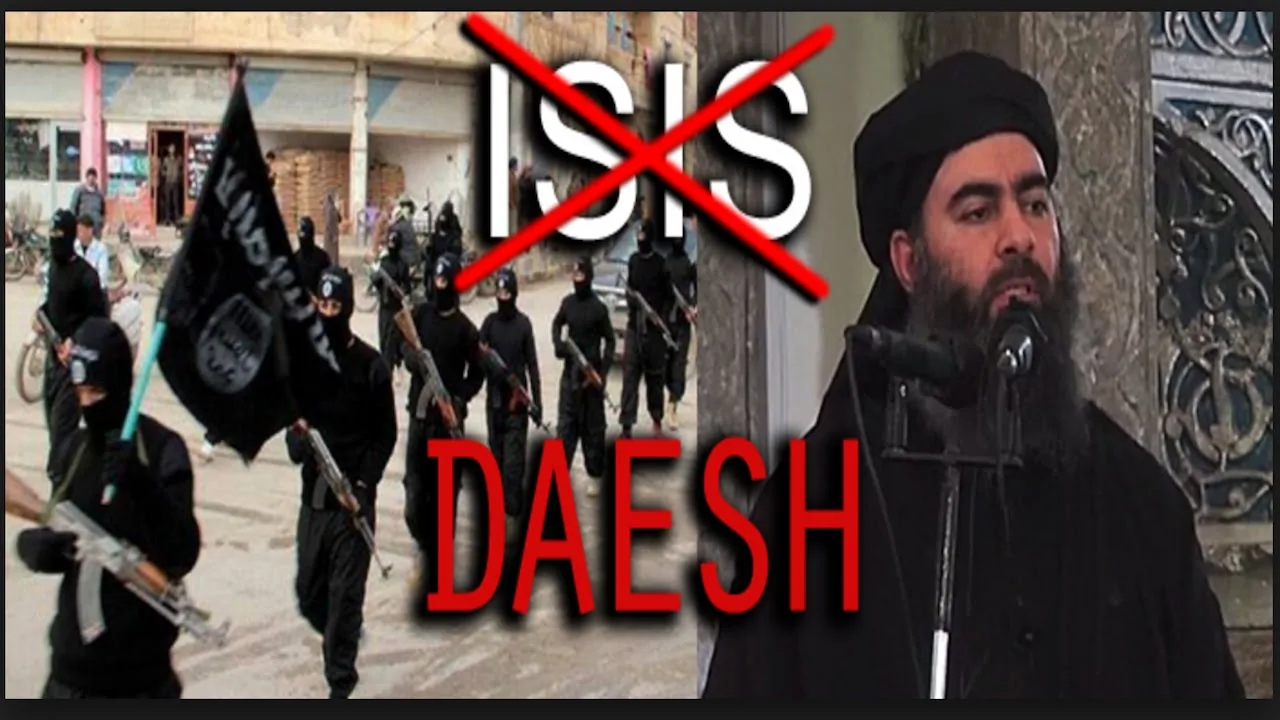
When the name ISIS appears in headlines, Islam is almost reflexively blamed — yet a rigorous examination of the group’s actual leadership, ideology, and tactics reveals a radically different story. Brother Ali, a convert to Islam who discovered through genealogical research that his Spanish-Catholic ancestors were almost certainly Muslims forcibly baptised during the Reconquista, is pursuing his PhD thesis titled The Delusional State of ISIS: The Anti-Islamic State at a prestigious Malaysian university. His research brings both academic precision and lived spiritual experience to one of the most misunderstood crises of our time, demonstrating through primary sources what millions of Muslims and non-Muslims alike have long sensed: the ideology driving ISIS has no genuine root in Islamic faith, spirituality, or the guidance of the Prophet Muhammad ﷺ.
The Secular Ba’athist Roots of ISIS — Nothing Islamic About It
Ali’s doctoral research uncovers a foundational deception at the heart of the ISIS narrative. Seventeen of the group’s top officials are confirmed ex-Ba’athists — secular Arab nationalists who served under Saddam Hussein’s regime. The primary architect of ISIS’s military strategy was Haji Bakr, a former senior Intelligence Officer in Saddam’s government, a man whose worldview was forged in secular Arab nationalism, not Quranic scholarship. When Ali examined ISIS’s war doctrines and written treatises, he found their tactics are not drawn from the jurisprudence of Islamic scholars or the ethical traditions of the Prophet’s ﷺ companions — they are lifted verbatim from Western secular military textbooks. Islam explicitly forbids the killing of civilians; Surah Al-Baqarah (2:190) commands fighting those who fight you but prohibits all transgression of limits. Every major traditional scholar has condemned ISIS, classifying them as Khawarij who have exited the bounds of proper Islamic conduct entirely.
- 17 of ISIS’s top officials are ex-Ba’athists — former secular Arab nationalists under Saddam Hussein’s regime
- Haji Bakr, ISIS’s primary military architect, was one of Saddam Hussein’s leading Intelligence Officers
- ISIS war tactics are copied word-for-word from Western secular military textbooks, not Islamic sources
- Traditional Islamic scholars universally condemn ISIS as Khawarij — those who deviated from authentic Islamic practice
- The Quran prohibits killing civilians; ISIS’s justifications for civilian targeting violate every established principle of Islamic law
- Many ISIS recruits in Western countries come from non-practising backgrounds — drawn by identity crises and political grievances, not Islamic knowledge
“Their ideology has absolutely zero to do with Islam — and I am not saying that to protect Islam. That is what you literally find when you research the way they think and what they write about. You can find it in Western textbooks, word for word, in many respects.”
A Global Double Standard — What the Research Actually Shows
The statistics that rarely reach prime-time news are deeply revealing. From 1980 to 2003, the world’s most prolific perpetrators of suicide attacks were not any Islamic group — they were the Tamil Tigers of Sri Lanka, a Marxist, secular, predominantly Hindu organisation responsible for 315 completed attacks carried out by 462 bombers. Dr. Robert Pape of the University of Chicago compiled the first complete database of every suicide terrorist attack worldwide since 1980 and concluded that the primary driver is not religion but foreign military occupation. The IRA were identifiably Catholic in background, yet no serious commentator blamed Roman Catholicism for their three-decade campaign. George W. Bush’s bombing campaigns that killed countless Iraqi and Afghan civilians were never held up as proof that Christianity or American democracy were inherently violent. The same basic intellectual honesty and fairness is owed to Islam and its nearly two billion peaceful adherents — and withholding it does not protect anyone; it feeds a perpetual cycle of grievance, marginalisation, and radicalisation.
“The principle cause of suicide terrorism is foreign occupation. If Islam were an inherently violent religion, you would expect a thin, scattered veneer of attacks all around the world among 1.4 billion Muslims — but that is not what the data shows at all. It is heavily concentrated precisely in regions under military occupation.” — Dr. Robert Pape, University of Chicago
The deeper lesson from this conversation reaches far beyond geopolitics and academic research. Ali’s own journey to Islam — from a Spanish-Catholic identity shaped by centuries of forced conversion, through the intellectual rigour of philosophy, through a cold Chicago night when he walked outside without a coat and pressed his forehead to the snow-covered ground in gratitude to his Creator — is a living testament to Islam’s timeless, universal guidance. The same faith that once gave his Andalusian ancestors dignity and purpose found him again across centuries of suppression. For anyone sincerely seeking truth about Islam, the invitation has never changed: visit a mosque, sit with scholars, read the Quran without the distortions of media headlines, and allow its message — to worship the One Creator alone with sincerity, to honour one’s parents, to live with justice and mercy toward all — to speak directly to the heart. The great delusion of ISIS is not a failure of Islam; it is the failure of those who abandoned Islam’s most essential values while exploiting its name, and every Muslim and non-Muslim of conscience has a responsibility to understand the difference.