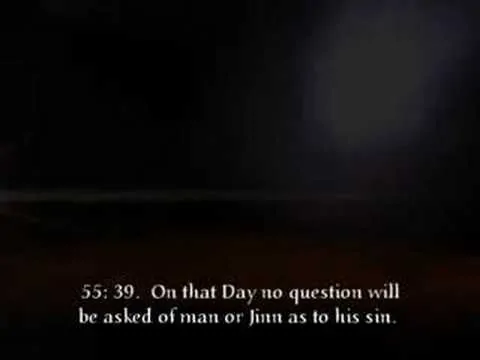
Few chapters of the Quran strike the heart quite like Surah ar-Rahman — the 55th chapter, often described in Islamic tradition as the “Bride of the Quran.” In this beautiful recitation by the renowned Saudi reciter Sheikh Saad al-Ghamdi, the surah unfolds as an extended meditation on divine mercy, cosmic order, and the accountability that awaits every soul. Across its 78 verses, Allah addresses both mankind and jinn simultaneously, cataloguing His blessings across creation — from the teaching of the Quran itself to the fruit-laden gardens of Paradise — and challenging both races with the same piercing refrain, repeated 31 times: “So which of the favors of your Lord will you deny?” It is a surah that does not merely inform the intellect; it awakens the conscience, demands gratitude, and orients the believer toward their ultimate purpose in this life.
A Universe Built on Balance, Mercy, and Signs
The surah opens by naming Allah al-Rahman — the Most Merciful — as the one who taught the Quran, placing divine education before even the creation of man. This sequencing is profound: before Allah describes the physical world, He establishes that His greatest gift to humanity is revelation itself, the guidance that transforms raw existence into purposeful spiritual life. From there, the verses move through the architecture of creation with breathtaking economy — the sun and moon running precise calculations, the stars and trees in prostration, the heavens raised and the cosmic balance set in place. The earth is described as laid out for creatures, filled with fruits, date-palms, grain, and sweet-scented basil. Man was created from clay like pottery; jinn from a smokeless flame of fire. Allah is Lord of the two easts and the two wests. Two seas meet yet do not transgress their barrier, and from their depths emerge pearls and coral. Every image points the same direction: the entire observable universe is a sustained act of divine generosity, and ingratitude in the face of it is a form of spiritual blindness.
- The Quran precedes creation — teaching of revelation is named as Allah’s first act, emphasizing that guidance is the foundation of all other blessings
- Cosmic balance (al-Mizan) — the heaven was raised and the balance set; believers are commanded to uphold justice and not defraud the scales, linking natural law with moral obligation
- Dual address to jinn and men — the surah speaks to both races as co-inhabitants of creation, each equally accountable for the blessings they received and either honored or denied
- Natural world as Ayat (signs) — every element of creation described — seas, trees, stars, fruit, ships like mountains — functions as a sign pointing back to the Creator, inviting reflection and faith
- The central refrain as spiritual mirror — the repeated question “So which of the favors of your Lord will you deny?” is not rhetorical punishment; it is an invitation to audit one’s gratitude and return to awareness of Allah
“So which of the favors of your Lord will you deny?” — Surah ar-Rahman (55:13, repeated 31 times)
The Day of Standing and the Gardens of the Righteous
The surah shifts in tone as it addresses the Day of Judgment, describing a reckoning that will be self-evident rather than interrogative — on that Day, “neither man nor jinn will be asked about his sin,” for the criminals will already be known by their marks, seized by their forelocks and feet, circulating between Hell and scalding water. The contrast drawn immediately after is what makes this section spiritually powerful: for the one who fears the standing before his Lord, there are not one but two pairs of gardens, each with flowing springs, every kind of fruit, date-palms, pomegranates, silk-brocade couches, and companions of exquisite beauty described as rubies and coral. The repetition of blessings across the two sets of gardens — one described as lush and spreading, the second dark-green and verdant — mirrors the surah’s rhythm of relentless generosity. And woven through every description of Paradise is the same challenge: will you deny this? The Islamic vision of the afterlife presented here is not merely transactional reward; it is the fullest expression of mercy toward those who returned that mercy with awareness, worship, and moral rectitude in this life.
- Self-evident accountability — the Day of Judgment requires no questioning because deeds will be manifest; faith and integrity are lived now, not performed at the gate
- Fear of Allah’s station (Maqam) as the entry condition — the two gardens are promised specifically to “him who fears the position of his Lord,” grounding Paradise not in outward ritual alone but in internalized God-consciousness (taqwa)
- Four gardens total — two primary gardens and two additional gardens are described, each with distinct qualities; Islamic scholarship understands these as representing degrees of reward for varying levels of righteousness
- The principle of reciprocity — the verse “Is the reward for good anything but good?” (verse 60) encapsulates the entire surah’s logic: divine justice is not arbitrary; it mirrors the quality of what the servant brought to their Creator
- The surah’s closing seal — the final verse, “Blessed be the Name of your Lord, the Possessor of Majesty and Honor,” returns to the beginning, reminding the listener that all blessings — in this world and the next — originate in the majesty of Allah alone
“Blessed be the Name of your Lord, the Possessor of Majesty and Honor.” — Surah ar-Rahman (55:78)
Listening to Sheikh Saad al-Ghamdi’s recitation of Surah ar-Rahman is an act of worship that carries its own transformative weight. His measured, emotive delivery draws out the architecture of the surah — the rhythmic refrain, the vivid imagery, the gentle yet urgent challenge — and places the listener in the position Allah intended: standing between the evidence of divine generosity and the honest question of their own response to it. For Muslims navigating the noise and distraction of modern life, this surah functions as a spiritual recalibration. It does not ask for complicated theology; it asks for open eyes — eyes that can look at the sea, the sky, the food on the table, the capacity for speech, and the gift of the Quran itself, and say, in full sincerity: La, nothing — not a single favor of my Lord will I deny. That acknowledgment, renewed again and again through recitation and reflection, is the living heart of Islamic faith and the beginning of genuine gratitude.