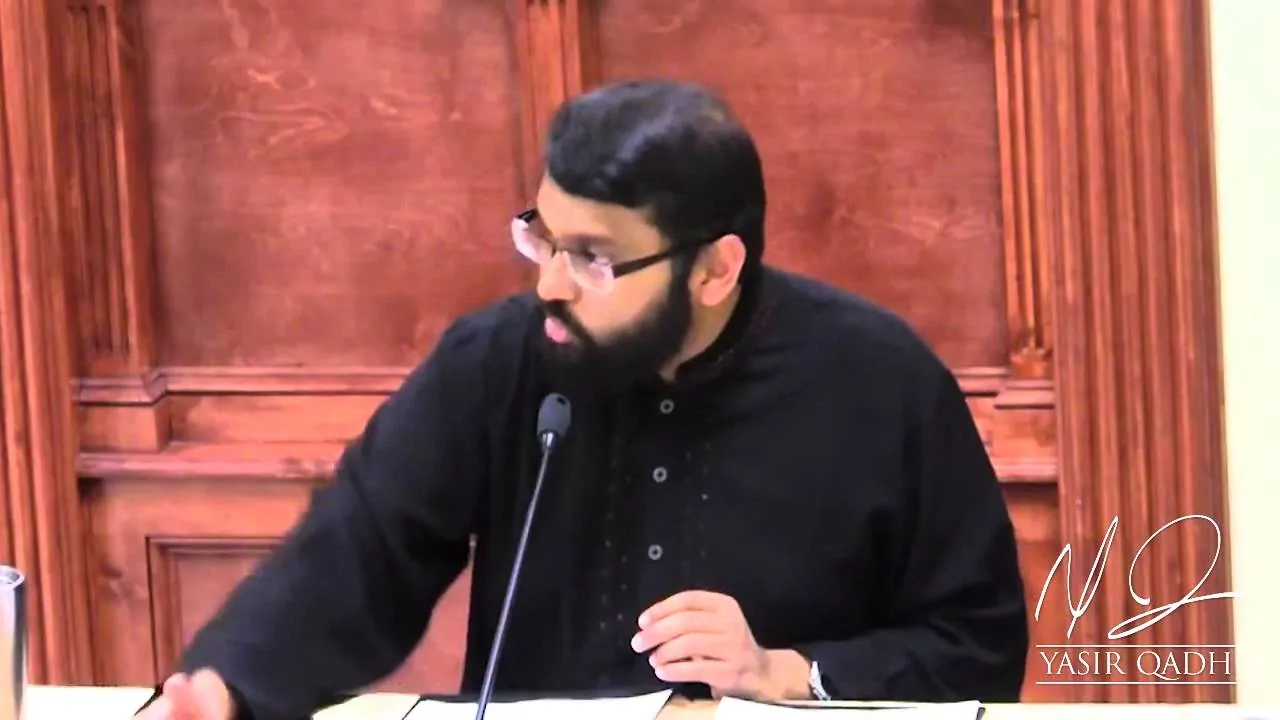
In the fifth year of the da’wah, the Prophet Muhammad ﷺ authorized the first migration to Abyssinia — a Christian land where early Muslims could worship Allah freely, far from the torture and oppression of Mecca. Yet within three months, those same migrants returned to the very land of persecution they had fled. They came back because of a single rumor: that the Quraysh had accepted Islam. That rumor had a kernel of truth, but it had been catastrophically misunderstood. To trace that misunderstanding to its source is to encounter one of the most fiercely debated incidents in Islamic scholarship — the so-called “Satanic Verses.” In this detailed lecture from his Seerah series, Shaykh Yasir Qadhi approaches this controversy with the academic rigor and spiritual clarity it demands, presenting three competing historical narratives and the robust scholarly framework that decisively separates authentic revelation from fabricated doubt.
Three Competing Narratives Around Surah an-Najm
The incident centers on a moment in Ramadan of the fifth year of the hijrah, when the Prophet ﷺ recited Surah an-Najm in its entirety before a gathering of Muslims and non-Muslims near the Ka’bah. Surah an-Najm is among the most emotionally charged and rhetorically powerful surahs in the Quran — its closing verses build in intensity through rapid-fire rhetorical questions, confronting the Quraysh over their worship of idols while affirming Allah’s absolute sovereignty over life, death, laughter, tears, and the cosmos itself. Understanding three distinct versions of what happened after that recitation is essential to understanding where the controversy originates:
- Version 1 — Sahih al-Bukhari (authentic): As narrated by Ibn Abbas (radhiAllahu ‘anh), when the Prophet ﷺ concluded Surah an-Najm and prostrated, the sheer power of the recitation overcame everyone present — Muslims, mushrikeen, jinn, and humans alike. Every single person prostrated alongside him, united before Allah ﷻ for the first time, with one sole exception: a man too proud to bow who instead placed a handful of sand to his forehead and said, “This is enough for me.” When this extraordinary scene was reported to the Abyssinian emigrants, the rumor had inflated into: “The Quraysh have all accepted Islam and united behind the Prophet.”
- Version 2 — weak narration found in Tabari and others: This account, which traces back only to a tabi’i (not a Companion) and contains a broken chain, claims that after verse 20 of Surah an-Najm — “Have you not seen al-Lat, al-‘Uzza, and Manat, the third?” — Shaytan cried out two additional sentences praising the idols as intercessors, heard by the mushrikeen but not the Muslims. The Quraysh interpreted this as the Prophet ﷺ finally compromising on tawhid and conceding legitimacy to their gods, and prostrated in apparent agreement.
- Version 3 — even weaker, and far more theologically troubling: In this variant, found in obscure tertiary sources, Shaytan impersonated Jibreel ‘alayhissalam and inserted two verses of idol-praise into the very transmission of revelation. The Prophet ﷺ, unable to distinguish Shaytan’s voice from Jibreel’s, recited the false verses. Jibreel later returned, informed the Prophet ﷺ that he had never delivered those words, and Allah ﷻ then revealed Surah al-Hajj verse 52 as divine consolation. This version — the most damaging theologically — became the premise of Salman Rushdie’s controversial novel, though that work is fiction bearing no scholarly weight.
“The name ‘Satanic Verses’ is not found in the Quran or the Sunnah — not even in the weak narrations themselves. It was coined by the 19th-century orientalist Sir William Muir, a Presbyterian minister who labeled a chapter of his English-language book on the Seerah with this term. Islamic sources, where these disputed accounts appear at all, refer to the incident as qissat al-gharaneeq — the story of the high-flying cranes — a word whose very linguistic strangeness, as we shall see, is itself evidence against the story’s authenticity.” — Shaykh Yasir Qadhi
Seven Scholarly Reasons the Fabricated Versions Cannot Stand
Shaykh Qadhi does not dismiss Versions 2 and 3 by decree — he acknowledges honestly that they appear in early Islamic Arabic sources and that even some major classical scholars debated them, including names too significant to simply ignore. But the overwhelming convergence of hadith methodology, Quranic linguistics, and contextual analysis firmly rules them out. Scholars of the caliber of al-Albani wrote entire booklets exhaustively cataloguing every chain of narration for the gharaneeq story and demonstrating that every single one is weak. A worldwide academic conference convened in Cairo in 1966 reached the same conclusion: the story is fabricated. The seven most decisive reasons are:
- Integrity of wahy: Allah ﷻ has guaranteed the protection of revelation in numerous Quranic verses. Any version that allows Shaytan to insert words into prophetic recitation — even briefly — fundamentally undermines the Islamic claim that the Quran is preserved and divinely guarded.
- No authentic chain of narration: Not a single version in Tabari, al-Wahidi, or anywhere else traces back with a sound chain to the Prophet ﷺ. The strongest narrations reach only to a tabi’i — a generation removed from the Companions. Even Ibn Hajar al-‘Asqalani and Ibn Taymiyyah acknowledged the weakness of these chains.
- Internal contradictions within the story: The multiple versions of the gharaneeq story cannot all be true simultaneously. One places the Prophet ﷺ in salah at the Ka’bah; another in a sitting gathering; another says he was drowsy and made an error. These contradictions signal an unstable, unverified oral tradition rather than a preserved historical account.
- Absent from all primary Seerah and hadith sources: The story appears in none of the six canonical hadith collections, not in Musnad Imam Ahmad, and not even in Ibn Hisham’s or Ibn Ishaq’s authenticated Seerah works. It surfaces only in encyclopedic tertiary sources like Tabari — who stated explicitly in his own introduction that he collected everything he found, authentic or not, without critical filtering.
- Contextual and linguistic incoherence within Surah an-Najm (Shaykh Qadhi’s strongest argument): Verses 19–21 of Surah an-Najm use istifham inkari — a derogatory rhetorical questioning that signals sharp criticism, not praise. The verse immediately following criticizes the Arabs’ “unjust division” of daughters to Allah while prizing sons. If the two “satanic” praising verses were inserted between these critical verses, the passage moves from condemnation → praise → condemnation — a sequence that is linguistically incoherent and contextually impossible.
- The word “gharaneeq” has no pre-Islamic precedent for idol-worship: As the Egyptian scholar and Mufti Muhammad Abdu (d. 1905 CE) observed, the word gharaneeq — used in the disputed verses to praise the idols — never appears in pre-Islamic Arabic poetry to describe idol worship. This would be its sole known usage in that meaning. Had Shaytan genuinely intended to deceive the Quraysh, he would have used a word already embedded in their poetic tradition.
- Version 1 already provides a complete and compelling explanation: The authenticated Bukhari narration is entirely self-sufficient. The emotional and rhetorical power of Surah an-Najm overwhelmed an entire congregation — Muslims, mushrikeen, jinn, and humans — into collective prostration. There is no gap to be filled by unverified accounts. Ibn Abbas (radhiAllahu ‘anh) himself confirmed the scene, noting only one man refused to bow.
“Even legends have a basis in some real event. A modern historian has theorized that when the Quraysh found themselves prostrating alongside the Prophet ﷺ — moved by the sheer power of the Quran — they felt embarrassed by their own emotional surrender. To save face, they began claiming they had prostrated because the Prophet ﷺ had praised their idols, not because the revelation had broken through their defiance. That social fabrication, not any authentic narration from the Companions, may be the seed from which the entire gharaneeq story grew — a story invented not by the enemies of Islam, but by the very people whose hearts the Quran had temporarily cracked open.” — Shaykh Yasir Qadhi, citing contemporary historical analysis
What This Episode Teaches Us About Faith, Scholarship, and the Protection of Revelation
The story of the first Hijra to Abyssinia and the rumor that brought those early Muslims rushing home is, at its heart, a story of hearts so longing for unity that even a wild rumor was enough to make them abandon a foreign refuge and walk back into danger. That yearning — for the ummah to be whole, for oppression to end, for the truth to triumph — is among the most human and most Islamic of impulses. And the controversy that grew from that moment, across fourteen centuries of Islamic scholarship, reveals something equally profound: Islam does not ask its believers to embrace a faith that closes its eyes to hard questions. From the earliest generations, Muslim scholars interrogated even the most sensitive historical claims with precision and intellectual courage, producing hadith sciences, contextual Quranic analysis, and academic conferences to protect the integrity of revelation. The guidance of Allah ﷻ does not depend on suppressing difficult questions — it emerges stronger from honest engagement with them. As Shaykh Yasir Qadhi demonstrates in this episode of the Seerah, the story that was meant to cast doubt on the prophethood of Muhammad ﷺ ultimately affirms it: that a surah so powerful it moved an entire gathering of enemies to involuntary prostration could only have come from the One who makes people laugh and makes them cry, who gives life and decrees death, who is the Lord of the mighty Sirius — and who has promised, without qualification, to preserve His Word.