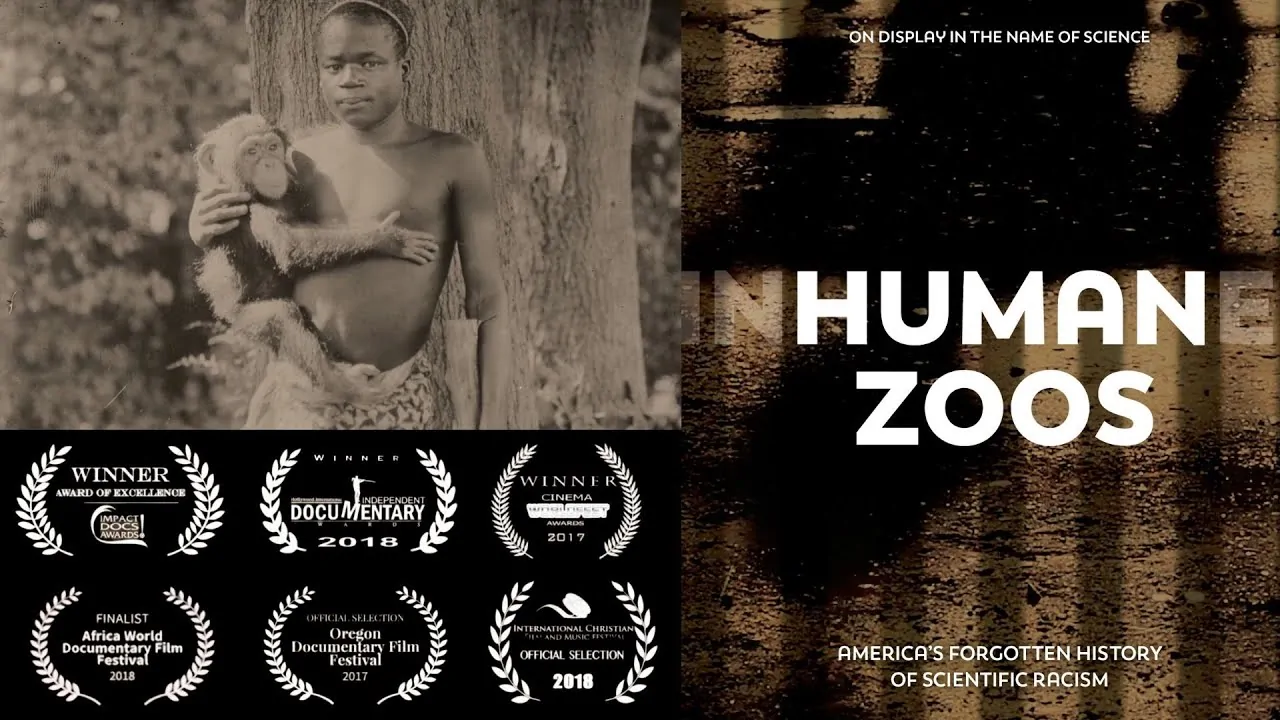
Between 1859 and the early twentieth century, thousands of indigenous and African peoples were placed on public display in America — exhibited in cages, subjected to experiments, and marketed to paying crowds as “missing links” between apes and humans. This was not the work of fringe bigots operating in the shadows. It was mainstream science, championed by America’s most prestigious universities and celebrated institutions, and it went largely unchallenged by a society conditioned by Social Darwinism to see certain human beings as less than fully human. The documentary Human Zoos examines this haunting chapter with unflinching honesty — and its lessons speak urgently to anyone who holds, as Islam affirms, that We have honoured the children of Adam (Qur’an 17:70), and that no ideology, scientific or otherwise, can strip a human soul of its God-given dignity.
When Elite Institutions Became the Engine of Dehumanisation
The machinery of scientific racism was not built by outsiders — it was constructed and maintained by the most credentialed men of the age. In 1859, just months after Darwin published On the Origin of Species, showman PT Barnum put William Henry Johnson on display as a so-called “man monkey,” and newspapers like the New York Tribune enthusiastically promoted the deception. By 1904, anthropologist William McGee — former acting president of the American Association for the Advancement of Science — organised the St. Louis World’s Fair’s human zoo, importing thousands of indigenous peoples from Africa, the Philippines, South America, and Japan to be publicly exhibited in fenced enclosures as living proof of evolutionary hierarchy. Smithsonian anthropologist Aleš Hrdlička attended the same fair hunting for the brains of natives who might die during the exhibition. By 1906, Ota Benga — a Congolese pygmy purchased at a slave market — was displayed in a cage inside the Bronx Zoo’s monkey house, drawing 40,000 spectators on a single Sunday. Ernst Haeckel, Darwin’s close correspondent, published evolutionary charts placing Africans nearest to apes and Germanic men at the pinnacle of humanity. These were not the opinions of the ignorant — they were the consensus of the credentialed. Key facts from this history that every person of conscience and faith should know:
- The 1904 St. Louis World’s Fair was attended by over 19 million people and its anthropology exhibit was designed by elite scientists to dramatise evolutionary racial hierarchy as settled fact
- Leading men of science from Harvard, Princeton, and Columbia publicly declared that Africans were “midway between an orangutan and a human being”
- Ota Benga was purchased at a slave market, displayed at the World’s Fair, then caged in the Bronx Zoo’s monkey house — with the full endorsement of the zoological society’s leadership
- The New York Times dismissed protesters, called African pygmies “very low in the human scale,” and insisted evolutionary theory was “no more debatable than the multiplication table”
- By 1921, eugenics — the movement to breed “better” human beings along Darwinian lines — had become the consensus view of leading scientists from Harvard, Yale, MIT, and Columbia, with forced sterilisation and immigration restriction among its policy goals
- The book championing Nordic supremacy written by Madison Grant — a key figure in the Ota Benga affair — was reportedly described by Adolf Hitler as his “Bible”
“The placing of the boy in the cage with a monkey is an outrage. The Negro race in America has a hard enough time as it is, getting away from the prejudice that is closely related to the monkey, without having a member of the race placed on exhibition.”
The Voices of Faith That Stood Where Institutions Failed
When government, academia, and the mainstream press all refused to act, it was people of faith who cut through the silence. Reverend Robert Stewart MacArthur, pastor of one of America’s largest Baptist congregations, was among the first to publicly condemn Ota Benga’s display at the Bronx Zoo, stating plainly that “the person responsible for this exhibition degrades himself as much as he does the African.” African American ministers formed a protest committee and appealed — in turn — to the zoo’s director, the mayor of New York, and the Zoological Society’s secretary. All three dismissed them. James H. Gordon, superintendent of the Howard Colored Orphan Asylum in Brooklyn, argued with moral clarity that the exhibition used a vulnerable human being as a prop for an ideology whose consequences were already devastating communities. These ministers understood through faith and lived experience what the scientific establishment refused to see: that every human being carries inherent worth that no theory, no taxonomy, and no cage can diminish. Their resistance was not without cost — the institutions of power held firm for weeks — but it was ultimately vindicated. Ota Benga was released to the ministers’ care. Yet the trauma of captivity, displacement, and dehumanisation left wounds that never healed. He took his own life in 1916, unable to return to a homeland he longed for, caught between a continent ravaged by colonial warfare and a country that had treated him as a spectacle. The New York Times published an obituary that rewrote history entirely, describing him as a voluntary employee of the Bronx Zoo.
“Such an exhibition only degrades a human being. We do not like this exhibition of one of our race with the monkeys — depressed enough without exhibiting one of us with the apes.” — James H. Gordon, Howard Colored Orphan Asylum, 1906
The story of America’s human zoos is not a distant curiosity sealed inside history books — it is a warning about what happens when society permits ideology, even ideology dressed in the language of science, to define who counts as fully human. Islam has always taught that humanity shares a single origin: we were created from one soul and divided into peoples and tribes not for supremacy but for lita’arafu — that you may come to know one another (Qur’an 49:13). The African American ministers who stood at the gates of the Bronx Zoo in 1906 were not simply making a political argument. They were making a deeply theological one — rooted in the same conviction that forms the foundation of Islamic ethics: to degrade a human being is to dishonour the One who created them. That conviction is not contingent on scientific consensus, political power, or media approval. It is a matter of guidance from the Divine, transmitted through revelation and confirmed by the innate human conscience — the fitrah — that knows, without being taught, that a man in a cage is still a man. The question this film presses upon us is one every generation must answer for itself: when the powerful construct ideological frameworks to dehumanise the vulnerable, will people of faith and conscience have the spiritual clarity and moral courage to stand apart, speak truth, and refuse?